We Can’t Have Everything

Source: Rupert Hughes, We Can’t Have Everything (New York: Harper & Bros, 1917), pp. 58-61

Text: At length she reached a center of what she most desired – noise and mob and hurry. At 164th Street she came to a star of streets where the Third Avenue Elevated collaborated with the surface-cars and the loose traffic to create a delicious pandemonium. She loved those high numbers—a hundred and eighty streets! Beautiful! At home Main Street dissolved into pastures at Tenth Street.

She wanted to find Main Street in New York and see what First Street looked like. It was probably along the Atlantic Ocean. That also was one of the things she must see – her first ocean!

But while Kedzie was reveling in the splendors of 164th Street her eye was caught by the gaudy placards of a moving-picture emporium. There was a movie-palace at home. It was the town’s one metropolitan charm.

There was a lithograph here that reached out and caught her like a bale-hook. It represented an impossibly large-eyed girl, cowering behind a door on whose other side stood a handsome devil in evening dress. He was tugging villainously at a wicked mustache, and his eyes were thrillingly leery. Behind a curtain stood a young man who held a revolver and waited. The title of the picture decided Kedzie. It was “The Vampire’s Victim; a Scathing Exposure of High Society.”

Kedzie studied hard. For all her gipsy wildness, she had a trace of her father’s parsimony, and she hated to spend money that was her very own. Some of the dimes and quarters in that little purse had been there for ages. Besides, her treasury would have to sustain her for an indefinite period.

But she wanted to know about high society. She was not sure what scathing meant, or what the pronunciation of it was. She rather inclined to “scat-ting.” Anyway, it looked important.

She stumbled into the black theater and found a seat among mysterious persons dully silhouetted against the screen. This was none of the latter-day temples where moving pictures are run through with cathedral solemnity, soft lights, flowers, orchestral uplift, and nearly classic song. This was a dismal little tunnel with one end lighted by the twinkling pictures. Tired mothers came here to escape from their children, and children came here to escape from their tired mothers. The plots of the pictures were as trite and as rancid as spoiled meat, but they suited the market. This plot concerned a beautiful girl who came to the city from a small town. She was a good girl, because she came from a small town and had poor parents.

She was dazzled a little, however, by the attentions of a swell devil of great wealth, and she neglected her poor – therefore honest – lover temporarily. She learned the fearful joys of a limousined life, and was lured into a false marriage which nearly proved her ruin. The villain got a fellow-demon to pretend to be a minister, put on false hair, reversed his collar, and read the wedding ceremony; and the heroine was taken to the rich man’s home.

The rooms were as full of furniture as a furniture-store, and so Kedzie knew it was a swell home. Also there was a butler who walked and acted like a wooden man.

The heroine was becomingly shy of her husband, but finally went to her room, where a swell maid put her to bed (with a proper omission of critical moments) in a bed that must have cost a million dollars. Some womanly, though welching, intuition led the bride to lock her door. Some manly intuition led the hero to enter the gardens and climb in through a window into the house. If he had not been a hero it would have been a rather reprehensible act. But to the heroes all things are pure. He prowled through the house heroically without attracting attention. Every step of his burglarious progress was applauded by the audience.

The hero hid behind one of those numberless portières that hang everywhere in the homes of the noveaux riches, and waited with drawn revolver for the dastard bridegroom to attempt his hellish purpose.

The locked door thwarted the villain for the time, and he decided to wait till he got the girl aboard one of those yachts which rich people keep for evil purposes. Thus the villain unwittingly saved the hero from the painful necessity of committing murder, and added another reel to the picture.

It is not necessary and it might infringe a copyright to tell the rest of the story. It would be insulting to say that the false minister, repenting, told the hero, who told the heroine after he rescued her from the satanic yacht and various other temptations. Of course she married the plain-clothes man and lived happily ever after in a sin-proof cottage with a garden of virtuous roses.

Comments: Rupert Hughes (1872-1956) was an American novelist, playwright, biographer and screenwriter. He was also uncle to business magnate and film producer Howard Hughes. His novel of marital disharmony We Can’t Have Everything was turned into a film (of the same title), directed by Cecil B. DeMille, in 1918. Many other of his works were also filmed.

Links: Copy at Internet Archive
The Sense of Touch

senseoftouch

Source: ‘Ole Luke-Oie’ [Ernest Dunlop Swinton], extract from ‘The Sense of Touch’, The Strand Magazine, December 1912, pp. 620-631. Illustrations by John Cameron.

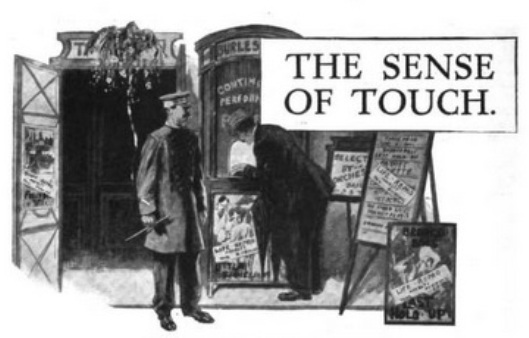
Text: ‘Pon my word, I really don’t know what made me go into the place. I’ve never been keen on cinemas. The ones I went to when they first came out quite choked me off. The jiggling of the pictures pulled my eyes out till they felt like a crab’s, and the potted atmosphere made my head ache. I was strolling along, rather bored with things in general and more than a bit tired, and happened to stop as I passed the doors. It seemed just the ordinary picture palace or electric theatre show – ivory-enamelled portico, neuralgic blaze of flame arc-lights above, and underneath, in coloured incandescents, the words, “Mountains of Fun.”

Fun! Good Lord!

An out-sized and over-uniformed tout, in dirty white gloves and a swagger stick, was strolling backwards and forwards, alternately shouting invitations to see the “continuous performance” and chasing away the recurring clusters of eager-eyed children, whose outward appearance was not suggestive of the possession of the necessary entrance fee. There were highly-coloured posters on every available foot of wall-space – sensational scenes, in which cowboys, revolvers, and assorted deaths predominated – and across them were pasted strips of paper bearing the legend, ” LIFE-REPRO Novelty This Evening.”

I confess that, old as I am, it was that expression which caught me – ” LIFE-REPRO.” It sounded like a new metal polish or an ointment for “swellings on the leg,” but it had the true showman’s ring. I asked the janitor what it meant. Of course he did not know – poor devil! – and only repeated his stock piece: “Splendid new novelty. Now showing. No waiting. Continuous performance. Walk right in.”

I was curious; it was just beginning to rain; and I decided to waste half an hour. No sooner had the metal disc – shot out at me in exchange for sixpence – rattled on to the zinc counter of the ticket-window than the uniformed scoundrel thrust a handbill on me and almost shoved me through a curtained doorway. Quite suddenly I found myself in a dark room, the gloom of which was only accentuated by the picture quivering on a screen about fifty feet away. The change from the glare outside was confusing and the atmosphere smote me, and as I heard the door bang and the curtain being redrawn I felt half inclined to turn round and go out. But while I hesitated, not daring to move until my eyes got acclimatized, someone flashed an electric torch in my eyes, grabbed my ticket, and squeaked, ” Straight along, please,” then switched off the light.

Useful, wasn’t it? I couldn’t see an inch. You know, I’m not very touchy as a rule, but I was getting a bit nettled, and a good deal of my boredom had vanished. I groped my way carefully down what felt like an inclined gangway, now in total darkness, for there was at the moment no picture on the screen, and at once stumbled down a step. A step, mind you, in the centre of a gangway, in a place of entertainment which is usually dark! I naturally threw out my hands to save myself and grabbed what I could. There was a scream, and the film then starting again, I discovered that I was clutching a lady by the hair. The whole thing gave me a jar and threw me into a perspiration – you must remember I was still shaky after my illness. When, as I was apologizing, the same, or another, fool with the torchlight flashed it at my waistcoat and said, “Mind the step,” I’m afraid I told him, as man to man, what I thought of him and the whole beastly show. I was now really annoyed, and showed it. I had no notion there were so many people in the hall until I heard the cries of “Ssshh! ” “Turn him out! ” from all directions.

When I was finally led to a flap-up seat – which I nearly missed, by the way, in the dark – I discovered the reason for the impatience evinced by the audience. I had butted in with my clatter and winged words at the critical moment of a touching scene. To the sound of soft, sad music, all on the black notes, the little incurable cripple child in the tenement house was just being restored to health by watching the remarkably quick growth of the cowslips given to her by the kind-hearted scavenger. Completely as boredom had been banished by the manner of my entrée it quickly returned while I suffered the long-drawn convalescence of ” Little Emmeline.” As soon as this harrowing film was over and the lights were raised I took my chance of looking round.

The hall was very much the usual sort of place – perhaps a bit smaller than most – long and narrow, with a floor sloping down from the back. In front of the screen, which was a very large one, was an enclosed pit containing some artificial palms and tin hydrangeas, a piano and a harmonium, and in the end wall at its right was a small door marked ” Private.” In the side wall on the left near the proscenium place was an exit. The only other means of egress, as far as I could see, was the doorway through which I had entered. Both of these were marked by illuminated glass signs, and on the walls were notices of “No smoking,” “The management beg to thank, those ladies who have so kindly removed their hats,” and advertisement placards – mostly of chocolate. The decorations were too garish for the place to be exactly homely, but it was distinctly commonplace, a contrast to the shambles it became later on. What?

Yes! I daresay you know all about these picture palaces, but I’ve got to give you the points as they appealed to me. I’m not telling you a story, man. I’m simply trying to give you an exact account of what happened. It’s the only way I can do it.

The ventilation was execrable, in spite of the couple of exhaust fans buzzing round overhead, and the air hung stagnant and heavy with traces of stale scent, while wafts of peppermint, aniseed, and eucalyptus occasionally reached me from the seats in front. Tobacco smoke might have increased the density of the atmosphere, but it would have been a welcome cloak to some of the other odours. The place was fairly well filled, the audience consisting largely of women and children of the poorer classes – even babies in arms – just the sort of innocent holiday crowd that awful things always happen to.

By the time I had noticed this much the lights were lowered, and we were treated to a scene of war which converted my boredom into absolute depression. I must describe it to you, because you always will maintain that we are a military nation at heart. By Jove, we are! Even the attendants at this one-horse gaff were wearing uniforms. And the applause with which the jumble of sheer military impossibility and misplaced sentiment presented to us was greeted proves it. The story was called “Only a Bugler Boy.” The first scene represented a small detachment of British soldiers ” At the Front” on ” Active Service” in a savage country. News came in of the “foe.” This was the occasion for a perfect orgy of mouthing, gesticulation, and salutation. How they saluted each other, usually with the wrong hand, without head-covering, and at what speed ! The actors were so keen to convey the military atmosphere that the officers, as often as not, acknowledged a salute before it was given.

Alter much consultation, deep breathing exercise, and making of goo-goo eyes, the long-haired rabbit who was in command selected a position for “defence to the death” so obviously unsuitable and suicidal that he should have been ham-strung at once by his round-shouldered gang of supers. But, no! In striking attitudes they waited to be attacked at immense and quite unnecessary disadvantage by the savage horde. Then, amid noise and smoke, the commander endeavoured to atone for the hopeless situation in which he had placed his luckless men by waving his sword and exposing himself to the enemy’s bullets. I say “atone,” for it would have been the only chance for his detachment if he had been killed, and killed quickly. Well, after some time and many casualties, it occurred to him that it would be as well to do something he should have done at first, and let the nearest friendly force know of his predicament. The diminutive bugler with the clean face and nicely-brushed hair was naturally chosen for this very dangerous mission, which even a grown man would have had a poor chance of carrying out, and after shaking hands all round, well in the open, the little hero started off with his written message.

Then followed a prolonged nightmare of crawling through the bush-studded desert.

Bugler stalled savage foe, and shot several with his revolver. Savage foe stalked bugler and wounded him in both arms and one leg. Finally, after squirming in accentuated and obvious agony for miles, bugler reached the nearest friendly force, staggered up to its commander, thrust his despatch upon him, and swooned in his arms. Occasion for more saluting, deep breathing, and gesticulation, and much keen gazing through field-glasses – notwithstanding the fact that if the beleaguered garrison were in sight the sound of the firing must have been heard long before ! Then a trumpet-call on the harmonium, and away dashed the relief force of mounted men.

Meanwhile we were given a chance of seeing how badly things had been going with the devoted garrison at bay. It was only when they were at their last gasp and cartridge that the relief reached them. With waving of helmets and cheers from the defenders, the first two men of the relieving force hurled themselves over the improvised stockade. You know what they were? I knew what they must be long before they appeared. And it is hardly necessary to specify to which branches of His Majesty’s United Services they belonged. The sorely-wounded but miraculously tough bugler took the stockade in his stride a very good third. He had apparently recovered sufficiently to gallop all the way back with the rescuers – only to faint again, this time in the arms of his own commanding officer. Curtain! “They all love Jack,” an imitation of bagpipes on the harmonium, and “Rule Britannia” from the combined orchestra. As I say, this effort of realism was received with great applause, even by the men present.

As soon as the light went up I had a look at my neighbours. The seats on each side of me were empty, and in the row in front, about a couple of seats to my right, there was one occupant. He was a young fellow of the type of which one sees only too many in our large towns – one of the products of an overdone industrialism. He was round-shouldered and narrow-chested, and his pale thin face suggested hard work carried out in insanitary surroundings and on unwholesome food. His expression was precocious, but the loose mouth showed that its owner was far too unintelligent to be more than feebly and unsuccessfully vicious. He wore a yachting cap well on the back of his head, and on it he sported a plush swallow or eagle – or some other bird – of that virulent but non-committal blue which is neither Oxford nor Cambridge. It was Boat-Race week. He was evidently out for pleasure – poor devil! – and from his incidental remarks, which were all of a quasi-sporting nature, I gathered that he was getting it. I felt sorry for him and sympathized in his entire absorption in the strange scenes passing before his eyes – scenes of excitement and adventure far removed from the monotonous round of his squalid life. How much better an hour of such innocent amusement than time and money wasted in some boozing-ken – eh?

Well, I’m not quite sure what it means myself – some sort of a low drinking-den. But, anyway, that’s what I felt about it. After all, he was a harmless sort of chap, and his unsophisticated enjoyment made me envious. I took an interest in him – thought of giving him a bob or two when I went out. I want you to realize that I had nothing but kindly feelings towards the fellow. He comes in later on – wasn’t so unsuccessful after all.

Then we had one of those interminable scenes of chase in which a horseman flies for life towards you over endless stretches of plain and down the perspective of long vistas of forest, pursued at a discreet distance by other riders, who follow in his exact tracks, even to avoiding the same tree-stumps, all mounted on a breed of horse which does forty-five miles an hour across country and fifty along the hard high road. I forget the cause of the pursuit and its ending, but I know revolvers were used.

The next film was French, and of the snowball type. A man runs down a street. He is at once chased by two policemen, one long and thin and the other fat and bow-legged with an obviously false stomach. The followers very rapidly increase in number to a mixed mob of fifty or more, including nurses with children in perambulators. They go round many corners, and round every corner there happens to be a carefully arranged obstacle which they all fall over in a kicking heap. I remember that soot and whitewash played an important part, also that the wheels of the passing vehicles went round the wrong way.

Owing to the interruption of light, was it? I daresay. Anyway, it was very annoying. Then we had a bit of the supernatural. I’m afraid I didn’t notice what took place, so I’ll spare you a description. I was entirely engrossed with the efforts of the wretched pianist to play tremolo for ten solid minutes. I think it was the ghost melody from “The Corsican Brothers ” that she was struggling with, and the harmonium did not help one bit. The execution got slower and slower and more staccato as her hands grew tired, and at the end I am sure she was jabbing the notes with her aching fingers straight and stiff. Poor girl! What a life!

At about this moment, as far as I remember, a lady came in and took the seat in front of mine. She was a small woman, and was wearing a microscopic bonnet composed of two strings and a sort of crepe muffin. The expression of her face was the most perfect crystallization of peevishness I’ve ever seen, and her hair was screwed up into a tight knob about the size and shape of a large snail-shell. Evidently not well off – probably a charwoman. I caught a glimpse of her gloves as she loosened her bonnet-strings, and the fingertips were like the split buds of a black fuchsia just about to bloom. Shortly after she had taken her seat my friend with the Boat-Race favour suddenly felt hungry, cracked a nut between his teeth, spat out the shell noisily, and ate the kernel with undisguised relish. The lady gathered her mantle round her and sniffed. I was not surprised. The brute continued to crack nuts, eject shells, and chew till he killed all my sympathy for him, till I began to loathe his unhealthy face, and longed for something to strike him dead. This was absolutely the limit, and I should have cleared out had not the words LIFE-REPRO” on the handbill caught my eye. After all it must come to that soon, and I determined to sit the thing out. After one or two more films of a banal nature there was a special interval – called “Intermission” on the screen – and signs were not wanting of the approach of the main event of the show.

Two of the youths had exchanged their electric torches for trays, and perambulated the gangways with cries of “Chuglit— milk chuglit.” A third produced a large garden syringe and proceeded to squirt a fine spray into the air. This hung about in a cloud, and made the room smell like a soap factory. When the curtain bell sounded the curtain was not drawn nor were the lights lowered. A man stepped out of the small door and climbed up on to the narrow ledge in front of the screen, which served as a kind of stage or platform, and much to my disgust made obvious preparation to address the audience. He was a bulky fellow, and his apparent solidity was increased by the cut of his coat. His square chin added to the sense of power conveyed by his build, while a pair of gold-rimmed spectacles gave him an air of seriousness and wisdom. I at once sized him up as a mountebank, and thought I knew what sort of showman’s patter to expect. He did not waste much time before he got busy. Looking slowly all round the room, he fixed my sporting friend with a baleful glare until the latter stopped eating, then cleared his throat and began …

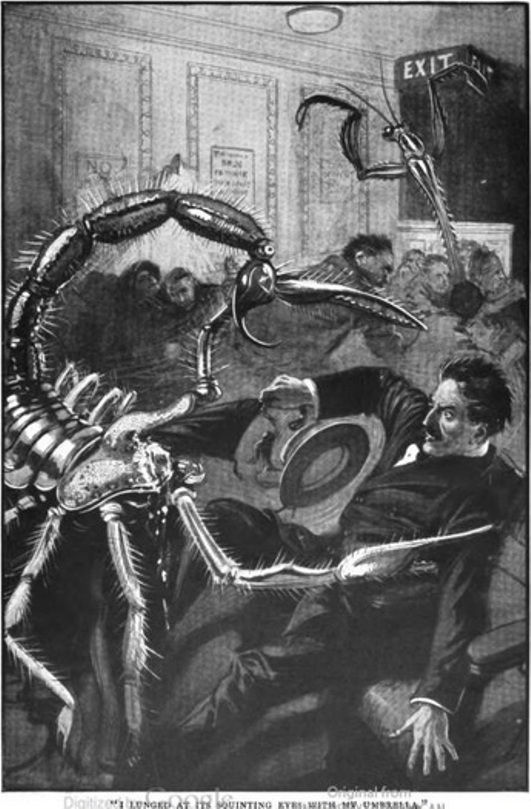
Comments: Ernest Dunlop Swinton (1868-1951) was a British military officer (influential in the development of tanks in the First World War) and a writer, producing fiction under the pseudonym O’le Luk-Oie. The story continues with an announcer promising a natural history film of unsurpassed life-like realism. The film shows a praying mantis and a scorpion which come out of the screen giant-sized and attack the audience, killing those that the narrator disliked before turning on him (see illustration below). In the end it turns out to have been a dream. The description of a cinema show, though sardonic, is filled with useful documentary detail. The garden syringe is a reference to the disinfectant sprays commonly used on cinema audiences at this time.

Links: Copy of the complete story on the Internet Archive

scorpion

Babbitt

Source: Sinclair Lewis, Babbitt (New York: Harcourt, Brace and Company, 1922), p. 156

Text: At least once a week Mr. and Mrs. Babbitt and Tinka went to the movies. Their favorite motion-picture theater was the Chateau, which held three thousand spectators and had an orchestra of fifty pieces which played Arrangements from the Operas and suites portraying a Day on the Farm, or a Four-alarm Fire. In the stone rotunda, decorated with crown-embroidered velvet chairs and almost medieval tapestries, parrakeets sat on gilded lotos columns.

With exclamations of “Well, by golly!” and “You got to go some to beat this dump!” Babbitt admired the Chateau. As he stared across the thousands of heads, a gray plain in the dimness, as he smelled good clothes and mild perfume and chewing-gum, he felt as when he had first seen a mountain and realized how very, very much earth and rock there was in it.

He liked three kinds of films: pretty bathing girls with bare legs; policemen or cowboys and an industrious shooting of revolvers; and funny fat men who ate spaghetti. He chuckled with immense, moist-eyed sentimentality at interludes portraying puppies, kittens, and chubby babies; and he wept at deathbeds and old mothers being patient in mortgaged cottages. Mrs. Babbitt preferred the pictures in which handsome young women in elaborate frocks moved through sets ticketed as the drawing-rooms of New York millionaires. As for Tinka, she preferred, or was believed to prefer, whatever her parents told her to.

Comments: Sinclair Lewis (1885-1951) was an American novelist, winner of the Nobel Prize for Literature in 1930. His novel Babbitt is a satire on American middle-class life. Its central character is the materialistic and socially conformist businessman George Babbitt. It has numerous reference to the movies and movie-going. It was filmed twice in 1924 and 1934.

Bunny Brown and his Sister Sue

Source: Laura Lee Hope, extract from Bunny Brown and his Sister Sue (New York: Grosset & Dunlap, 1916)

bunnybrownText: Just beyond the corner there was a moving picture theatre, lately opened. Mrs. Brown and Aunt Lu had taken Bunny and his sister there once or twice, when there was a fairy play, or something nice to see, so Bunny and Sue knew what the moving pictures were like.

“Oh, let’s just go down and look at the picture posters outside,” said Bunny, as they stood on the corner, from where they could see the theatre.

“All right,” said Sue quickly.

In front of the moving picture place were some big boards, and on them were pasted brightly colored posters, almost like circus ones, telling about the moving pictures that were being shown inside. There was a picture of a man falling in the water, and another of a railroad train. Bunny loved cars and locomotives.

Not thinking anything wrong, the two tots ran across the street, looking carefully up and down first, to see that no automobiles were coming. They crossed safely.

A little later they were standing in front of the moving picture theatre, looking at the gay posters.

“Wouldn’t you like to go in?” asked Bunny.

Sue nodded her curly head.

“Maybe Aunt Lu will take us,” she said.

“We’ll ask her,” decided Bunny.

Then they heard, from down the side street, the sound of a piano. It came from the moving picture place, and the reason Bunny and Sue could hear it so plainly was because the piano was near a side door, which was open to let in the fresh air.

“Let’s go down there and listen to the music a minute,” Bunny said. “Then we’ll go back and tell Aunt Lu.”

“All right!” agreed Sue.

A little later the two were standing at the open, side door of the place. They could hear the piano very plainly now, and, what was more wonderful, they could look right in the theatre and see the moving pictures flashing on the white screen.

“Oh! oh!” murmured Bunny. “Look, Sue.”

“Oh! oh!” whispered Sue. And then Bunny had a queer idea.

“We can walk right in,” he said. “The door is open. I guess this is for children like us – they don’t want any money. Come on in, Sue, and we’ll see the moving pictures!”

Bunny Brown and his sister Sue walked right into the moving picture theatre. The door, as I have told you, was open, there was no one standing near to take tickets, or ask for money, and of course the children thought it was all right to go in.

No one seemed to notice them, perhaps because the place was dark, except where the brilliant pictures were dancing and flashing on the white screen. And no one heard Bunny and Sue, for not only did they walk very softly, but just then the girl at the piano was playing loudly, and the sound filled the place.

Right in through the open side door walked Bunny and Sue, and never for a moment did they think they were doing anything wrong. I suppose, after all, it was not very wrong.

Bunny walked ahead, and Sue followed, keeping hold of his hand. Pretty soon she whispered to her brother:

“Bunny! Bunny! I can’t see very good at all here. I want to see the pictures better.”

“All right,” Bunny whispered back. “I can’t see very good, either. We’ll find a better place.”

You know you can’t look at moving pictures from the side, they all seem to be twisted if you do. You must be almost in front of them, and this time Bunny and Sue were very much to one edge.

“We’ll get up real close, and right in front,” Bunny went on. Then he saw a little pair of steps leading up to the stage, or platform; only Bunny did not know it was that. He just thought if he and Sue went up the steps they would be better able to see. So up he went.

The screen, or big white sheet, on which the moving pictures were shown, stood back some distance from the front of the stage. And it was a real stage, with footlights and all, but it was not used for acting any more, as only moving pictures were given in that theatre now.

Sue followed Bunny up the steps. The pictures were ever so much clearer and larger now. She was quite delighted, and so was her brother. They wandered out to the middle of the stage, paying no attention to the audience. And the people in the theatre were so interested in the picture on the screen, that, for a while, they did not see the children who had wandered into the darkened theatre by the side door.

The music from the piano sounded louder and louder. The pictures became more brilliant. Then suddenly Bunny and Sue walked right out on the stage in front of the screen, where the light from the moving picture lantern shone brightly on them.

“What’s that?” cried several persons.

“Look! Why they’re real children!” said others.

Bunny and Sue could be plainly seen now, for they were exactly in the path of the strong light. There was some laughter in the audience, and then the man who was turning the crank of the moving picture machine began to understand that something was wrong.

He stopped the picture film, and turned on a plain, white light, very strong and glaring, Just like the headlights of an automobile. Bunny and Sue could hardly see, and they looked like two black shadows on the white screen.

“Look! Look! It’s part of the show!” said some persons in front.

“Maybe they’re going to sing,” said others.

“Or do a little act.”

“Oh, aren’t they cute!” laughed a lady.

By this time the piano player had stopped making music. She knew that something was wrong. So did the moving picture man up in his little iron box, and so did the usher – that’s the man who shows you where to find a seat. The usher came hurrying down the aisle.

“Hello, youngsters!” he called out, but he was not in the least bit cross. “Where did you get in?” he asked.

By this time the lights all over the place had been turned up, and Bunny and Sue could see the crowd, while the audience could also see them. Bunny blinked and smiled, but Sue was bashful, and tried to hide behind her brother. This made the people laugh still more.

“How did you get in, and who is with you?” asked the usher.

“We walked in the door over there,” and Bunny pointed to the side one. “And we came all alone. We’re waiting for Aunt Lu.”

“Oh, then she is coming?”

“I don’t guess so,” Bunny said. “We didn’t tell her we were coming here.”

“Well, well!” exclaimed the usher-man. “What does it all mean? Did your Aunt Lu send you on ahead? We don’t let little children in here unless some older person is with them, but -”

“We just comed in,” Sue said. “The door was open, and we wanted to see the pictures, so we comed in; didn’t we Bunny?”

“Yes,” he said. “But we’d like to sit down. We can’t see good up here.”

“No, you are a little too close to the screen,” said the usher. “Well, I’d send you home if I knew where you lived, but–”

“I know them!” called out a woman near the front of the theatre. “That is Bunny Brown and his sister Sue. They live just up the street. I’ll take them home.”

“Thank you; that’s very kind of you,” said the man. “I guess their folks must be worrying about them. Please take them home.”

“We don’t want to go home!” exclaimed Sue. “We want to see the pictures; don’t we, Bunny?”

“Yes,” answered the little fellow, “but maybe we’d better go and get Aunt Lu.”

“I think so myself,” laughed the usher. “You can come some other time, youngsters. But bring your aunt, or your mother, with you; and don’t come in the side door. I’ll have to keep some one there, if it’s going to be open, or I’ll have more tots walking in without paying.”

“Come the next time, with your aunt or mother,” he went on, “and I’ll give you free tickets. It won’t cost you even a penny!”

“Oh, goodie!” cried Sue. She was willing to go home now, and the lady who said she knew them – who was a Mrs. Wakefield, and lived not far from the Brown home – took Bunny and Sue by the hands and led them out of the theatre.

The lights were turned low again, and the moving picture show went on. Bunny and Sue wished they could have stayed, but they were glad they could come again, as the man had invited them.

Comments: Laura Lee Hope was a pseudonym used by American book publisher the Stratemeyer Syndicate to produce books for children, including Nancy Drew, The Hardy Boys, and Bunny Brown and his Sister Sue. The latter series, aimed at young children, was published 1916-1930.

Links: Copy on Project Gutenberg

The Plastic Age

Source: Percy Marks, The Plastic Age (New York: The Century Co., 1924), pp. 24-28

Text: “Well,” he exclaimed, “that’s that! At last I know where I’m going. You certainly saved my life. I know where all the buildings are; so it ought to be easy.”

“Sure,” said Carl encouragingly; “it’s easy. Now there’s nothing to do till to-morrow until eight forty-five when we attend chapel to the glory of the Lord. I think I’ll pray to-morrow; I may need it. Christ! I hate to study.”

“Me, too,” Hugh lied. He really loved books, but somehow he couldn’t admit the fact, which had suddenly become shameful, to Carl. “Let’s go to the movies,” he suggested, changing the subject for safety.

“Right-o!” Carl put on his freshman cap and flung Hugh’s to him. “Gloria Nielsen is there, and she’s a pash baby. Ought to be a good fillum.”

The Blue and Orange – it was the only movie theater in town – was almost full when the boys arrived. Only a few seats near the front were still vacant. A freshman started down the aisle, his “baby bonnet” stuck jauntily on the back of his head.

“Freshman!”… “Kill him!”… “Murder the frosh!” Shouts came from all parts of the house, and an instant later hundreds of peanuts shot swiftly at the startled freshman. “Cap! Cap! Cap off!” There was a panic of excitement. Upper-classmen were standing on their chairs to get free throwing room. The freshman snatched off his cap, drew his head like a scared turtle down into his coat collar, and ran for a seat. Hugh and Carl tucked their caps into their coat pockets and attempted to stroll nonchalantly down the aisle. They hadn’t taken three steps before the bombardment began. Like their classmate, they ran for safety.

Then some one in the front of the theatre threw a peanut at some one in the rear. The fight was on! Yelling like madmen, the students stood on their chairs and hurled peanuts, the front and rear of the house automatically dividing into enemy camps. When the fight was at its hottest, three girls entered.

“Wimmen! Wimmen!” As the girls walked down the aisle, infinitely pleased with their reception, five hundred men stamped in time with their steps.

No sooner were the girls seated than there was a scramble in one corner, an excited scuffling of feet. “I’ve got it!” a boy screamed. He stood on his chair and held up a live mouse by its tail. There was a shout of applause and then – “Play catch!”

The boy dropped the writhing mouse into a peanut bag, screwed the open end tight-closed, and then threw the bag far across the room. Another boy caught it and threw it, this time over the girls’ heads. They screamed and jumped upon their chairs, holding their skirts, and dancing up and down in assumed terror. Back over their heads, back and over, again and again the bagged mouse was thrown while the girls screamed and the boys roared with delight. Suddenly one of he girls threw up her arm, caught the bag deftly, held it for a second, and then tossed it into the rear of the theater.

Cheers of terrifying violence broke loose: “Ray! Ray! Atta girl! Hot dog! Ray, ray!” And then the lights went out.

“Moosick! Moosick! Moo-sick!” The audience stamped and roared, whistled and howled. “Moosick! We want moosick!”

The pianist, an undergraduate, calmly strolled down the aisle.

“Get a move on!”… “Earn your salary!”… “Give us moosick!”

The pianist paused to thumb his nose casually at the entire audience, and then amid shouts and hisses sat down at the piano and began to play “Love Nest.”

Immediately the boys began to whistle, and as the comedy was utterly stupid, they relieved their boredom by whistling the various tunes that the pianist played until the miserable film flickered out.

Then the “feature” and the fun began. During the stretches of pure narrative, the boys whistled, but when there was any real action they talked. The picture was a melodrama of “love and hate,” as the advertisement said.

The boys told the actors what to do; they revealed to them the secrets of the plot. “She’s hiding behind the door, Harold. No, no! Not that way. Hey, dumbbell – behind the door.”… “Catch him, Gloria; he’s only shy!”… “No, that’s not him!”

The climactic fight brought shouts of encouragement – to the villain. “Kill him!”… “Shoot one to his kidneys!”… “Ahhhhh,” as the villain hit the hero in the stomach…. “Muss his hair. Attaboy!”… “Kill the skunk!” And finally groans of despair when the hero won his inevitable victory.

But it was the love scenes that aroused the greatest ardor and joy. The hero was given careful instructions. “Some neckin’, Harold!”… “Kiss her! Kiss her! Ahhh!”… “Harold, Harold, you’re getting rough!”… “She’s vamping you, Harold!”… “Stop it; Gloria; he’s a good boy.” And so on until the picture ended in the usual close-up of the hero and heroine silhouetted in a tender embrace against the setting sun. The boys breathed “Ahhhh” and “Ooooh” ecstatically – and laughed. The meretricious melodrama did not fool them, but they delighted in its absurdities.

The lights flashed on and the crowd filed out, “wise-cracking” about the picture and commenting favorably on the heroine’s figure. There were shouts to this fellow or that fellow to come on over and play bridge, and suggestions here and there to go to a drug store and get a drink.

Hugh and Carl strolled home over the dark campus, both of them radiant with excitement, Hugh frankly so.

Comments: Percy Marks (1891-1956) was an American author whose notorious novel of college life, The Plastic Age, was filmed under that title in 1925 (starring Clara Bow) and in 1929 as Red Lips.

Links: Copy at Hathi Trust

Tickets, Please

Source: D.H. Lawrence, extract from ‘Tickets, Please’ in England, My England and Other Stories (New York: Thomas Seltzer, 1922), pp. 56-57

Text: After the dragons they went on the horses. John Thomas paid each time, so she could but be complaisant. He, of course, sat astride on the outer horse – named ‘Black Bess’ – and she sat sideways, towards him, on the inner horse – named ‘Wildfire’. But of course John Thomas was not going to sit discreetly on ‘Black Bess’, holding the brass bar. Round they spun and heaved, in the light. And round he swung on his wooden steed, flinging one leg across her mount, and perilously tipping up and down, across the space, half lying back, laughing at her. He was perfectly happy; she was afraid her hat was on one side, but she was excited.

He threw quoits on a table, and won for her two large, pale-blue hat-pins. And then, hearing the noise of the cinemas, announcing another performance, they climbed the boards and went in.

Of course, during these performances pitch darkness falls from time to time, when the machine goes wrong. Then there is a wild whooping, and a loud smacking of simulated kisses. In these moments John Thomas drew Annie towards him. After all, he had a wonderfully warm, cosy way of holding a girl with his arm, he seemed to make such a nice fit. And, after all, it was pleasant to be so held: so very comforting and cosy and nice. He leaned over her and she felt his breath on her hair; she knew he wanted to kiss her on the lips. And, after all, he was so warm and she fitted in to him so softly. After all, she wanted him to touch her lips.

But the light sprang up; she also started electrically, and put her hat straight. He left his arm lying nonchalantly behind her. Well, it was fun, it was exciting to be at the Statutes with John Thomas.

Comments: The British novelist and short story writer David Herbert Lawrence (1885-1930) makes numerous references to the cinema in his writings, usually from a hostile point of view but clearly based on knowledge of cinemagoing. This passage from a short story (about a tramway inspector and serial seducer whose victims take revenge on him) features a visit to a fairground cinema show.

The Secret City

Source: Hugh Walpole, The Secret City (London: Macmillan, 1919), pp. 61-64

Text: We had arrived. The cinema door blazed with light, and around it was gathered a group of soldiers and women and children, peering in at a soldiers’ band, which, placed on benches in a corner of the room, played away for its very life. Outside, around the door were large bills announcing “The Woman without a Soul, Drama in four parts,” and there were fine pictures of women falling over precipices, men shot in bedrooms, and parties in which all the guests shrank back in extreme horror from the heroine. We went inside and were overwhelmed by the band, so that we could not hear one another speak. The floor was covered with sunflower seeds, and there was a strong smell of soldiers’ boots and bad cigarettes and urine. We bought tickets from an old Jewess behind the pigeon-hole and then, pushing the curtain aside, stumbled into darkness. Here the smell was different, being, quite simply that of human flesh not very carefully washed. Although, as we stumbled to some seats at the back, we could feel that we were alone, it had the impression that multitudes of people pressed in upon us, and when the lights did go up we found that the little hall was indeed packed to its extremest limit.

No one could have denied that it was a cheerful scene. Soldiers, sailors, peasants, women, and children crowded together upon the narrow benches. There was a great consumption of sunflower seeds, and the narrow passage down the middle of the room was littered with fragments. Two stout and elaborate policemen leaned against the wall surveying the public with a friendly if superior air. There was a tremendous amount of noise. Mingled with the strains of the band beyond the curtain were cries and calls and loud roars of laughter. The soldiers embraced the girls, and the children, their fingers in their mouths, wandered from bench to bench, and a mangy dog begged wherever he thought that he saw a kindly face. All the faces were kindly – kindly, ignorant, and astoundingly young. As I felt that youth I felt also separation; I and my like could emphasise as we pleased the goodness, docility, mysticism even of these people, but we were walking in a country of darkness. I caught a laugh, the glance of some women, the voice of a young soldier – I felt behind us, watching us, the thick heavy figure of Rasputin. I smelt the eastern scent of the sunflower seeds, I looked back and glanced at the impenetrable superiority of the two policemen, and I laughed at myself for the knowledge that I thought I had, for the security upon which I thought that I rested, for the familiarity with which I had fancied I could approach my neighbours… I was not wise, I was not secure, I had no claim to familiarity…

The lights were down and we were shown pictures of Paris. Because the cinema was a little one and the prices small the films were faded and torn, so that the Opera and the Place de la Concorde and the Louvre and the Seine danced and wriggled and broke before our eyes. They looked strange enough to us and only accented our isolation and the odd semi-civilisation in which we were living. There were comments all around the room in exactly the spirit of children before a conjurer at a party… The smell grew steadily stronger and stronger… my head swam a little and I seemed to see Rasputin, swelling in his black robe, catching us all into its folds, sweeping us up into the starlight sky. We were under the flare of the light again. I caught Bohun’s happy eyes; he was talking eagerly to Vera Michailovna, not removing his eyes from her face. She had conquered him; I fancied as I looked at her that her thoughts were elsewhere.

There followed a Vaudeville entertainment. A woman and a man in peasants’ dress came and laughed raucously, without meaning, their eyes narrowly searching the depths of the house, then they stamped their feet and whirled around, struck one another, laughed again, and vanished.

The applause was half-hearted. Then there was a trainer of dogs, a black-eyed Tartar with four very miserable little fox-terriers, who shivered and trembled and jumped reluctantly through hoops. The audience liked this, and cried and shouted and threw paper pellets at the dogs. A stout perspiring Jew in a shabby evening suit came forward and begged for decorum. Then there appeared a stout little man in a top hat who wished to recite verses of, I gathered, a violent indecency. I was uncomfortable about Vera Michailovna, but I need not have been. The indecency was of no importance to her, and she was interested in the human tragedy of the performer. Tragedy it was. The man was hungry and dirty and not far from tears. He forgot his verses and glanced nervously into the wings as though he expected to be beaten publicly by the perspiring Jew.

He stammered; his mouth wobbled; he covered it with a dirty hand. He could not continue.

The audience was sympathetic. They listened in encouraging silence; then they clapped; then they shouted friendly words to him. You could feel throughout the room an intense desire that he should succeed. He responded a little to the encouragement, but could not remember his verses. He struggled, struggled, did a hurried little breakdown dance, bowed and vanished into the wings, to be beaten, I have no doubt, by the Jewish gentleman. We watched a little of the “Drama of the Woman without a Soul,” but the sense of being in a large vat filled with boiling human flesh into whose depths we were pressed ever more and more deeply was at last too much for us, and we stumbled our way into the open air. The black shadow of the barge, the jagged outline of the huddled buildings against the sky, the black tower at the end of the canal, all these swam in the crystal air.

Comment: Hugh Walpole (1884-1941) was a prolific British novelist, best known for Rogue Herries and its follow-up novels. He spent much of the First World War in Russia, working for for the Red Cross and then as head of the Anglo-Russian Propaganda Bureau, based in Petrograd. His novel The Secret City draws on these experiences. Ekateringofsky canal is in Petrograd/St Petersburg. Though there were British and American films made in 1915 called The Woman Without a Soul the film described is probably Walpole’s invention. Ellipses are in the original text.

Links: Copy on the Internet Archive

The Secret City

Source: Hugh Walpole, The Secret City (London: Macmillan, 1919), pp. 61-64

Text: We had arrived. The cinema door blazed with light, and around it was gathered a group of soldiers and women and children, peering in at a soldiers’ band, which, placed on benches in a corner of the room, played away for its very life. Outside, around the door were large bills announcing “The Woman without a Soul, Drama in four parts,” and there were fine pictures of women falling over precipices, men shot in bedrooms, and parties in which all the guests shrank back in extreme horror from the heroine. We went inside and were overwhelmed by the band, so that we could not hear one another speak. The floor was covered with sunflower seeds, and there was a strong smell of soldiers’ boots and bad cigarettes and urine. We bought tickets from an old Jewess behind the pigeon-hole and then, pushing the curtain aside, stumbled into darkness. Here the smell was different, being, quite simply that of human flesh not very carefully washed. Although, as we stumbled to some seats at the back, we could feel that we were alone, it had the impression that multitudes of people pressed in upon us, and when the lights did go up we found that the little hall was indeed packed to its extremest limit.

No one could have denied that it was a cheerful scene. Soldiers, sailors, peasants, women, and children crowded together upon the narrow benches. There was a great consumption of sunflower seeds, and the narrow passage down the middle of the room was littered with fragments. Two stout and elaborate policemen leaned against the wall surveying the public with a friendly if superior air. There was a tremendous amount of noise. Mingled with the strains of the band beyond the curtain were cries and calls and loud roars of laughter. The soldiers embraced the girls, and the children, their fingers in their mouths, wandered from bench to bench, and a mangy dog begged wherever he thought that he saw a kindly face. All the faces were kindly – kindly, ignorant, and astoundingly young. As I felt that youth I felt also separation; I and my like could emphasise as we pleased the goodness, docility, mysticism even of these people, but we were walking in a country of darkness. I caught a laugh, the glance of some women, the voice of a young soldier – I felt behind us, watching us, the thick heavy figure of Rasputin. I smelt the eastern scent of the sunflower seeds, I looked back and glanced at the impenetrable superiority of the two policemen, and I laughed at myself for the knowledge that I thought I had, for the security upon which I thought that I rested, for the familiarity with which I had fancied I could approach my neighbours… I was not wise, I was not secure, I had no claim to familiarity…

The lights were down and we were shown pictures of Paris. Because the cinema was a little one and the prices small the films were faded and torn, so that the Opera and the Place de la Concorde and the Louvre and the Seine danced and wriggled and broke before our eyes. They looked strange enough to us and only accented our isolation and the odd semi-civilisation in which we were living. There were comments all around the room in exactly the spirit of children before a conjurer at a party… The smell grew steadily stronger and stronger… my head swam a little and I seemed to see Rasputin, swelling in his black robe, catching us all into its folds, sweeping us up into the starlight sky. We were under the flare of the light again. I caught Bohun’s happy eyes; he was talking eagerly to Vera Michailovna, not removing his eyes from her face. She had conquered him; I fancied as I looked at her that her thoughts were elsewhere.

There followed a Vaudeville entertainment. A woman and a man in peasants’ dress came and laughed raucously, without meaning, their eyes narrowly searching the depths of the house, then they stamped their feet and whirled around, struck one another, laughed again, and vanished.

The applause was half-hearted. Then there was a trainer of dogs, a black-eyed Tartar with four very miserable little fox-terriers, who shivered and trembled and jumped reluctantly through hoops. The audience liked this, and cried and shouted and threw paper pellets at the dogs. A stout perspiring Jew in a shabby evening suit came forward and begged for decorum. Then there appeared a stout little man in a top hat who wished to recite verses of, I gathered, a violent indecency. I was uncomfortable about Vera Michailovna, but I need not have been. The indecency was of no importance to her, and she was interested in the human tragedy of the performer. Tragedy it was. The man was hungry and dirty and not far from tears. He forgot his verses and glanced nervously into the wings as though he expected to be beaten publicly by the perspiring Jew.

He stammered; his mouth wobbled; he covered it with a dirty hand. He could not continue.

The audience was sympathetic. They listened in encouraging silence; then they clapped; then they shouted friendly words to him. You could feel throughout the room an intense desire that he should succeed. He responded a little to the encouragement, but could not remember his verses. He struggled, struggled, did a hurried little breakdown dance, bowed and vanished into the wings, to be beaten, I have no doubt, by the Jewish gentleman. We watched a little of the “Drama of the Woman without a Soul,” but the sense of being in a large vat filled with boiling human flesh into whose depths we were pressed ever more and more deeply was at last too much for us, and we stumbled our way into the open air. The black shadow of the barge, the jagged outline of the huddled buildings against the sky, the black tower at the end of the canal, all these swam in the crystal air.

Comment: Hugh Walpole (1884-1941) was a prolific British novelist, best known for Rogue Herries and its follow-up novels. He spent much of the First World War in Russia, working for for the Red Cross and then as head of the Anglo-Russian Propaganda Bureau, based in Petrograd. His novel The Secret City draws on these experiences. Ekateringofsky canal is in Petrograd/St Petersburg. Though there were British and American films made in 1915 called The Woman Without a Soul the film described is probably Walpole’s invention. Ellipses are in the original text.

Links: Copy on the Internet Archive

The Lost Girl

Source: D.H. Lawrence, The Lost Girl (London: Martin Secker, 1920), pp. 128-132

Text: The Endeavour was successful – yes, it was successful. But not overwhelmingly so. On wet nights Woodhouse did not care to trail down to Lumley. And then Lumley was one of those depressed, negative spots on the face of the earth which have no pull at all. In that region of sharp hills with fine hill-brows, and shallow, rather dreary canal-valleys, it was the places on the hill-brows, like Woodhouse and Hathersedge and Rapton which flourished, while the dreary places down along the canals existed only for work-places, not for life and pleasure. It was just like James to have planted his endeavour down in the stagnant dust and rust of potteries and foundries, where no illusion could bloom.

He had dreamed of crowded houses every night, and of raised prices. But there was no probability of his being able to raise his prices. He had to figure lower than the Woodhouse Empire. He was second-rate from the start. His hope now lay in the tramway which was being built from Knarborough away through the country – a black country indeed – through Woodhouse and Lumley and Hathersedge, to Rapton. When once this tramway-system was working, he would have a supply of youths and lasses always on tap, as it were. So he spread his rainbow wings towards the future, and began to say:

“When we’ve got the trams, I shall buy a new machine and finer lenses, and I shall extend my premises.”

Mr. May did not talk business to Alvina. He was terribly secretive with respect to business. But he said to her once, in the early year following their opening:

“Well, how do you think we’re doing, Miss Houghton?”

“We’re not doing any better than we did at first, I think,” she said.

“No,” he answered. “No! That’s true. That’s perfectly true. But why? They seem to like the programs.”

“I think they do,” said Alvina. “I think they like them when they’re there. But isn’t it funny, they don’t seem to want to come to them. I know they always talk as if we were second-rate. And they only come because they can’t get to the Empire, or up to Hathersedge. We’re a stop-gap. I know we are.”

Mr. May looked down in the mouth. He cocked his blue eyes at her, miserable and frightened. Failure began to frighten him abjectly.

“Why do you think that is?” he said.

“I don’t believe they like the turns,” she said.

“But look how they applaud them! Look how pleased they are!”

“I know. I know they like them once they’re there, and they see them. But they don’t come again. They crowd the Empire – and the Empire is only pictures now; and it’s much cheaper to run.”

He watched her dismally.

“I can’t believe they want nothing but pictures. I can’t believe they want everything in the flat,” he said, coaxing and miserable. He himself was not interested in the film. His interest was still the human interest in living performers and their living feats. “Why,” he continued, “they are ever so much more excited after a good turn, than after any film.”

“I know they are,” said Alvina. “But I don’t believe they want to be excited in that way.”

“In what way?” asked Mr. May plaintively.

“By the things which the artistes do. I believe they’re jealous.”

“Oh nonsense!” exploded Mr. May, starting as if he had been shot. Then he laid his hand on her arm. “But forgive my rudeness! I don’t mean it, of cauce! But do you mean to say that these collier louts and factory girls are jealous of the things the artistes do, because they could never do them themselves?”

“I’m sure they are,” said Alvina.

“But I can’t believe it,” said Mr. May, pouting up his mouth and smiling at her as if she were a whimsical child. “What a low opinion you have of human nature!”

“Have I?” laughed Alvina. “I’ve never reckoned it up. But I’m sure that these common people here are jealous if anybody does anything or has anything they can’t have themselves.”

“I can’t believe it,” protested Mr. May. “Could they be so silly! And then why aren’t they jealous of the extraordinary things which are done on the film?”

“Because they don’t see the flesh-and-blood people. I’m sure that’s it. The film is only pictures, like pictures in the Daily Mirror. And pictures don’t have any feelings apart from their own feelings. I mean the feelings of the people who watch them. Pictures don’t have any life except in the people who watch them. And that’s why they like them. Because they make them feel that they are everything.”

“The pictures make the colliers and lasses feel that they themselves are everything? But how? They identify themselves with the heroes and heroines on the screen?”

“Yes – they take it all to themselves – and there isn’t anything except themselves. I know it’s like that. It’s because they can spread themselves over a film, and they can’t over a living performer. They’re up against the performer himself. And they hate it.”

Mr. May watched her long and dismally.

“I can’t believe people are like that! – sane people!” he said. “Why, to me the whole joy is in the living personality, the curious personality of the artiste. That’s what I enjoy so much.”

“I know. But that’s where you’re different from them.”

“But am I?”

“Yes. You’re not as up to the mark as they are.”

“Not up to the mark? What do you mean? Do you mean they are more intelligent?”

“No, but they’re more modern. You like things which aren’t yourself. But they don’t. They hate to admire anything that they can’t take to themselves. They hate anything that isn’t themselves. And that’s why they like pictures. It’s all themselves to them, all the time.”

He still puzzled.

“You know I don’t follow you,” he said, a little mocking, as if she were making a fool of herself.

“Because you don’t know them. You don’t know the common people. You don’t know how conceited they are.”

He watched her a long time.

“And you think we ought to cut out the variety, and give nothing but pictures, like the Empire?” he said.

“I believe it takes best,” she said.

“And costs less,” he answered. “But then! It’s so dull. Oh my word, it’s so dull. I don’t think I could bear it.”

“And our pictures aren’t good enough,” she said. “We should have to get a new machine, and pay for the expensive films. Our pictures do shake, and our films are rather ragged.”

“But then, surely they’re good enough!” he said.

That was how matters stood. The Endeavour paid its way, and made just a margin of profit – no more. Spring went on to summer, and then there was a very shadowy margin of profit. But James was not at all daunted. He was waiting now for the trams, and building up hopes since he could not build in bricks and mortar.

The navvies were busy in troops along the Knarborough Road, and down Lumley Hill. Alvina became quite used to them. As she went down the hill soon after six o’clock in the evening, she met them trooping home. And some of them she liked. There was an outlawed look about them as they swung along the pavement – some of them; and there was a certain lurking set of the head which rather frightened her because it fascinated her. There was one tall young fellow with a red face and fair hair, who looked as if he had fronted the seas and the arctic sun. He looked at her. They knew each other quite well, in passing. And he would glance at perky Mr. May. Alvina tried to fathom what the young fellow’s look meant. She wondered what he thought of Mr. May.

She was surprised to hear Mr. May’s opinion of the navvy.

He’s a handsome young man, now!” exclaimed her companion one evening as the navvies passed. And all three turned round, to find all three turning round. Alvina laughed, and made eyes. At that moment she would cheerfully have gone along with the navvy. She was getting so tired of Mr. May’s quiet prance.

On the whole, Alvina enjoyed the cinema and the life it brought her. She accepted it. And she became somewhat vulgarized in her bearing. She was déclassée: she had lost her class altogether. The other daughters of respectable tradesmen avoided her now, or spoke to her only from a distance. She was supposed to be “carrying on” with Mr. May.

Comment: David Herbert Lawrence (1885-1930) was a British novelist who was considerably hostile towards the cinema. The Lost Girl tells of the frustrated Alvina Houghton, whose draper father James is poor in business and tries his luck with a cinema in his Midlands town of Woodhouse. Mr May is the cinema manager and projectionist. Alvina plays the piano for the films and variety performers that feature as part of the programme. She eventually strikes up a relationship with an Italian performer, Ciccio, from a travelling show her father sets up following the cinema. Lawrence’s view of cinema entertainment probably says more about Lawrence than it does about cinema.

Links: Copy on Internet Archive (1925 edition)

The Price of Love

Source: Arnold Bennett, The Price of Love (New York/London: Harper Brothers, 1914), pp. 171-178

Text: It was not surprising that Rachel, who never in her life had beheld at close quarters any of the phenomena of luxury, should blink her ingenuous eyes at the blinding splendour of the antechambers of the Imperial Cinema de Luxe. Eyes less ingenuous than hers had blinked before that prodigious dazzlement. Even Louis, a man of vast experience and sublime imperturbability, visiting the Imperial on its opening night, had allowed the significant words to escape him, “Well, I’m blest!” – proof enough of the triumph of the Imperial!

The Imperial had set out to be the most gorgeous cinema in the Five Towns; and it simply was. Its advertisements read: “There is always room at the top.” There was. Over the ceiling of its foyer enormous crimson peonies expanded like tropic blooms, and the heart of each peony was a sixteen-candle-power electric lamp. No other two cinemas in the Five Towns, it was reported, consumed together as much current as the Imperial de Luxe; and nobody could deny that the degree of excellence of a cinema is finally settled by its consumption of electricity.

Rachel now understood better the symbolic meaning of the glare in the sky caused at night by the determination of the Imperial to make itself known. She had been brought up to believe that, gas being dear, no opportunity should be lost of turning a jet down, and that electricity was so dear as to be inconceivable in any house not inhabited by crass spendthrift folly. She now saw electricity scattered about as though it were as cheap as salt. She saw written in electric fire across the inner entrance the beautiful sentiment, “Our aim is to please YOU.” The “you” had two lines of fire under it. She saw, also, the polite nod of the official, dressed not less glitteringly than an Admiral of the Fleet in full uniform, whose sole duty in life was to welcome and reassure the visitor. All this in Bursley, which even by Knype was deemed an out-of-the-world spot and home of sordid decay! In Hanbridge she would have been less surprised to discover such marvels, because the flaunting modernity of Hanbridge was notorious. And her astonishment would have been milder had she had been in the habit of going out at night. Like all those who never went out at night, she had quite failed to keep pace with the advancing stride of the Five Towns on the great road of civilization.

More impressive still than the extreme radiance about her was the easy and superb gesture of Louis as, swinging the reticule containing pineapple, cocoa, and cutlets, he slid his hand into his pocket and drew therefrom a coin and smacked it on the wooden ledge of the ticket-window – gesture of a man to whom money was naught provided he got the best of everything. “Two!” he repeated, with slight impatience, bending down so as to see the young woman in white who sat in another world behind gilt bars. He was paying for Rachel! Exquisite experience for the daughter and sister of Fleckrings! Experience unique in her career! And it seemed so right and yet so wondrous, that he should pay for her!… He picked up the change, and without a glance at them dropped the coins into his pocket. It was a glorious thing to be a man! But was it not even more glorious to be a girl and the object of his princely care?… They passed a heavy draped curtain, on which was a large card, “Tea-Room,” and there seemed to be celestial social possibilities behind that curtain, though indeed it bore another and smaller card: “Closed after six o’clock” – the result of excessive caution on the part of a kill-joy Town Council. A boy in the likeness of a midshipman took halves of the curving tickets and dropped them into a tin box, and then next Rachel was in a sudden black darkness, studded here and there with minute glowing rubies that revealed the legend: “Exit. Exit. Exit.”

Row after row of dim, pale, intent faces became gradually visible, stretching far back-into complete obscurity; thousands, tens of thousands of faces, it seemed – for the Imperial de Luxe was demonstrating that Saturday night its claim to be “the fashionable rage of Bursley.” Then mysterious laughter rippled in the gloom, and loud guffaws shot up out of the rippling. Rachel saw nothing whatever to originate this mirth until an attendant in black with a tiny white apron loomed upon them out of the darkness, and, beckoning them forward, bent down, and indicated two empty places at the end of a row, and the great white scintillating screen of the cinema came into view. Instead of being at the extremity it was at the beginning of the auditorium. And as Rachel took her seat she saw on the screen – which was scarcely a dozen feet away – a man kneeling at the end of a canal-lock, and sucking up the water of the canal through a hose-pipe; and this astoundingly thirsty man drank with such rapidity that the water, with huge boats floating on it, subsided at the rate of about a foot a second, and the drinker waxed enormously in girth. The laughter grew uproarious. Rachel herself gave a quick, uncontrolled, joyous laugh, and it was as if the laugh had been drawn out of her violently unawares. Louis Fores also laughed very heartily.

“Cute idea, that!” he whispered.

When the film was cut off Rachel wanted to take back her laugh. She felt a little ashamed of having laughed at anything so silly.

“How absurd!” she murmured, trying to be serious.

Nevertheless she was in bliss. She surrendered herself to the joy of life, as to a new sensation. She was intoxicated, ravished, bewildered, and quite careless. Perhaps for the first time in her adult existence she lived without reserve or preoccupation completely in and for the moment. Moreover the hearty laughter of Louis Fores helped to restore her dignity. If the spectacle was good enough for him, with all his knowledge of the world, to laugh at, she need not blush for its effect on herself. And in another ten seconds, when the swollen man, staggering along a wide thoroughfare, was run down by an automobile and squashed flat, while streams of water inundated the roadway, she burst again into free laughter, and then looked round at Louis, who at the same instant looked round at her, and they exchanged an intimate smiling glance. It seemed to Rachel that they were alone and solitary in the crowded interior, and that they shared exactly the same tastes and emotions and comprehended one another profoundly and utterly; her confidence in him, at that instant, was absolute, and enchanting to her. Half a minute later the emaciated man was in a room and being ecstatically kissed by a most beautiful and sweetly shameless girl in a striped shirtwaist; it was a very small room, and the furniture was close upon the couple, giving the scene an air of delightful privacy. And then the scene was blotted out and gay music rose lilting from some unseen cave in front of the screen.

Rachel was rapturously happy. Gazing along the dim rows, she descried many young couples, without recognizing anybody at all, and most of these couples were absorbed in each other, and some of the girls seemed so elegant and alluring in the dusk of the theatre, and some of the men so fine in their manliness! And the ruby-studded gloom protected them all, including Rachel and Louis, from the audience at large.

The screen glowed again. And as it did so Louis gave a start.

“By Jove!” he said, “I’ve left my stick somewhere. It must have been at Heath’s. Yes, it was. I put it on the counter while I opened this net thing. Don’t you remember? You were taking some money out of your purse.” Louis had a very distinct vision of his Rachel’s agreeably gloved fingers primly unfastening the purse and choosing a shilling from it.

“How annoying!” murmured Rachel feelingly.

“I wouldn’t lose that stick for a five-pound note.” (He had a marvellous way of saying “five-pound note.”) “Would you mind very much if I just slip over and get it, before he shuts? It’s only across the road, you know.”

There was something in the politeness of the phrase “mind very much” that was irresistible to Rachel. It caused her to imagine splendid drawing-rooms far beyond her modest level, and the superlative deportment therein of the well-born.

“Not at all!” she replied, with her best affability. “But will they let you come in again without paying?”

“Oh, I’ll risk that,” he whispered, smiling superiorly.

Then he went, leaving the reticule, and she was alone.

She rearranged the reticule on the seat by her side. The reticule being already perfectly secure, there was no need for her to touch it, but some nervous movement was necessary to her. Yet she was less self-conscious than she had been with Louis at her elbow. She felt, however, a very slight sense of peril – of the unreality of the plush fauteuil on which she sat, and those rows of vaguely discerned faces on her right; and the reality of distant phenomena such as Mrs. Maldon in bed. Notwithstanding her strange and ecstatic experiences with Louis Fores that night in the dark, romantic town, the problem of the lost money remained, or ought to have remained, as disturbing as ever. To ignore it was not to destroy it. She sat rather tight in her place, increasing her primness, and trying to show by her carriage that she was an adult in full control of all her wise faculties. She set her lips to judge the film with the cold impartiality of middle age, but they persisted in being the fresh, responsive, mobile lips of a young girl. They were saying noiselessly: “He will be back in a moment. And he will find me sitting here just as he left me. When I hear him coming I shan’t turn my head to look. It will be better not.”

The film showed a forest with a wooden house in the middle of it. Out of this house came a most adorable young woman, who leaped on to a glossy horse and galloped at a terrific rate, plunging down ravines, and then trotting fast over the crests of clearings. She came to a man who was boiling a kettle over a camp-fire, and slipped lithely from the horse, and the man, with a start of surprise, seized her pretty waist and kissed her passionately, in the midst of the immense forest whose every leaf was moving. And she returned his kiss without restraint. For they were betrothed. And Rachel imagined the free life of distant forests, where love was, and where slim girls rode mettlesome horses more easily than the girls of the Five Towns rode bicycles. She could not even ride a bicycle, had never had the opportunity to learn. The vision of emotional pleasures that in her narrow existence she had not dreamed of filled her with mild, delightful sorrow. She could conceive nothing more heavenly than to embrace one’s true love in the recesses of a forest…. Then came crouching Indians…. And then she heard Louis Fores behind her. She had not meant to turn round, but when a hand was put heavily on her shoulder she turned quickly, resenting the contact.

“I should like a word with ye, if ye can spare a minute, young miss,” whispered a voice as heavy as the hand. It was old Thomas Batchgrew’s face and whiskers that she was looking up at in the gloom.

Comment: Arnold Bennett (1867-1931) was a British writer, best known for his novels of life in the Potteries with its ‘five towns’ that now equate with Stoke-on-Trent. His novel The Price of Love tells of a lower middle class woman (Rachel Fleckring) who marries a rogue (Louis Fores) and comes to regret it. This extract comes from Chapter VII, entitled ‘The Cinema’. Thomas Batchgrew is a town councillor and owner of a cinema chain, of which the Imperial Cinema de Luxe is one. Investing in the cinema business forms part of the plot. ‘Bursley’ equates with the real-life Burslem. Ellipses in the above occur as they do in the original text.

Links: Copy at Internet Archive