Tolstoy on the Cinema

Source: David Bernstein (trans.), ‘Tolstoy on the Cinema’, New York Times, 31 January 1937, p. 158, supposedly quoting Leo Tolstoy in conversation August 1908

Text: Tolstoy on the Cinema

He Foretold the Future of the Medium While It Was Still in Its Infancy

Although Tolstoy’s “Anna Karenina” is one of the four or five novels that have been made into moving pictures more often than any others, the sage of Yasnaya Polyana never had to go through the torture that is scenario writing in Hollywood. But Leo Tolstoy had his own troubles with the movies, nevertheless. All through the last years of his life, when his writings and philosophy were revered the world over, Tolstoy was bothered by an unceasing flow of visitors, who questioned him on all sorts of things, from literature to vegetarianism. And, on the eve of his eightieth birthday, in August, 1908, the motion picture camera men flocked into his home for a few historic shots. Said Tolstoy on that occasion to his friend I. Teneromo and the visitors:

“You will see that this little clicking contraption with the revolving handle will make a revolution in our life-in the life of writers. It is a direct attack on the old methods of literary art. We shall have to adapt ourselves to the shadowy screen and to the cold machine. A new form of writing will be necessary. I have thought of that and I can feel what in coming.”

“But I rather like it. This swift change of scene, this blending of motion and experience – it is much better than heavy, long-drawn-out kind of writing to which we are accustomed. It is closer to life. In life, too, changes and transitions flash by before our eyes, and emotions of the soul are like a hurricane. The cinema has divined the mystery of motion. And that is greatness.

“When I was writing ‘The Living Corpse,’ I tore my hair and chewed my fingers because I could not give enough scenes, enough pictures, because I could not pass rapidly enough from one event to another. The accursed stage was like a halter choking the throat of the dramatist; and I had to cut the life and swing of the work according to the dimensions and requirements of the stage. I remember when I was told that some clever person had devised a scheme for a revolving stage, on which a number of scenes could be prepared in advance. I rejoiced like a child, and allowed myself to write ten scenes into my play. Even then I was afraid the play would be killed.

“But the films! They are wonderful! Drr! and a scene is ready! Drr! and we have another! We have the sea, the coast, the city, the palace – and in the palace there is tragedy (there is always tragedy in palaces, as we see in Shakespeare).

“I am seriously thinking of writing a play for the screen. I have a subject for it. It is a terrible and bloody theme. I am not afraid of bloody themes. Take Homer or the Bible, for instance. How many bloodthirsty passages there are in them- murders, wars. And yet these are the sacred books, and they ennoble and uplift the people. It is not the subject itself that is so terrible. It is the propagation of bloodshed, and the justification for it, that is really terrible! Some friends of mine returned from Kursk recently and told me a shocking incident. It is a story for the films. You couldn’t write it in fiction or for the stage. But on the screen it would be good. Listen – it may turn out to be a powerful thing!”

And Leo Tolstoy related the story in detail. He was deeply agitated as he spoke. But he never developed the theme in writing. Tolstoy was always like that. When he was inspired by a story he had been thinking of he would become excited by its possibilities. If some one happened to be near by, he would unfold the plot in all its details. Then he would forget all about it. Once the gestation was over and his brain-child born, Tolstoy would seldom bother to write about it.

Some one spoke of the domination of the films by business men interested only in profits. “Yes, I know, I’ve been told about that before,” Tolstoy replied. “The films have fallen into the clutches of business men and art is weeping! But where aren’t there business men?” And he proceeded to relate one of those delightful little parables for which he is famous.

“A little while ago I was standing on the banks of our pond. It was noon of a hot day, and butterflies of all colors and sizes were circling around, bathing and darting in the sunlight, fluttering among the flowers through their short – their very short – lives, for with the setting of the sun they would die.

“But there on the shore near the reeds I saw an insect with little lavender spots on its wings. It, too, was circling around. It would flutter about, obstinately, and its circles became smaller and smaller. I glanced over there. In among the reeds sat a great green toad with staring eyes on each aide of his flat head, breathing quickly with his greenish-white, glistening throat. The toad did not look at the butterfly, but the butterfly kept flying over him as though she wished to be seen. What happened? The toad looked up, opened his mouth wide and – remarkable! – the butterfly flew in of her own accord! The toad snapped his jaws shut quickly, and the butterfly disappeared.

“Then I remembered that thus the insect reaches the stomach of the toad, leaves its seed there to developed and again appear on God’s earth, become a larva, a chrysalis. The chrysalis becomes a caterpillar, and out of the caterpillar springs a new butterfly. And then the playing in the sun, the bathing in the light, and the creating of new life, I begin all over again.

“Thus it is with the cinema. In the reeds of film art sits the toad – the business man. Above him hovers the insect – the artist. A glance, and the jaws of the business man devour the artist. But that doesn’t, mean destruction. It is only one of the methods of procreation, of propagating the race; in the belly of the business man is carried on the process of impregnation and the development of the seeds of the future. These seeds will come out on God’s earth and will begin their beautiful, brilliant lives all over again.”

Comments: Count Lev Nikolayevich Tolstoy (1828-1910) was a Russian novelist and political thinker, author of War and Peace and Anna Karenina. Tolstoy is known to have gone to the cinema on more than one occasion, and was acutely aware of the new industry because in his last years he was regularly pursued by newsreel cameramen. There are accounts of him reacting to the average cinema fare with disgust, and this interview needs to be treated with caution. It is a record of a conversation supposedly conducted with Tolstoy on his eightieth birthday in August 1908 by Tolstoyan acolyte Isaak Teneromo, but Tolstoy’s daughter told film historian Jay Leyda (in his book Kino: A History of the Russian and Soviet Film) that “there are several aspects of this record that make it suspect, but that it incorporates remarks that Tolstoy may have made, either to Teneromo or others, but not on his eightieth birthday”. Teneromo subsequently wrote the screenplay for Ukhod velikovo startza (The Departure of a Great Man) (Russia 1912), a film dramatising Tolstoy’s life.

Links: Copy at New York Times Archive (subscription site)
The Tragedy of Tolstoy

Source: Aleksandra Tolstaya, The Tragedy of Tolstoy (Yale University Press, 1933)

Text: Chertkov and mother willingly informed everybody of the day of father’s departure from Krekshino; and when we came to the railway station, moving-picture men and photographers were waiting in readiness and cameras clicked. At the Briansky terminal in Moscow a crowd gathered – it seemed to have suddenly sprung up from the ground. Wrenching ourselves free, we took a hackney coach and went to Khamovniki. Here again the house was full of guests: Chertkov, Gorbunov, Dunayev, Maklakov, Goldenweiser. Brother Sergey had come from his estate. Father was cheerful and in good spirits. In spite of the multitude of people, he had rested up at Krekshino. I believe it was Maklakov who suggested going to the theater.

“Why not?” said father. “I would like to go to the ballet.”

Everybody was surprised. “Why to the ballet?”

“I have two followers who dance in the ballet, I should like very much to look at them.”

But the Bolshoy Theater was closed for the summer. We went to a movie on the Arbat. The audience recognized father at once, whispered, and craned their necks. It was stuffy, and a stupid piece was on the screen.

“What a pity,” father said, “the film might be one of the mightiest means of spreading knowledge and great ideas, and yet it only serves to litter people’s brains. And geography! How fine it would be to use the movies for the study of peoples and countries!”

We left the picture early and went home.

Comments: Aleksandra Tolstaya (1884-1979) was the youngest daughter of and secretary to the Russian novelist Leo Tolstoy. This visit to a cinema occurred in 1909 during a trip to Moscow. Tolstoy was regularly pursued by news cameramen at this time.

Some Unpublished Letters of Lafcadio Hearn

Source: Osman Edwards, ‘Some Unpublished Letters of Lafcadio Hearn’, Transactions and Proceedings of the Japan Society, vol. 16 (1918), pp. 16-32

Text: We know how he loved to mingle unobtrusively with the joys and sorrows of his unsophisticated neighbours. He gives the following account of a visit to a Tokyo cinema:

“Here I, too, have been looking at scenes of the Boer War – shadowed by the cinematograph. The representation was managed so as to create only sympathy for the Boers: and I acknowledge that it made my heart jump several times. The Boer girls and wives were displayed as shooting and being shot. What you would have enjoyed were the little discourses in Japanese, uttered between each exhibition. They were simple and appealed to Japanese sympathy, – to the sense of patriotism, and the duty of dying to the last man, woman, and child for one’s country.

Also I saw the Paris Exhibition (1900) in the Kinematograph – and – a can-can! Before the shadows began to dance, their dancing was properly apologised for to the Japanese audience. ‘It is rather queer dancing,’ said the man, ‘but the French think that it is very fine!’ The dancers kept white veils or something before them when they kicked, – police injunction, perhaps! You can imagine how the audience felt – and how I felt with them! And I was glad when it was over.”

Comments: Patrick Lafcadio Hearn (1850-1904) was an Irish-Greek journalist and travel writer best known for books on Japan, where he lived from 1890, taking on Japanese nationality with the name Koizumi Yakumo. The films of the Anglo-Boer War (1899-1902) may have been the fictions produced by the Edison company. My thanks to Dawid Glownia for bringing this reference to my attention.

Letters of James Joyce

Source: James Joyce, extract from letter to Stanislaus Joyce, 28 December 1904, reproduced in Richard Ellmann (ed.), Letters of James Joyce, vol. II (New York: Viking Press, 1966), p. 75

Text: One night I had a severe cramp in my stomach and Nora prayed ‘O my God, take away Jim’s pain.’ The other evening we went to a bioscope. There were a series of pictures about betrayed Gretchen. In the third last Lothario throws her into the river and rushes off, followed by rabble. Nora said ‘O, policeman, catch him’.

Comments: James Joyce (1882-1941) was an Irish novelist and briefly (December 1909-January 1910) a cinema manager. In 1904, while he and Nora Barnacle were living in Pola (now Pula) in what is now Croatia but was then part of Austria-Hungary, they went to a travelling film show, possibly the ‘Bioscopio elettrico’ managed by Carlo Lifka, which was located close to the Berlitz language school where Joyce taught. The reference to Gretchen and Lothario is probably generic rather than a specific film with those characters. Stanislaus Joyce was his brother.

The Life and Letters of Sir Edmund Gosse

Source: Edmund Gosse, letter to Lady Gosse, 20 September 1909, in Evan Charteris, The Life and Letters of Sir Edmund Gosse (London, W. Heinemann, 1931), p. 317

Text: My dearest,—
Here is a day of heavenly brightness at last. I do so rejoice in it for you. I should think that Beaulieu must look quite lovely. Yesterday, at 8 in the morning, before I was out of bed, Evan telegraphed to know whether I would go to the Theatre. I did not like to leave Tessa alone, but she insisted I should go, and I wanted to see Evan, who was only passing through London. He started for Russia by the Moscow express this morning. We dined at the Ritz — such a nice little dinner, cold soup, a trout, a grouse and some raspberries, nothing more — but we could not get any theatre tickets we cared about. So at 9.45 we went to the Empire music-hall, and saw a very clever and amusing ballet, Une Visite a Paris (with the famous Apache dance), and afterwards, on the bioscope, the aviation week at Rheims. You cannot think how extraordinarily interesting this last was. To see the strange aeroplanes run along, and then soar up into the sky, and wheel gracefully about like great sleepy insects — most curious! It gave me my first idea of what it is all really like.

Comments: Edmund Gosse (1848-1928) was a British author and autobiographer. The film he saw was probably Pathé’s coverage of the aviation meeting held at Rheims in France, 22-29 August 1909, which was widely for shown and which was for many people the first sight that they had had of an aeroplane.

Links: Copy at Hathi Trust

Tinker's Mufti

Source: Basil Peacock, Tinker’s Mufti: Memoirs of a Part-Time Soldier (London: Seeley, 1974)

Text: The first entertainment I recall, for which one had to pay, was a panorama display in the town hall. It was mainly educational and consisted of a series of enormous canvases depicting scenes from Switzerland and Italy passing across a stage from one roller to another. The scenes were brilliantly coloured and lit, and a man gave a running commentary as they passed across. Towards the end of the performance, he announced that for the first time in Newcastle actual moving pictures would be shown on a screen. I remember that the actors in them looked foreign and appeared to be moving in heavy rainstorms. A few years later, moving pictures were shown in our church hall for the benefit of children in the Band of Hope. I remember seeing the first epic film, The Great Train Robbery, and being terrified when the steam engine seemed to be coming off the screen and into the audience.

Comments: Basil Peacock (1898-1991) was a dentist, a soldier, and a radio broadcaster, whose childhood was spent in Newcastle. There is more than a suggestion of mixed memories here. It is unlikely (if not impossible) that a panorama exhibition was combined with motion pictures, which were first shown on a screen in Newcastle two years before Peacock was born. The 1903 dramatic film The Great Train Robbery does not feature a scene in which the train comes at the audience (an effect more commonly ascribed to the 1896 Lumière film L’Arrivée d’un train).

Benares, the Stronghold of Hinduism

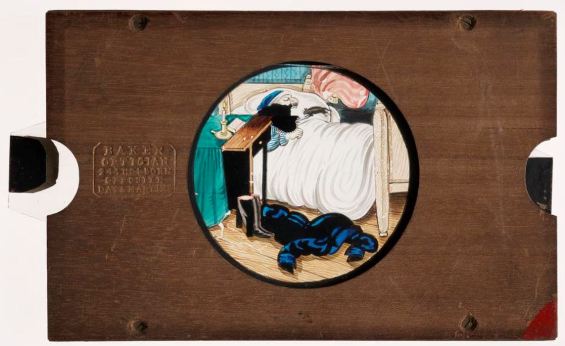
Man swallowing rat, from National Media Museum collection

Source: C.[harles] Phillips Cape, Benares, the Stronghold of Hinduism (Boston: R.G. Badger, 1910), pp. 209-210

Text: A night or two after our arrival, a magic-lantern entertainment was given outside the tent. It can hardly be called a lantern service, as some of the slides had a secular tendency. When the well-known moving picture of the rat-swallowing sleeper appeared on the sheet, the evangelist, thinking it must have a moral, explained to the wondering audience that this was the fruit of drunkenness.

But on another night, when this same slide was shown for the amusement of the children, one of our younger preachers informed the listeners that the swallower of rats was a victim of the opium habit! All the slides were not of this nature, for we followed with ‘Probable Sons,’ ‘The Pilgrim’s Progress,’ and finished with some scenes in the life of our Lord, which seemed to impress the people deeply. We thought we had been generous enough in allowing all to come without charge or collection, and were not a little surprised by a man asking next day how much we would give him if he attended the entertainment!

Comments: Charles Phillips Cape (1874-?) was a British Christian missionary. His book on Hindusim and Benares (now Varansi) is a mixture of missionary endeavour and travel writing. The incident described took place in a village outside the city. The set of images showing a sleeping man appearing to swallow a rat was one of the most popular of all magic lantern slide sets.

Links: Copy at Hathi Trust

Die Illusion im kinematographischen Theater

Source: Fred Hood [Friedrich Huth], extract from ‘Die Illusion im kinematographischen Theater,’ Der Kinematograph, 17 March 1907, quoted in Gabriele Pedullà (trans. Patricia Gaborik), In Broad Daylight: Movies and Spectators After the Cinema (London/New York: Verso, 2012, originally published in Italian in 2008), p. 51

Text: When we enter into a movie house, we immediately see the screen on the wall, which is nothing other than a large cloth framed with wood or velvet. We know that on this cloth nothing can really happen, as it were; it is as if it lacks the stage to put a good number of people in the scene. We would like to fall under the illusion, but this ought not to be made so difficult for us. Entering the auditorium, for example, we expect to see a stage. It is incredible how our emotions rise when, taking our place, we find the familiar old stage and curtain; certainly, the curtain should cover only the screen, hiding its edges. But our fancy enchants us, and we imagine a complete set design with wings, dressing rooms, trapdoors, machines that put actors in flight, etc. If one does not want to construct an artificial stage, there is still another possibility for intensifying the illusion. An architectural frame can be placed on the wall to make the screen seem to emerge from a big opening. In this way we would see the events, as it were, from the balcony of a salon, from a castle loggia. This seems like an even better solution because we get something like the impression that everything is happening far away. Anyone who keeps these elements in mind will manage greatly to increase the public’s interest in movies.

Comments: Fred Hood was the pseudonym of Friedrich Huth (1866-c1935), a German secondary school teacher. He wrote several commentaries on film and cinemagoing in German journals at this period.

Memoirs

Source: Sir Almeric FitzRoy, Memoirs (New York: G.H. Doran Company, 1925), p. 105

Text: September 14th. … Unlike the practice in the Queen’s time, the whole party in the house, King and Queen included, dine together. Jimmie Webb and Lady Cecily were also there from Mar Lodge. The King and Queen entered the drawing-room where we were all assembled, and shook hands with the newcomers, and then proceeded into the dining-room together. The Queen’s manner during dinner was much more vivacious than I had been led to expect, and she wore an expression of interest that belied her deafness, though Lord Cromer told me he did not think she heard a word he said.

After dinner we were called upon to witness a cinematograph entertainment; the scenes were mostly taken from the Coronation Procession, and the gilded coach was presented to us ad nauseam; very few of the figures were recognisable, and the oscillation of the medium affected the optic nerves most unpleasantly. The display opened with a vulgar presentment of the King on a very large scale, which elicited from His Majesty the characteristic remark: “Decorations on the wrong side!”

Comments: Almeric FitzRoy (1851-1935) was Chief Clerk to the Privy Council of Queen Victoria and King Edward VII. This extract from his chatty memoirs comes from a diary entry for 14 September 1902, shortly after the coronation of Edward VII. The location was Balmoral in Scotland.

Links: Copy at Hathi Trust

Childhood Years

Source: Junichiro Tanizaki (trans. Paul McCarthy), Childhood Years: A Memoir (London: Collins, 1990, orig. pub. 1957), pp. 137-138

Text: There were some good places like the Yurakukan, falling somewhere between a legitimate theater and a vaudeville hall. The result was that a variety of interesting and unusual entertainments were presented: it was there that I saw my first motion picture and my first Western-style marionette show. According to One Hundred Stories of the World of Meiji by the late Yamamoto Shogetsu, the first presentation of a motion picture in Tokyo was around February 1897 at the Kabukiza; and the Yurakukan must have begun showing them soon after. They were either simple records of actual events taken on the spot on trick shots, and the ends of the reel would be joined together so that the same films could be projected over and over. I can still remember a scene, endlessly repeated, of high waves rolling in on a shore somewhere, breaking, and then receding, and of a lone dog playing there, now pursuing, now being pursued by the retreating and advancing waters. There was also a scene of a long line of horses in the distance at the edge of a broad plain, looking as small as grains of millet, They came rushing straight towards the camera, growing bigger moment by moment until finally they were upon us. Suddenly they veered away into the distance, to be succeeded by another thin line on the horizon.

Then there were scenes reminiscent of the upheavals that attended the French Revolution or the persecution of the Protestants after the Reformation: aristocratic-looking women are being dragged to the place of execution, placed on a great pile of bundled faggots, and burned to death; the smoke billows forth and the women are enveloped in flames; at last the fire and smoke die down to reveal only ashes – not even the outlines of the bodies remain.

There was yet another scene in which two beautiful, almost naked women, one on either side of a devil dressed like Mephistopheles. He summons one of them and orders her to lie on a table shaped like a chopping block. He then wraps her body in a huge sheet of glistening black material like carbon paper. A sign is given, and the body of the woman in its black wrappings rises into the air. Then from the area of her feet flames appear and begin to lick at her body, moving upward and finally consuming her, paper wrappings and all.

Comments: Junichiro Tanizaki (1886-1965) was a major Japanese novelist, who also worked for a time as a scriptwiter for the Taikatsu studio in the 1920s. The films he recalls at Yurakukan are a mixture of 1890s and 1900s works: waves breaking on a shore was a common subject in some the earliest film shows; the trick films and the burning of the women would have been a few years later (possibly French Pathé productions). Film reels could not be joined end-to-end to be projected on an endless loop. The first projected motion pictures were exhibited in Tokyo in March 1897 (preceded by showings in Osaka in February).