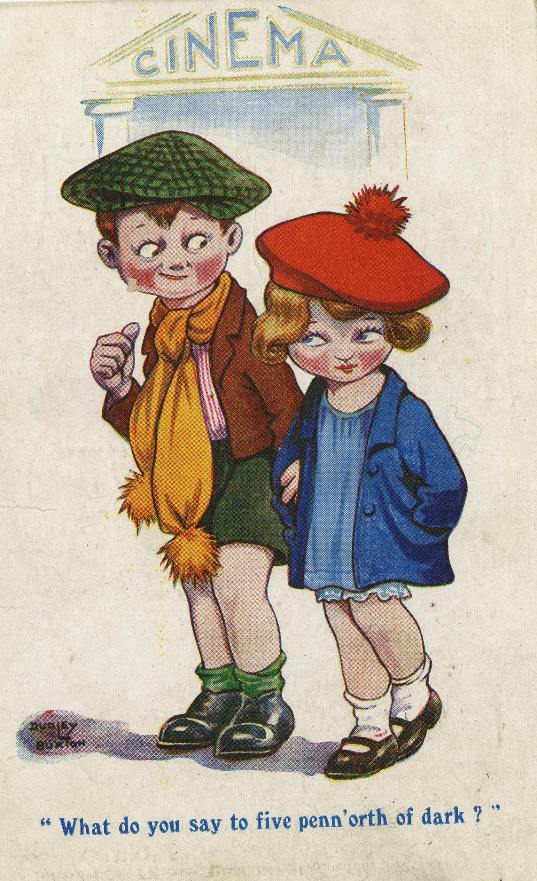
What do you say to five penn’worth of dark?

Source: Dudley Buxton, ‘What do you say to five penn’orth of dark?’, ‘Comique’ series no. 3141, Inter-Art Co., posted Scarborough, 25 July 1921, from the Nicholas Hiley collection

whatdoyousay

whatdoyousay_back

Comments: Dudley Buxton (c.1885-1951) was a British comic artist involved in some of the first British animated films, including working with Anson Dyer and the Kine Komedy Kartoons in the 1910s.

What do you say to five penn'worth of dark?

Source: Dudley Buxton, ‘What do you say to five penn’orth of dark?’, ‘Comique’ series no. 3141, Inter-Art Co., posted Scarborough, 25 July 1921, from the Nicholas Hiley collection

whatdoyousay

whatdoyousay_back

Comments: Dudley Buxton (c.1885-1951) was a British comic artist involved in some of the first British animated films, including working with Anson Dyer and the Kine Komedy Kartoons in the 1910s.

A long-felt want

Source: ‘A long-felt want: a Cinema designed for both Lovers and Picture-Lovers’, from The Humourist (1925), reproduced in E.S. Turner, A History of Courting (New York: Dutton, 1955), p. 245

longfeltwant

Comments: E.S. Turner was a British journalist and author of popular social histories. His A History of Courting has a chapter on cinema, entitled ‘Lessons in the Dark’.

Links: Copy of book at Hathi Trust

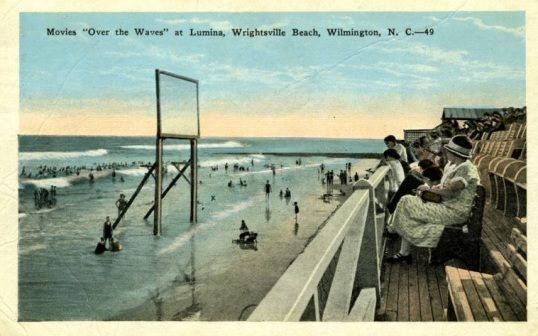
Over the Waves

Source: ‘Movies “Over the Waves” at Lumina, Wrightsville Beach, Wilmington, N.C.’ in Durwood Barbour Collection of North Carolina Postcards (P077), North Carolina Collection Photographic Archives, Wilson Library, UNC-Chapel Hill. Postmarked 22 July 1926.

overthewaves

Comments: The postcard shows a cinema screen positioned at Wrightsville Beach, Wilmington, North Carolina, with seats along the shoreline for the audience. The screen was an extension of the Lumina Theatre entertainment centre. The message on the back of the postcard reads: “Well Beulah how are you. I am just fine only rather warm for it sure is hot here. Wish you could have been with us yesterday you would have had a time. We [went] to the Ocean. I was in bathing right by the post in the picture. Fondly, Violet.” The image is used as a key identifier for the exceptional Going to the Show website, which documents the experience of movies and moviegoing in North Carolina, from the introduction of projected motion pictures to the end of the silent film era.

Links: Going to the Show website
Information from Going to the Show on the Lumina
Postcard images of the Lumina Theatre

All Pals Together

Source: Anonymous contribution to Terry Staples, All Pals Together: The Story of Children’s Cinema (Edinburgh: Edinburgh University Press, 1997), p. 25

Text: When I was at senior school in Kingston in the twenties we were drafted in to the Elite Cinema one Saturday to see a show which was probably organised in conjunction with the Empire Marketing Board. We were somewhat upset at having our morning taken away, and this feeling was compounded when it turned out that the reason for our being there was so that we could be shown a film about rice-growing. After the screening someone made a long speech, and I think we were supposed to write a competitive essay about what we had seen. By this time were were getting restless, and after someone else, probably the Mayor, had had his say, we were supposed to applaud. I never knew which school started it, but the applause gradually developed into a slow handclap. Very angrily, the officials left the stage; and, a bit earlier than planned, the National Anthem was played on the organ. We got a good wigging for our bad manners, but I don’t think any of us ever did write that essay on rice-growing.

Comments: All Pals Together is a history of British children’s cinema. It quotes from several memoirs gathered in the research for the book, unfortunately without identifying the contributors. This passage refers to the practice of some educational authorities organising screenings of instructional films for children on Saturday mornings.

So Laugh a Little

Source: Molly Picon, So Laugh a Little (New York: Julian Messner, 1962), pp. 136-142

Text: If someone were to write a history of the movies from the fan’s point of view, he would have to include my grandmother. From the day she walked in to see her first nickelodeon, she was completely captivated by Hollywood. She might not have gone to the nickelodeon if my grandfather hadn’t used every argument he could muster to get her there – what did she need it for, she cried, the first time the subject came up, she had a million things to to around the house, she didn’t feel like getting all dressed up, if he wanted to go, she wouldn’t stand in his way. My grandfather patiently outwaited all her cogent reasons for not leaving the house and eventually bore her off triumphantly to witness the marvel of moving pictures. Afterwards he used to complain that a man didn’t know when he was well off, why hadn’t he left well enough alone, if he had known how she would react he would have had his head examined before he talked her into it. My grandmother would smile and wave her hand at him and tell him not to get excited, at least she wasn’t a gambler or a drinker. My grandmother didn’t need alcoholic stimulation; she was intoxicated by the silver screen. Although she loved the theatre, she never responded to it the way she did to the movies. I have often thought that the plays she saw on the Yiddish stage hit too close to home; the situations were exaggerated, perhaps, but always contained nuggets of reality; the people were too easily identified with. They were, after all, her own people. But up there on the screen, magnified out of all contact with her world, scenes would unfold before her that would transport her into a never-never land. Even when she didn’t understand what was happening – and this occurred more often than not – she still loved every minute of it.

When I would ask her what she had seen, she would shrug her shoulders and say, “Do I know? They were hitting and fighting, and the girl didn’t like the good-looking one, and then she did like him, and then she changed her mind again. I don’t know what’s the matter with the girls today. In my time nobody asked you. You got married and that finished it.”

“Then you didn’t care for the picture?” I asked.

“Didn’t care for it?” she repeated incredulously. “With all that fighting and hitting and that poor boy up there eating his heart out for her? Why didn’t I like it?”

She became such an avid movie fan that Helen and I had to sit and read every little bit of gossip we could find in the papers to her, up to and including the blurbs of coming attractions. To my grandmother this wasn’t gossip, but gospel. She never for a moment doubted that every word was true. After all, it was printed, right there, in black and white. In those days, we lost my grandmother regularly once a week. For this was the era of the weekly serial, and Pearl White was its human sacrifice in fifteen installments. In spite of my grandmother’s shrieking warnings, Pearl White always managed to get herself into utterly hopeless situations. She would be huddling in some dank cellar while up above the villain would be peering down at her through a convenient hole in the floor, threatening to flood the cellar and drown poor Pearl unless she immediately and forthwith yielded what my grandmother always called her “good name.” Both Pearl White and my grandmother rejected these advances haughtily, no matter what the consequences. And the villain, of course, would then promptly turn on the waterworks.

All week long, my grandmother would worry and fret and strain for the days to pass so she could see how Pearl was doing. Pearl would escape from drowning only to wind up, at the end of that particular installment, in an even more precarious position, maybe tied to the railroad tracks, or about to be evenly distributed in a sawmill, or hanging by her fingertips from a cliff whilst the villain carefully and painstakingly lifted her fingers, one by one. I remember one time my grandmother was ill and unable to attend the next showing. She went into an absolute frenzy. I couldn’t go, because I was involved in a rehearsal. Helen was out of town. My mother had to stay home and take care of my grandmother. That left only my grandfather, who regarded the whole thing as bordering on simple insanity. “I should spend a beautiful day in the dark to watch a girl make a fool of herself,” he scoffed. “This week she’ll hang by the neck, and next week she’ll hang by the toes, and after the fifteen weeks is up, she’ll only start all in again with the foolishness. You would think with all the trouble she gets into that she would learn something.”

“Aaron, I beg you,” my grandmother pleaded. “I left her last week the house was burning down, and she was choking … such choking she was purple in the face. Like this she was, Aaron …” And my grandmother went into a graphic illustration that almost purpled her own face, but my grandfather remained unmoved.

“So what are you so worried?” he replied indifferently. “You think they’ll let anything happen to her? And for her I should miss my checkers?”

Even my grandmother couldn’t expect my grandfather to give up a checker game for Pearl White. All week she brooded. A whole episode missed and gone forever. When she would return to the theatre, Pearl would be facing a completely new peril. It was too much for flesh and blood to stand, my grandmother complained. As soon as she was well, she hurried off to the theatre and cornered the manager.

“Mr. Brody,” she panted. “From you I can have an answer. Tell me what happened last week. One foot I don’t put outside this office till I hear what happened.”

“God love you, Mrs. Ostrow,” said Mr. Brody, who had come to know my grandmother very well, in weekly installments, “how would I be knowing that? I’ve more adventures of my own keeping an eye on the little devils that come to watch her than she’ll ever be having.”

My grandmother couldn’t believe it. She herself would sit through both showings of the serial, just in the hope that it might come out differently at the end the second time, and here was Mr. Brody, with such a golden opportunity, who didn’t even care!

“Do you have any idea what the little monsters do here of an afternoon?” Mr. Brody warmed up to his subject as one who had had much practice. “I won’t mention the condition of the floors, with the boxes and papers and bags filled with banana peels and apple cores,” he said, waving an angry finger under my grandmother’s nose. “Nor do I care to mention the state of the bathrooms in front of a lady. But do you have any idea what happens to the seats?” He clutched his head. “The black plague on him that invented chewing gum!”

“I ask him about last week and he gives me chewing gum. Mr. Brody. A whole week I’m dying …”

“It’s the back of my hand to the next whippersnapper I see with a mouthful of the stuff.” Mr. Brody, my grandmother could understand, was too full of his own woes to be concerned with hers. She left his office, muttering to herself angrily. Fortunately she ran into an usher who was as much enraptured with Pearl White as my grandmother.

“Ya dint see ut?” he whispered, aghast.

“I was sick. Please. I’m dying. How did she get out of the fire?”

“It was the cat’s pajamas,” the usher said. “Ya know how she dint see no way outa there, an thuh fire gettin’ closer alla time, and she was kinda chokin’ up from the smoke …?”

“Yeh, yeh, I know the fire and the smoke … what did she do?”

“Well, just when it looked like she was a goner, she noticed a little door she never seen before and …”

And turned the knob and escaped into the clean, outside world to start running from the villain in Chapter Ten, to be seen at this theatre next week, don’t miss this exciting episode.

When talking pictures came in, my grandmother became an even more ardent fan. She would come home beaming and repeat the story to us whether we wanted to hear it or not. Since the plot suffered considerably in the retelling, it was like trying to solve a puzzle with half the pieces missing. For some reason or other, my grandmother would identify the actor or actress with the role he was playing, so that if John Gilbert’s name in the story was Henry, he would remain Henry to her.

I’ll never forget the day she saw Al Jolson in The Jazz Singer. She sobbed so hard through this performance that even after the curtain swished across the screen and the house fights were put on, she sat in her seat and cried vigorously. She came home with a bagful of sodden handkerchiefs, convinced that Al Jolson had sustained a terrible loss. In the picture, he sang a tearjerker called Sonny Boy to an angelic-faced child who subsequently died. Nothing could persuade my grandmother that this boy was not Al Jolson’s child. For weeks she would walk around the house, heaving racking sighs and wiping tears from her eyes.

“Bubba. For heaven’s sake,” I said, annoyed. “It was only a picture! That boy will be in a dozen new pictures before the year is over.”

“What do you know how a father’s heart can break? Wait. When you’re a mother, you’ll understand what it is to have love for a child.”

“But, Bubba. That child did not die. It was just a story.”

“Malkele,” she replied sorrowfully. “I know you mean well and you’re trying to make me feel better. But you’re young yet. You don’t know what real suffering is.”

From that time on, she became especially interested in Al Jolson’s career. If she heard gossip that was good, she felt considerably cheered. If she heard comments that were unfavorable, she would shake her head gravely and say, “That poor man hasn’t been the same since he lost his little boy.”

As she became older, she preferred stories with modern settings. When we took her to see a picture depicting early days in man’s history, she would turn to me or to Yonkel and say disapprovingly, “Why do you take me to see a picture made in olden days?”

“Bubba,” I would answer. “The picture wasn’t made in those days. The movies are practically brand new. That is a picture that just came out this year from Hollywood.”

“Go on,” she denied unbelievingly, “don’t I see with my own eyes what they’re wearing and how they are living?”

We discovered, after a while, that my grandmother would go to the movies for still another reason than to see what was playing. It was so dark and cozy and relaxing, my grandmother found it ideal for sleeping. The music would crash through the theatre; sirens would wail; heroines would shriek. My grandmother would doze blissfully through it all, awaken refreshed, and remark that she didn’t remember when she had enjoyed a picture more.

Finally my grandmother took to going to see foreign films. This was somewhat of a puzzle to me, since she had rough going with American films. One day I spoke to her as she was busily preparing to go to a Spanish movie.

“Bubba,” I protested. “A Spanish movie you want to see? Do you understand Spanish?”

She looked at me, and her eyes crinkled with amusement as she answered, “And who understands English?”

My grandmother was constantly amazed at the new innovations in the motion picture field, but I think there was never a time to equal, for her, the Pearl White days. Once, when I took her to see some mystery film, remembering how she loved the suspense in the old-time serials, she turned to me and said, “You think she is suffering?” – pointing scornfully to the quaking heroine on the screen – “you should have seen little Pearlie White. She was a real wreck.”

Comments: Molly Picon (1898-1992) was a renowned American star of Yiddish theatre and film. The above is a chapter from her memoir (‘as told Eth Clifford Rosenberg’) of her family and upbringing. Her Ostrovsky (later Ostrow) grandparents came from Rizshishtchov in Russia, where Picon’s mother was born. Molly Picon herself was born in New York. Al Jolson’s song ‘Sonny Boy’ comes from the film The Singing Fool (USA 1928), not The Jazz Singer (USA 1927). Pearl White starred in the serial The Perils of Pauline (USA 1914).

Links: Copy at Hathi Trust
The Negro in Chicago

Source: The Negro in Chicago: A Study of Race Relations and a Race Riot (Chicago: University of Chicago Press, 1922), pp. 318-320

Text: Reports of investigators indicate that the managers of movies are convinced that their main floors, at least, should be guarded against Negroes. In most of the commercial amusement places, Negroes seldom have difficulty if they are willing to sit in the balcony, though attempts are frequently made to seat them on the aisles next to the walls, even when there are center seats empty. It is rare that any report is obtained of objections by white patrons to the actual presence of Negroes when they are well-mannered, well-dressed, and appreciative auditors.

As a rule movie theaters do not sell reserved seats, general admission entitling any patron to any seat in the house. But the following detailed report of the experience of two intelligent, well-dressed, quiet-mannered Negro women at a new movie theater on State Street is typical:

Purchased tickets, and entered the large lobby which extends across the front of the house. From this lobby there are closed doors at the entrance of several aisles, so that patrons are directed by ushers to different aisles, supposedly wherever there are vacant seats. We followed directions, and went to the extreme left of the lobby.

We opened the door, and the usher in charge of this aisle started down toward the front to show us seats. We saw at once that the narrow section of seats next to the wall was empty except for one colored woman sitting about the middle of the section. Instead of following the usher down the aisle, and taking seats indicated to the right of this section, we turned through a row of empty seats on the left-hand section, and sat next to a woman in the aisle seat. This put us two rows from the rear in a side middle section, instead of in the section which seemed to be reserved for colored patrons, next to the wall. As the usher returned to his station he said, “We have some lovely seats in the balcony; wouldn’t you prefer sitting there?” He was courteous, and I thanked him, telling him that we were quite satisfied with the seats we had taken.

Later, seeing two vacant seats further front in the center section which gave us a much better view we decided to take them and see what would happen. As we rose, the usher tried to block ms by putting his hands on the back of the seat in front, and saying, “I am sorry that you can’t take those seats.” I brushed by him and took one of the seats. He tried the same thing with Mrs. H — , and she also brushed by and joined me. There were scattered vacant seats both in the section we left and the one to which we moved. We remained until the end of the show without embarrassment.

The manager of this theater has had many years of experience in Chicago, and was quite willing to discuss race contacts. Nothing in his words would indicate any strong prejudice against Negroes, even when expressing his conviction that they should keep to places intended especially for them. He said, in substance:

Not many Negroes buy tickets — perhaps ten or a dozen a day. An effort is made to seat them in one section of the house, preferably the balcony, to which they are directed by ushers. Reason is the complaint by white patrons who object to sitting next to them for an hour, or hour and a half. Offensive odor reason usually given. White patrons often complain to manager as they go out if Negro has been sitting near them.

Conduct of Negroes is not often objectionable — runs about the same as all patrons. Occasionally one tries to “start something.” Recently two Negroes came to manager in crowded lobby after they had attended the show and objected to their seats on the balcony to which they had been sent by ushers, saying there were vacant seats on the main floor. Wanted to know why they were discriminated against. Manager did not want an argument in the presence of other patrons, and told them that as they had seen the show, heard the music, and shared everything with other patrons, he did not see they had any real cause for complaint. Called attention to the notice printed on almost every theater ticket in some form or other to the effect that the management reserves the right to revoke the license granted in the sale of the ticket, by refunding the money paid.

The same two women bought tickets the next day and attended a movie in an older and very popular “Loop” theater. They reported that they had no difficulty of any kind.

In a test made of a new and popular movie theater in an outlying section the investigator reported:

There were four of us in the party on June 5. We were told by the usher that there were no seats on the first floor, and that we would find seats in the first balcony. I think he was right, for there were white people also sent to the balcony. We were ushered in promptly, but another usher met us and said, “Right on up to the second balcony.” We said we preferred seats in the first balcony, and walked by him. He went and got two more ushers and stood in front of us to prevent us from going into the first balcony, insisting that there were no seats there. One of the young ladies stepped around the usher, and saw three vacant seats. She called them to the attention of the usher, and he then said he meant there were no seats for four. Two of our party took those seats, and the other two waited about twenty minutes till they could get the seats they wanted. After getting into the first balcony, we saw vacant seats in at least four rows, two, three, and four seats together into which we might quietly have gone had the usher been courteous.

On June 18, 1920, a well-known Negro employed in the City Hall was denied admission to a movie theater at Halsted and Sixty-third streets. There is a small but long-established Negro colony about a mile west of this location.

Comments: The Negro in Chicago is a report commissioned by the Chicago Commission of Race Relations following severe racial disturbances in the city in 1919. In Northern states Black audiences had the legal right to be seated anywhere at a public entertainment, but many cinemas and theatres attempted to keep them to segregated areas (often the balcony), or might charge them higher prices than white audiences. Some cinemas had separate entrances for blacks. Southern states enforced racial segregation under the Jim Crow laws. Cinemas managed solely for black audiences existed in both North and South.

Links: Copy at Internet Archive

Movies, Delinquency and Crime

Source: ‘Male, white, Polish, 28, sentenced for burglary, inmate of reformatory’, quoted in Herbert Blumer and Philip M. Hauser, Movies, Delinquency and Crime (New York: Macmillan, 1933), pp. 38-39

Text: The ideas that I got from the movies about easy money were from watching pictures where the hero never worked but seemed always to have lots of money to spend. All the women would be after him and usually there would be two or three women who have a fight over him. They’d pull each other’s hair and all that sort of thing. I thought it would be great to lead that kind of life. To always have plenty of money and ride around in swell machines, wear good clothes, and grab off a girl whenever you wanted to. I still think it would be a great life. After seeing these pictures I would think how great it would be if I could get hold of a few hundred thousand dollars and travel all over the world and see everything and have a girl in every city in the world so that no matter where I was I could get lots of loving.

Comments: American sociologist Herbert Blumer’s Movies, Delinquency and Crime studies the supposed connection between cinemagoing and crime, and is part of a series of studies made by the Committee on Educational Research of the Payne Fund, at the request of the National Committee for the Study of Social Values in Motion Pictures.

Links: Copy at Internet Archive

Sociology of Film

Source: J.P. Mayer, Sociology of Film: Studies and Documents (London: Faber and Faber, 1946), pp. 205-208

Text: 22. Mr. …

An ardent filmgoer since the early days of Cinema I can recall no instance of a film encouraging me to make any important personal decision. I was, however, inspired during adolescence by the antics of the late Douglas Fairbanks, snr. I tried to imitate his personal mannerisms and emulate his athletic prowess in the mistaken belief that I could, so achieve an extra strength and self reliance — (at the time I suffered from exaggerated feelings of inferiority).

Since those days, I have never consciously desired to imitate anything admired in others, on the screen.

Whereas my early cinegoing was largely a matter of ‘escapism’, to-day choice has supplanted habit. What concerns me now is enjoyment through interest, not escape through fantasy. I now seek interest through appraisement and analysis. The appreciation of good acting, imaginative lighting, interestingly authentic decor and wardrobe, evocative ‘cutting’, the expressive use of sound and dialogue — in short, seeing films ‘whole’ motivates my present day picturegoing. It is the content and manipulation of a film that now interests me and not merely that a film can provide a temporary escape from a reality which is, in nine cases out of ten, largely self-created.

Having grown up with the Cinema my understanding and appreciation of it has matured just as the Cinema has, in many ways, itself matured. It was during the pre-talkie period of the so-called ‘Golden Era’ of German and Swedish production, that I first became aware of the real possibilities inherent in the film as an art, and a mental and cultural stimulus. The notorious Cabinet of Doctor Caligari, for instance, excited my imagination because, for me it opened up new vistas of a fascinating and undreamed of significance.

‘Caligari’ is said to have changed the whole outlook of cinema, and I believe that it did.

I will admit that my first impressions here were largely bound up with childhood wonder and excitation experienced through Grimm’s fairy tales. I think ‘Caligari’ re-created for me those perhaps rather unhealthy delights, connected somehow with fear, i.e. the fascination of weirdness, dark forests, witches, hobgoblins, magic, sinister castles, and, in fact, the frighteningly suggestive in general.

And yet it was through such films as Caligari, Waxworks, The Student of Prague, The Golem, Nosferatu (Dracula), etc., etc. that I was subsequently to acquire a more objective understanding of what artistic and constructive film entertainment could mean. They gave me my first insight into the true potentialities of Cinema.

To-day, I visit films less often, and when rare and culturally valuable ones such as Citizen Kane, Earth, The Grapes of Wrath, etc. do become available I try to see them as often as possible before they disappear — possibly for ever.

In answer to your question regarding fashions and manners, it is obvious, and especially with regard to women, how greatly the screen has influenced and encouraged consciousness of and interest in personal appearance and behaviour. Women have learned the value of attractive clothing and make-up in the development of poise and self confidence, or at least a sense of it, for I notice that people influenced by such things frequently fail to adopt them with any real degree of success.

Misapplication, resulting in artificiality rather than attractiveness seems all too often the inevitable result. Finger nails and hair ‘do’s’ are not necessarily indicative of character or self reliance, or even of good taste.

Personally, I cannot say that I have been influenced in any way here. I believe that real poise and self confidence result from an objective rather than a subjective attitude to life. I would far rather be my natural self (at least as far as I am capable of being), than a second rate edition of some movie idol I admired, or might happen, faintly to resemble.

Love and divorce do not apply to me. For one thing I have never really been in love, and for another I do not believe that the screen exercises so much influence with morals as seems generally to be supposed.

So now to dreams. I believe that few people dream about the films they see, but I can recall (though of necessity, only partially) dream experiences the content of which included the Cinema in one form or another, although I have never dreamed of any particular film. When I have dreamed about Cinema, the building itself seems always to have been included. Sometimes it has been curved in shape, (which is when I have been inside), and sometimes square, and rather aggressively strong looking, (and then I have been outside). Recognising, in my limited understanding of Freudian psychology, that ‘shape’ has significance in dreams, I draw, or imagine I draw, the obvious conclusion here. I have also dreamt of meeting ‘stars’ personally, and having them regard my criticisms of their work and of Cinema in general as something to marvel at.

I certainly do feel that the Cinema can and does exercise considerable, and probably far reaching influence on individual psychology, and mainly in the sense that many filmgoers tend unconsciously to identify themselves with pictured characters and emotional situations. More briefly, many of us see ourselves in the movies we like.

I think, for example that it is possible to read into films the things we would really like to do and be. But are the things we enjoy really projections of the hidden truths about us? I cannot arrive at a decision about this.

I do think about it, but I really do not know. I would very much like to determine just why I believe my initial reactions to say Caligari, or Warning Shadows, or perhaps The Street or The Last Laugh, would not be repeated were I able to see them again to-day.

I might still enjoy them as museum pieces, and in a nostalgic sort of way, but would, somehow be unable to ‘recapture the first fine careless rapture’. This overlong letter must now end.

I hope you will gather at least something from it that is worthwhile to you. I expect there are many things I have failed to remember, and probably from your own point of view the most important ones of all, but, on the spur of the moment, it is the best I can do in the time at my disposal. I have tried to be truthful about it, but how often can one be satisfied that one has succeeded in being really truthful? As a psychologist, you will probably arrive at a much truer solution to this problem than I myself am at all capable of achieving.

Age — 44. Sex — Male. Nationality — British. Profession — Shopkeeper — (now in costing office of war factory).
Profession of Father — Builder. Mother — originally a court dressmaker.

Comments: J.P. (Jacob Peter) Mayer was a German sociologist at the London School of Economics. His Sociology of Film draws on a large amount of evidence gathered through questionnaires and submissions received through invitations published in Picturegoer magazine. The above response comes from the section ‘The Adult and the Cinema’. People were asked to answer two questions: Have films ever influenced you with regard to personal decisions or behaviour? and Have films ever appeared in your dreams? The films referred to here are Das Cabinet des Dr. Caligari (Germany 1920), Das Wachsfigurenkabinett (Waxworks) (Germany 1924), Der Student von Prag (Germany 1926), Der Golem, wie er in die Welt kam (Germany 1920), Nosferatu, eine Symphonie des Grauens (Germany 1922), Citizen Kane (USA 1941), Zemlya (Earth) (USSR 1930), The Grapes of Wrath (USA 1940), Schatten (Warning Shadows) (Germany 1923), Die Straße (Germany 1923) and Der letzte Mann (The Last Laugh) (Germany 1924).

Babbitt

Source: Sinclair Lewis, Babbitt (New York: Harcourt, Brace and Company, 1922), p. 156

Text: At least once a week Mr. and Mrs. Babbitt and Tinka went to the movies. Their favorite motion-picture theater was the Chateau, which held three thousand spectators and had an orchestra of fifty pieces which played Arrangements from the Operas and suites portraying a Day on the Farm, or a Four-alarm Fire. In the stone rotunda, decorated with crown-embroidered velvet chairs and almost medieval tapestries, parrakeets sat on gilded lotos columns.

With exclamations of “Well, by golly!” and “You got to go some to beat this dump!” Babbitt admired the Chateau. As he stared across the thousands of heads, a gray plain in the dimness, as he smelled good clothes and mild perfume and chewing-gum, he felt as when he had first seen a mountain and realized how very, very much earth and rock there was in it.

He liked three kinds of films: pretty bathing girls with bare legs; policemen or cowboys and an industrious shooting of revolvers; and funny fat men who ate spaghetti. He chuckled with immense, moist-eyed sentimentality at interludes portraying puppies, kittens, and chubby babies; and he wept at deathbeds and old mothers being patient in mortgaged cottages. Mrs. Babbitt preferred the pictures in which handsome young women in elaborate frocks moved through sets ticketed as the drawing-rooms of New York millionaires. As for Tinka, she preferred, or was believed to prefer, whatever her parents told her to.

Comments: Sinclair Lewis (1885-1951) was an American novelist, winner of the Nobel Prize for Literature in 1930. His novel Babbitt is a satire on American middle-class life. Its central character is the materialistic and socially conformist businessman George Babbitt. It has numerous reference to the movies and movie-going. It was filmed twice in 1924 and 1934.