Bioscoop

Source: Louis Couperus, ‘Bioscoop’, Haagsche Post, 2 December 1916, English translation by Ivo Blom in ‘North and South: two early texts about cinema-going by Louis Couperus’, Film History vol. 20, issue 2 (2008), pp. 127-132

Text: The contrast between North and South manifests itself in many different ways. At the Bioscoop, too. First of all, in the South the Bioscoop is called Cinematografo in Italy or Cine in Spain. Well, this difference is negligible. But in both southern countries the difference is great as compared with cinema in Germany and the Netherlands. As soon as we go North, the cinema becomes something of a theater, becomes pretentiously heavy. You are received by employees in braided frocks, your coat and stick are taken from you, you are allocated a certain, fixed seat, you are not allowed to stand up, you notice everyone around you in the shimmering darkness in their seats for hours, there is an intermission … Nothing of all this in Italy or Spain. Not only is the cinematografo or the cine much cheaper than the bioscoop, but the whole interior is more light-hearted, comfortable, accommodating. The illuminated foyer which you can see from the street is inviting, with a salon orchestra (albeit not very attractive to me personally), and a reading table. To enter when it rains, when I don’t want to go to a bar, when I have paraded around enough, when I am tired, bored … I pay 30 centimes and whenever I want to look rich, 50 centimes. I cannot go above that, unless for a world famous film such as Quo Vadis? Even for 50 centimes – both in Italy and Spain – my seat is too chic, so terribly chic, that I prefer to pay 30 centimes … Around me are casual, very decent people, so decent that if I want to see the less decent, I need to descend into places where I pay only 20 or 15 or 10 centimes. I see the same films, but … one week later. But everywhere the experience is light and capricious, an ephemeral joy, while in the North cinema has shut itself inside an impenetrable shell. Really, when I walk into a cinema I want to do it in a light-hearted and casual way. I’ll stand up for a quarter of an hour if necessary, just to see Max Linder or a scene of the war, and then leave again. Dear heavens, you really notice when you are in the North, as soon as you are away from Italy: in Munich or … The Hague. There is no question of standing up; everything is so solemn and heavy, that your first casual impulse to see a film is immediately crushed. In Italy I saw the whole war in Tripoli screened before me, surrounded by a decent officer-with-family audience, without reserving seats and always for 30 centimes each day. Here, I am hesitant to go and see The Battle of the Somme because I don’t want to reserve a seat. I want to keep my coat on, even keep my wet umbrella with me; I’d rather stand than sit; in particular I don’t want to turn my cinema joy into a solemn visit; rather I desire an unpretentious, casual ‘walking in’, a passing pleasure, which should not last more than twenty minutes at the most.

Oh North and South, not even in the bioscoop and cinematograph do you have anything in common.

But now the analysis. Why is it so different in the North and the South? Because of the heavy soul of the Northerners? Of course, but also because ‘street life’ does not exist in the North and because in the South ‘walking into a cinema’ is a part of everyday life. Just as in the North it is not allowed in a lunchroom bar to toss off a little glass of vermouth standing up, so it is not normal to consider the cinema as a short halt in your flanerie, as a shelter from the rain, as a short, oh, so short, distraction from the melancholy which can so affect the flaneur when he is lonely, wandering among the busy crowd. And so he longs for Max Linder or Charles Prince; yes, even some lively pictures of actuality, whose photographic ugliness, teasing and screeching, scratch the silently suffering soul of the purposeless street wanderer when the winter twilight hour nears, when the shopping lights and street lanterns are starting to flame and the pain of wistfulness hurts him, without really knowing why …

It is then that you lose yourself – not in a bar where the electric light shines mercilessly – and where you need to drink something; it is then that you lose yourself, in the South, in the cinematograph, where you can watch pictures as if still on your mother’s lap.

Comments: Louis Couperus (1863-1923) was a Dutch novelist and poet and is considered one of the leading figures in Dutch literature. He wrote about films in his regular ‘Bioscoop’ column for the Dutch newspaper Haagsche Post. The films referred to are Quo Vadis? (Italy 1913) and The Battle of the Somme (UK 1916). Max Linder and Charles Prince were French film comedians, the latter known on-screen as Rigadin. Bioscoop is the Dutch word for a cinema building, taken from the English word Bioscope. My thanks to Ivo Blom for his permission to reproduce his translation, and to Deac Rossell for alerting me to the Film History article. Ellipses are as given in the Film History translation.
The little Madeleine

Source: Mrs Robert Henrey, The little Madeleine: the autobiography of a young French girl (New York: Dutton, 1953), pp. 199-200, 204-205

Text: Mme Maurer, grateful and generous, found a charming way to say thank you. Immediately after lunch on my half-holiday she, my mother, and I would go to the cinema in the Avenue de Clichy, where the programme included a film in several episodes, with Pearl White, and a Max Linder comedy. The programme started at two, and as soon as I heard the bell announcing the approach of the great moment my excitement was immense. Pathé Journal began with a flickering news-reel. Weary soldiers in long files marched down the lines. Lloyd George and Clemenceau danced across the screen with unbelievable speed. King George V and his good-looking son, the Prince of Wales, shook hands with soldiers and climbed over trenches and barbed wire. The cinema seemed to soak all these famous men and incidents with an oblique and incessant rain.

My mother found in these visits to the cinema her first moments of genuine pleasure. We would discuss what we had seen, thinking all the week about the next episode. A little later the great Gaumont Palace was opened in the Place Clichy. Then it was a different matter. The most famous cabaret singers in Paris were engaged to appear in the intervals, and the auditorium, full of soldiers and officers of every nation, made our hearts beat with patriotism.

[…]

When my father was on a night shift my mother, Marguerite Rosier (we had now forgiven her for running away from the man with the knife), and I went to a cheap cinema in the Boulevard National, arriving half an hour before the performance started, to be sure of having the best seats.

Our cinema smelt of garlic and peppermint drops. Palm-trees stood on either side of the stage, their branches casting uneven shadows on the white screen like giant spiders. Excitedly we waited. In spite of our love for Pearl White we had not quite cured ourselves of thinking of the cinema in terms of the age-old theatre, and we had gone instinctively to the front of the stalls where, after a while, we would see appear from behind a curtain a little hunchback woman with a big white head surmounted by a number of diamanté spangled combs. She would slip her rheumatic knees under an upright piano and begin a Strauss waltz. The apache boys from the fortifications who were here in large numbers whistled the accompaniment, while putting an arm round the shoulder of a girl, getting into position to unbutton the blouse and fondle her breasts. These were the girls who worked for them as prostitutes on the outer zone, drawing men with alluring gestures, like Circes, near to the wall where the apache lay in waiting with his knife. All the boys wore their caps and sometimes their red scarves. A few moments later came a small dark man holding a violin case tightly under his arm, and as he made his way towards the hunchback his journey was followed by loud whistles and exclamations of ‘Hurry up, maestro! You’re late, brother! Let’s go and sleep with his wife while he scratches a tune on his fiddle!’ The fiddler, pale and without any sign of fluster, removed a black hat, placing it carefully on the edge of a chair, folded his overcoat, took up the hat which he would then place on top of the folded overcoat, and delicately brush the dandruff from his narrow shoulders. At last he opened the case, holding the violin under an arm whilst he put a handkerchief under his chin. The audience invariably cried out: ‘The little old man is going to weep!’ Then dolefully: ‘Don’t worry, daddy, you’ll see her again, your girl friend!’ Now at last, with a sign of his bow to the hunchback, he would begin to play. The lights would go out. The screen flickered.

By the time the big film started this chaffing audience was settling down to the charms of Mary Pickford with her blonde curls. The love-story was getting the better of these boys and girls from the fortifications who, for all their naughtiness, were just sentimental children. At this magnificent moment, after all the fatigues of the long day, after school, after queueing, after playing in the street, exhausted, I fell fast asleep on my mother’s shoulder! This happened every time we went to the cinema. Before setting out in the evening I would say: ‘If I go to sleep you will wake me up, won’t you, mother?’ She promised. Indeed she did wake me, but after rubbing the sand out of my eyes and trying to unravel the plot, I fell asleep again, and my mother, transported to a land of make-believe, was far too interested in the romance to keep on pinching my arm. I would sulk on the way home, and childishly threaten to tell my father where we had been. My mother answered patiently: ‘To-morrow I will describe the whole episode to you while you are sewing, and next time you really must try to keep awake!’

Comments: Madeleine Henrey (1906-2004), who mostly published as Mrs Robert Henrey, was a French author of popular memoirs. Her son, Bobby Henrey, played the child lead in the film The Fallen Idol (UK 1948). The Gaumont Palace, located at Place Clichy, Paris, opened in December 1907, ahead of Henrey’s First World War period memories. It was the largest cinema in Europe, seating over 6,000.

Links: Copy at Hathi Trust

The Heart of a Soldier

Source: Lauchlan MacLean Watt, The Heart of a Soldier (New York: George H. Doran Company, 1918), pp. 78-79

Text: There are constant opportunities for the artist amongst our men, if only the artist were there to catch the play of firelight on rugged faces, and the shapes and postures of comely manhood. One night we had a cinematograph show in a farm courtyard, which was packed with our fellows. The scene was unforgettable. Some heavy clouds hung overhead, but there were wide blue star-strewn spaces, where the sickle of the new moon hung dimly, like a thing of dream. The bare, gaunt skeleton rafters of the broken roofs of the barns and outhouses stood out black against the sky. And as the pictures flickered across the screen, the hushed attention of the men was most infectious. Sometimes it was a scene of some of the places only too familiar to them — a ruined village, a shell-torn road, or a group of officers at the door of a broken-down house, to be greeted with a deep silence, or the swift intake of breath which speaks of poignant remembrance, or a hearty cheer as this or that favourite personality appeared. Then there were ships, the sea-lions of Britannia; followed by laughter-provoking reproductions of Bairnsfather’s inimitable cartoons. The next time these men were crowded together under the strain of deep emotion, they were themselves passing through an episode of imperial and international picture-making and map-changing, up where the guns were drumming the prelude of another act in the tragedy of war. For it was just a few days later that the laughing crowd in that moonlit courtyard went up the line again.

Comments: Lauchlan MacLean Watt (1867-1957) was a Scottish author and cleric, who served as a chaplain with the Gordon Highlanders in the 7th Division during the First World War. The film based on the cartoons of Bruce Bairnsfather is The Better ‘Ole; or, The Romance of Old Bill (UK 1918 d. George Pearson). Bairnsfather was best-known for his soldier character Old Bill, with his famous advice to a soldier grumbling about his lot: “Well, if you knows of a better ‘ole, go to it”. The film shown described took place in France.

Links: Copy at Hathi Trust

The Story of the "9th King's" in France

Source: Enos Herbert Glynne Roberts, The Story of the “9th King’s” in France (Liverpool: The Northern Publishing Co., 1922), p. 56

Text: On the 9th there was a big attack by the British. The 16th Division attacked on the right in front of Delville Wood, and the 1st Division on the left, and consequently the Battalion was in the very centre of the fight. The garrisons of the strong points being cut off as they were, did not receive news of the attack. Suddenly in the afternoon after a comparatively quiet morning the artillery on both sides became very active, both the British and German artillery developing intense barrages. To the men in the strong points this presaged an enemy attack, and the order was given to be ready to fire the moment the enemy should come into view. The members of these small garrisons knew there would be no hope for them, as they would soon have been surrounded and annihilated, and most probably all of them bayoneted. Fortunately the attack was by the British and these eventualities did not arise. The Battalion was relieved during the next two days and went into reserve at Buire-sur-Ancre. After a few days here it moved to a bivouac area at E. 15 a., outside Dernancourt. Though this was some considerable distance behind the front line the enemy forced the Battalion to evacuate this area by firing at it with a long-ranged gun. In the evening there was a cinema show in the open, at which were shown pictures of the Somme Battle. It was very strange to see the soldiers keenly interested in the pictures of what shell fire was like when there were actual shells falling about half a mile away, and they had been shelled out of their camp that very afternoon. The British Army had made a successful attack on the 15th September, and on the 17th the Battalion went into line again at Flers, where two miserable days were spent in an incessant downpour of rain and very heavy shell fire. On relief it came back to the transport lines at Pommier Redoubt.

Comments: Enos Herbert Glynne Roberts was a captain with the King’s (Liverpool Regiment) Territorial Force, and his book documents the regiment’s experiences during the First World War. The date of the passage is 9 September 1916. The Battle of the Somme took place 1 July to 18 November 1916. The documentary film The Battle of the Somme, made by the British Topical Committee for War Films, was first shown in British cinemas on 21 August 1916, so it is presumably this film that the troops saw while they were still taking part in the conflict.

Links: Copy at Project Gutenberg

The Story of the “9th King’s” in France

Source: Enos Herbert Glynne Roberts, The Story of the “9th King’s” in France (Liverpool: The Northern Publishing Co., 1922), p. 56

Text: On the 9th there was a big attack by the British. The 16th Division attacked on the right in front of Delville Wood, and the 1st Division on the left, and consequently the Battalion was in the very centre of the fight. The garrisons of the strong points being cut off as they were, did not receive news of the attack. Suddenly in the afternoon after a comparatively quiet morning the artillery on both sides became very active, both the British and German artillery developing intense barrages. To the men in the strong points this presaged an enemy attack, and the order was given to be ready to fire the moment the enemy should come into view. The members of these small garrisons knew there would be no hope for them, as they would soon have been surrounded and annihilated, and most probably all of them bayoneted. Fortunately the attack was by the British and these eventualities did not arise. The Battalion was relieved during the next two days and went into reserve at Buire-sur-Ancre. After a few days here it moved to a bivouac area at E. 15 a., outside Dernancourt. Though this was some considerable distance behind the front line the enemy forced the Battalion to evacuate this area by firing at it with a long-ranged gun. In the evening there was a cinema show in the open, at which were shown pictures of the Somme Battle. It was very strange to see the soldiers keenly interested in the pictures of what shell fire was like when there were actual shells falling about half a mile away, and they had been shelled out of their camp that very afternoon. The British Army had made a successful attack on the 15th September, and on the 17th the Battalion went into line again at Flers, where two miserable days were spent in an incessant downpour of rain and very heavy shell fire. On relief it came back to the transport lines at Pommier Redoubt.

Comments: Enos Herbert Glynne Roberts was a captain with the King’s (Liverpool Regiment) Territorial Force, and his book documents the regiment’s experiences during the First World War. The date of the passage is 9 September 1916. The Battle of the Somme took place 1 July to 18 November 1916. The documentary film The Battle of the Somme, made by the British Topical Committee for War Films, was first shown in British cinemas on 21 August 1916, so it is presumably this film that the troops saw while they were still taking part in the conflict.

Links: Copy at Project Gutenberg

À la recherche du temps perdu

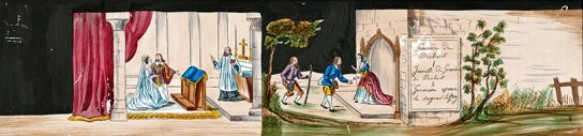
brabant_slides

Source: Marcel Proust, À la recherche du temps perdu: 1 – Du côté de chez Swann (1913), translated by C.K. Scott Moncrieff and Terence Kilmartin as Remembrance of Things Past (Harmondsworth: Penguin, 1983), vol. 1, pp. 9-11

Text: At Combray, as every afternoon ended, long before the time when I should have to go to bed and lie there, unsleeping, far from my mother and grandmother, my bedroom became the fixed point on which my melancholy and anxious thoughts were centred. Someone had indeed had the happy idea of giving me, to distract me on evenings when I seemed abnormally wretched, a magic lantern, which used to be set on top of my lamp while we waited for dinner-time to come; and, after the fashion of the master-builders and glass-painters of gothic days, it substituted for the opaqueness of my walls an impalpable iridescence, supernatural phenomena of many colours, in which legends were depicted as on a shifting and transitory window. But my sorrows were only increased thereby, because this mere change of lighting was enough to destroy the familiar impression I had of my room, thanks to which, save for the torture of having to go to bed, it had become quite endurable. Now I no longer recognised it, and felt uneasy in it, as in a room in some hotel or chalet, in a place where I had just arrived by train for the first time.

Riding at a jerky trot, Golo, filled with an infamous design, issued from the little triangular forest which dyed dark-green the slope of a convenient hill, and advanced fitfully towards the castle of poor Geneviève de Brabant. This castle was cut off short by a curved line which was in fact the circumference of one of the transparent ovals in the slides which were pushed into position through a slot in the lantern. It was only the wing of a castle, and in front of it stretched a moor on which Geneviève stood lost in contemplation, wearing a blue girdle. The castle and the moor were yellow, but I could tell their colour without waiting to see them, for before the slides made their appearance the old-gold sonorous name of Brabant had given me an unmistakable clue. Golo stopped for a moment and listened sadly to the accompanying patter read aloud by my great-aunt, which he seemed perfectly to understand, for he modified his attitude with a docility not devoid of a degree of majesty, so as to conform to the indications given in the text; then he rode away at the same jerky trot. And nothing could arrest his slow progress. If the lantern were moved I could still distinguish Golo’s horse advancing across the window-curtains, swelling out with their curves and diving into their folds. The body of Golo himself, being of the same supernatural substance as his steed’s, overcame all material obstacles — everything that seemed to bar his way — by taking it as an ossature and embodying it in himself: even the door-handle, for instance, over which, adapting itself at once, would float irresistibly his red cloak or his pale face, never losing its nobility or its melancholy, never betrayed the least concern at this transvertebration.

And, indeed, I found plenty of charm in these bright projections, which seemed to emanate from a Merovingian past and shed around me the reflections of such ancient history. But I cannot express the discomfort I felt at such an intrusion of mystery and beauty into a room which I had succeeded in filling with my own personality until I thought no more of it than of myself. The anaesthetic effect of habit being destroyed, I would begin to think – and to feel – such melancholy things. The door-handle of my room, which was different to me from all the other door-handles in the world, inasmuch as it seemed to open of its own accord and without my having to turn it, so unconscious had its manipulation become – lo and behold, it was now an astral body for Golo. And as soon as the dinner-bell rang I would run down to the dining-room, where the big hanging lamp, ignorant of Golo and Bluebeard but well acquainted with my family and the dish of stewed beef, shed the same light as on every other evening; and I would fall into the arms of my mother, whom the misfortunes of Geneviève de Brabant had made all the dearer to me, just as the crimes of Golo had driven me to a more than ordinarily scrupulous examination of my own conscience.

A Combray, tous les jours dès la fin de l’après-midi, longtemps avant le moment où il faudrait me mettre au lit et rester, sans dormir, loin de ma mère et de ma grand’mère, ma chambre à coucher redevenait le point fixe et douloureux de mes préoccupations. On avait bien inventé, pour me distraire les soirs où on me trouvait l’air trop malheureux, de me donner une lantern e magig ne. dont, en attendant l’heure du dîner, on coiffait ma lampe; et, à l’instar des premiers architectes et maîtres verriers de l’âge gothique,”) elle substituait à l’opacité des murs d’impalpables irisations, de surnaturehes apparitions multicolores, où des légendes étaient dépeintes comme dans un vitrail vacillant et momentané. Mais ma tristesse n’en était qu’accrue, parce que rien que le changement d’éclairage détruisait l’habitude que j’avais de ma chambre et grâce à quoi, sauf le supplice du coucher, elle m’était devenue
supportable. Maintenant je ne la reconnaissais plus et j’y étais inquiet, comme dans une chambre d’hôtel ou de «chalet» où je fusse arrivé pour la première fois en descendant de chemin de fer.

Au pas saccadé de son cheval, Golo, plein d’un affreux dessein, sortait de la petite forêt triangulaire qui veloutait d’un vert sombre la pente d’une colline, et s’avançait en tressautant vers le château de la pauvre Geneviève de Brabant. Ce château était coupé selon une ligne courbe qui n’était guère que la limite d’un des ovales de verre énagés dans le châssis qu’on glissait entre les coulisses de la lanterne. CCe n’était qu’un pan de château, et il avait devant lui une lande où rêvait Geneviève, qui portait une ceinture bleue. Le château et la lande étaient jaunes, et je n’avais pas attendu de les voir pour connaître leur couleur, car, avant les verres du châssis, la sonorité mordorée du nom de Brabant me l’avait montrée avec évidence. Golo s’arrêtait un instant pour écouter avec tristesse le boniment lu à haute voix par ma grand’tante, et qu’il avait l’air de comprendre parfaitement, conformant son attitude, avec une docilité qui n’excluait pas une certaine majesté, aux indications du texte; puis il s’éloignait du même pas saccadé. Et rien ne pouvait arrêter sa lente chevauchée. Si on bougeait la lanterne, je distinguais le cheval de Golo qui continuait à s’avancer sur les rideaux de la fenêtre, se bombant de leurs plis, descendant dans leurs fentes. Le corps de Golo lui-même, d’une essence aussi surnaturelle que celui de sa monture, s’arrangeait de tout obstacle matériel, de tout objet gênant qu’il rencontrait en le prenant comme ossature et en se le rendant intérieur, fût-ce le bouton de la porte sur lequel s’adaptait aussitôt et surnageait invinciblement sa robe rouge ou sa figure pâle toujours aussi noble et aussi mélancolique, mais qui ne laissait paraître aucun trouble de cette transvertébration.

Certes je leur trouvais du charme à ces brillantes projections qui semblaient émaner d’un passé mérovingien et promenaient autour de moi des reflets d’histoire si anciens. Mais je ne peux dire quel malaise me causait pourtant cette intrusion du mystère et de la beauté dans une chambre que j’avais fini par remplir de mon moi au point de ne pas faire plus attention à elle qu’à lui-même. L’influence anesthésiante de l’habitude ayant cessé, je me mettais à penser, à sentir, choses si tristes. Ce bouton de la porte de ma chambre, qui différait pour moi de tous les autres boutons de porte du monde en ceci qu’il semblait ouvrir tout seul, sans que j’eusse besoin de le tourner, tant le maniement m’en était devenu inconscient, le voilà qui servait maintenant de corps astral à Golo. Et dès qu’on sonnait le dîner, j’avais hâte de courir à la salle à manger, où la grosse lampe de la suspension, ignorante de Golo et de Barbe-Bleue, et qui connaissait mes parents et le bœuf à la casserole, donnait sa lumière de tous les soirs, et de tomber dans les bras de maman que les malheurs de Geneviève de Brabant me rendaient plus chère, tandis que les crimes de Golo me faisaient examiner ma propre conscience avec plus de scrupules.

Comments: Marcel Proust (1871-1922) was a French novelist, known for À la recherche du temps perdu which was published in seven parts between 1913 and 1927. The medieval legend of Geneviève de Brabant tells of a wronged nobleman’s wife who is accused of adultery with the treachorous Golo. She escapes execution and hides in a cave for some years, before being discovered by her husband and reinstated. The story has been made the subject of plays, operas and films. The Merovingians were a dynasty of French kings. The close relationship between Proust’s own childhood and that of the narrator in his novel places this incident in the 1870s.

Links: Magic lantern slides depicting the story of Geneviève de Brabant at the Cinémathèque française (illustrated above)

Kinomatograph in Paris

Source: Max Brod, extracts from ‘Kinomatograph in Paris’, Der Merker vol. 3 no. 1 (February 1912): pp. 95-98, reproduced in part in Hanns Zischler, Kafka Goes to the Movies (Chicago/London: University of Chicago Press, 2003), pp. 47-51, translation by Susan H. Gillespie

Text: On the very evening that we had set aside as a night off, after so many nocturnal exertions, for a modest meal in the four walls of our hotel and early to bed, we chanced upon a doorway on the boulevard, decked out with little electric light bulbs and a not exactly energetic barker, whose cap, however, bore a title that attracted us more magically than all his words could have. Omnia Pathé … So here we are stood at the source of so many of our enjoyments, once more at the center of a business whose rays shone so powerfully over the whole world that one would almost rather not believe in the existence of a center – a feeling, by the way, that was typical for our Parisian mood; for powerful central firms, (like Pneu Michelin, Douçet, Roger Gallet, Clement Bayard, etc.) besiege the heart of the newcomer with surprising force. We again dispensed with the night off (damned city!) and went in.

It is hard for one darkened hall to differentiate itself from other darkened halls. But for us, who are always firmly set on finding in everything Parisian something special and better than anyplace else, we are soon struck by the spaciousness – no, that’s not it yet – then, that people are disappearing through a dark doorway in the background and a cool draft seems to regulate this continuous movement of the audience – no, that’s how it is at home, too, uninterrupted showings, an entrance and an exit door – but now we feel we are on firmer ground. This freedom of people to be able to position themselves anywhere there is room, even in the aisle between the rows of benches, even on the ramp next to the apparatus, is something decidedly republican, any police force other than the Parisian police would not approve of it. Equally republican, we must admit, is the freedom of the many columns in the hall to be allowed to disturb the audience’s view in whatever way they please …

A girl in the uniform of a soldier in an operetta, on the cap, this time, the ambiguous inscription “Omnia,” accompanies us to our seats, sells us an (according to good Parisian custom, inexact) program. And already we are under the spell of the blindingly white, trembling screen in front of us. We nudge each other. “Say, the show is better here than at home.” Naturally, after all, in Paris everything has to be better.

[Brod describes some of the film programme, including travel films]

We saw, indeed we saw a great deal – by analogy to the Comédie, which puts eight acts on stage almost without intermission. We saw the doctor visit the poor sick child and turn around melodramatically several times in the doorway, with a distinctly pitying expression. We saw the mercifulness of some English king or other, hand-colored, sandwiched between some theatrical armor and a ruin (which had been created from a burned-out suburban cottage), enjoying life.

[…]

At the end , after the usual revolver shots, chases, fisticuffs, came the news. Naturally she was not absent – the one you now see on all the advertisements, candy boxes, and postcards in Paris: Mona Lisa. The picture opened with the presentation of M. Croumolle (everyone knows that it means “Homolle,” and no one protests against the perfidious way they are going after the gray-haired Delphi scholar). Croumolle is lying in bed, his stocking cap pulled down over his ears, and is startled out of sleep by a telegram: “Mona Lisa Stolen.” Croumolle – the Delphi scholar, if you please, but I am not protesting, I was laughing so hard – dresses himself with clownlike agility, now he puts both feet into one leg of his pants; now one foot into two socks. In the end, he runs into the street with his suspenders trailing, all the bystanders turn around to look at him, even those who are far in the background and evidently not in the pay of Pathé … It is a longing that ever since the emergence of the cinema lives on in me with the force of my early childhood wishes – I would like just once, by chance, to turn a street corner where such a staged cinematographic scene is taking place. What wouldn’t it be possible to improvise there! And in any case, what a sight! But to continue. The story is set in the hall of the Louvre, everything excellently imitated, the paintings and, in the middle, the three nails on which the Mona Lisa is hung. Horror; summoning of a comical detective; a shoe button of Croumolle’s as red herring; the detective as shoeshine boy; chase through the cafés of Paris; passers-by forced to have their shoes shined; arrest of the unfortunate Croumolle, for the button that was found at the scene naturally matches his shoe buttons. And now the final gag – while everyone is running through the hall at the Louvre and acting sensational, the thief sneaks in, the Mona Lisa under his arm, hangs her back where she belongs, and takes Velázquez’s Princess instead. No one notices him. Suddenly someone sees the Mona Lisa; general astonishment, and a note in one corner of the rediscovered painting that says, “Pardon me, I am nearsighted. I actually wanted to have the painting next to it.” … Croumolle, poor man, is released.

[…]

Then, in addition, the Journal Pathé. And so that everything quite resembles a newspaper, the title page and “Year III” are solemnly projected beforehand. We see demonstrations against inflation in France, which look like they have been arranged by Pathé; everyone is grinning in the direction of the audience. …

Comments: Max Brod (1884-1968) was a Czech author, best known as the friend and literary executor of Franz Kafka. His essay ‘Kinomatograph in Paris’ describes a visit to the Omnia Pathé cinema in Paris made by Brod and Kafka on 10 September 1911. The Mona Lisa was stolen from the Louvre on 21 August 1911. The Pathé film company rapidly issued Nick Winter et le vol de la Joconde (Nick Winter and the Theft of the Mona Lisa) the following month, as a title in its ‘Nick Winter’ detective series. Théophile Homolle (parodied in the film as Croumolle) was the director of the Louvre. Brod and Kafka had visited the Louvre the day before to witness the scene of the crime. The painting was recovered in 1913. The Omnia Pathé luxury cinema was the first cinema in the Pathé circuit to be in opened in Paris, in 1906.

Links: Copy of full original article (in German) at Hathi Trust

The Crowd at the Cinematograph

Source: Jules Romains, ‘La Foule au cinématographe’ [The Crowd at the Cinematograph], Les Puissances de Paris (Paris: Eugène Figuière, 1911), pp. 118-120, reproduced and translated in Richard Abel (ed.), French Film Theory and Criticism: a History/Anthology, 1907-1939 (Princeton, N.J.: Princeton University Press, 1988), vol. 1, p. 53

Text: The lights go down. A cry escapes from the crowd and immediately is taken back. It begins much like the great clamour which dying throngs have wailed into the night down through the centuries. These people are creatures who love the daylight. Their kind emerged from the compressing and transforming power of light. But the night of the cinema is far from long. They scarcely have time to suspect their death and the happiness of imperishable feeling; they are like swimmers who plunge their heads underwater and then keep their eyelids and lips and teeth tightly clenched, in order to experience a discomfort, an oppression, a suffocation, and then suddenly burst back through the surface into life.

A bright circle abruptly illuminates the far wall. The whole room seems to sigh, “Ah!” And though the surprise simulated by this cry, they welcome the resurrection they were certain would come.

The group dream now begins. They sleep; their eyes no longer see. They are no longer conscious of their bodies. Instead there are only passing images, a gliding and rustling of dreams. They no longer realize they are in a large square chamber, immobile, in parallel roads as in a ploughed field. A haze of visions which resemble life hovers before them. Things have a different appearance than they do outside. They have changed color, outline, and gesture. Creatures seem gigantic and move as if in a hurry. What controls their rhythm is not ordinary time, which occupies most people when they are not dreaming. Here they are quick, capricious, drunken, constantly skipping about; sometimes they attempt enormous leaps when least expected. Their actions have no logical order. Causes produced strange effects like golden eggs.

The crowd is a being that remembers and imagines, a group that evokes other groups much like itself – audiences, processions, parades, mobs in the street, armies. They imagine that it is they who are experiencing all these adventures, all these catastrophes, all these celebrations. And while their bodies slumber and their muscles relax and slacken in the depths of their seats, they pursue burglars across the rooftops, cheer the passing of a king from the East, or march into a wide plain with bayonets or bugles.

Comment: Jules Romains (1885-1972) was a French poet, novelist and creator of the Unanimism literary movement. He later wrote a ‘cinema-novel’ that attempted to combine the two artforms, Donogoo-Tonka ou Les Miracles de la science: conte cinématographique (1920). The impression of the projected image as a circle comes from knowledge of magic lantern practice, and is a mistake reproduced in several illustrations of film shows from this period.

A Life in Movies

Source: Michael Powell, A Life in Movies: An Autobiography (London: William Heinemann, 1986), pp. 90-91

Text: There was a cinema at Chantilly. There were local cinemas everywhere in those days. Chantilly was not a large town, but I think it had two. The one near us was down a side street and advertised that it was open for business by an electric buzzer which rang until the show started. I can hear that remorseless bell shattering the calm under the plane trees whenever I think of Chantilly. It is curious how the French, most sensitive of nations, are insensitive to noise, particularly if it is a new and splendid noise that stands for Progress.

The films were mostly serials, like the French films I had seen at the Palais de Luxe in Canterbury. One of my earliest movie images is of Fantomas, the Master Crook of Paris. When he wasn’t wearing white tie and tails, a can, a top hat, and an opera-cloak, he was in black tights with a black mask, performing incredible feats of hide-and-seek with the police. The image that stays with me is of an open cistern of water in the attic of some house. The police dash in, in pursuit of Fantomas, and find nobody. Baffled, they withdraw, but the Chief takes one last look at the cistern, sees a straw floating on the surface of the water, gives it an idle flush. Aha! we all think. And sure enough! As the last policeman goes, the water stirs and bubbles and the black form of Fantomas appears from the depths, between his lips the straw through which he has been breathing! I can see now his black figure, glistening like a seal’s, smiling triumphantly at the camera. For, in silent films, one learnt to “register” to the camera.

Candy and the movies have always gone together, and in the intervals at Chantilly girls moved up and down the aisle chanting “pochettes surprises!esqimaubriques!” There were frequent intervals. In 1919 most films were short comedies. In addition they were playing an interminable serial in fifteen episodes of The Three Musketeers, and there was another serial staring the famous French boxer Georges Carpentier. I believe that d’Artagnan was Aimé Simon-Girard, and as a movie historian I ought to check it with the dates, but I really don’t think it matters. Aimé Simon-Girard was in practically every romantic French costume film of that decade and the Musketeers serial may have been a year later. The Carpentier film I remember well. He was not an actor of any kind, but he was charming, and his flattened nose on his pretty face gave him a different look. The film was full of stunts, of course. All serials had to be full of stunts: jumping on and off moving trains. onto moving automobiles, flights on the edge of high buildings, all the tricks of the trade, from Georges Méliès to Superman. Carpentier moved obligingly (he had a pleasant smile) through the scenes, and we all thought he was splendid. Films were tinted then: the predominant colour of the Carpentier serial seemed to be green. The Musketeers did their stuff in a sort of Old Master yellowish-brown, suitable for cloak and rapier adventures. Night scenes, of course, were blue.

Comment: Michael Powell (1905-1990) was a British film director. His family stayed for a time immediately after the First World War at Chantilly in France, where his father had a share in a hotel. Les Trois Mosquetaires with Aimé Simon-Girard was made in 1921; the Georges Carpentier serial is probably Le trésor de Kériolet (France 1920).

Louis Olivier to Louis Lumière

Source: Louis Olivier, in Jacques Rittaud-Hutinet (ed.), Letters: Auguste and Louis Lumière (London: Faber and Faber, 1995), translation by Pierre Hodgson, pp. 21-22

Text: Paris, 13 July 1895

Dear Sir,

I am writing to thank you once more for the enchanting evening you gave me and my friend last night. Wherever I was yesterday and again this morning, people said what a brilliant session it was, and how enthusiastic the audience was, as you know from the extent of the applause. We were delighted to discover these marvels, never before seen in Paris. I am sure that they will spread throughout the country.

I am most grateful to you for having given my guests a preview of this fine show which is an important landmark in the story of the photographic sciences. Allow me to compliment you, you and your brother, on the magnificent results you have obtained and to express the pleasure which I ex[p]erienced on viewing them.

Further, I enclose all the letters I received in response to my invitations, filed according to whether they are acceptances or not. Several people who said they would come did not and others who did not reply, did come. The entire Bouvier dinner came as a gang. All in all, about one hundred and fifty people probably passed through the rooms where the projection was held on Thursday night. A pleasure for everyone.

Yours etc.

Louis Olivier

Comment: The Cinématographe Lumière was shown to the Revue Générale des Sciences Pure et Appliquées in Paris on 11 July 1895. The films exhibited were La Voltige, Un Incendie, Les Forgerons, Place des Cordeliers, Répas de Bébé and Pêche aux Poissons Rouges. This was its fifth showing to private audiences. Other private shows followed before the first commercial screening on 28 December 1895.