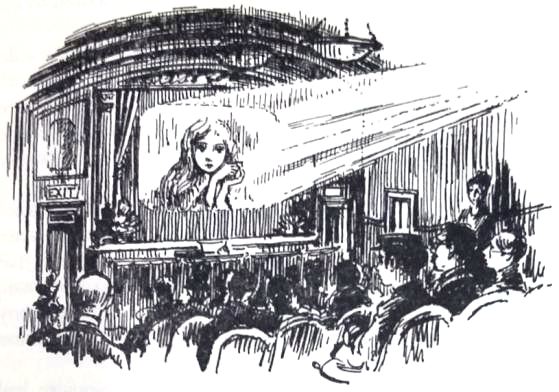
Source: Terry Staples, All Pals Together: The Story of Children’s Cinema (Edinburgh: Edinburgh University Press, 1997), p. 233
Text: Living as kids in rural Wiltshire, we never had a chance to go to a cinema there. But every summer we were packed off to our grandparents in Falkirk, and they sent us to the ABC every Saturday morning. In my memory of what I saw in those years cinema and telly are all mixed up, but I remember the atmosphere of the cinema clearly enough. There seemed to be hundreds and hundreds in the Falkirk ABC, and a lot of excitement and enthusiasm, but I don’t think things were being thrown around. It was lively, but not rowdy. At home in Wiltshire we watched telly on Saturday mornings – Tiswas or Swap Shop – and doing that I felt essentially alone. In Falkirk I was part of a crowd. I’d get dressed for the ABC, but not for the telly. The queuing and the anticipation were much more exciting than just walking across the room to turn on the telly. We bought lollipops or liquorice or toffees at the cinema, or we might have taken our own tablet (a very sweet kind of fudge, peculiar to Scotland). For us, the cinema was full of strangeness, specialness and fun.
Comments:All Pals Together is a history of children’s cinema in the UK. It contains many evocative memoir passages such as this, mostly conducted for the book, though they are uncredited (there is a list of the names of the interviewees given at the front of the book). The unnamed interviewee here was a member of the ABC Minors club, to which many cinemagoing children belonged. Tiswas (ITV, 1974-1982) and Multi-Coloured Swap Shop (BBC, 1976-1982) were two highly popular children’s television programmes shown on Saturday mornings. They are generally seen as having played a major part in bringing about the long tradition of children’s cinema in the UK to an end.
Source: Worton David and Ralph Penso, ‘Oh Joe! I Want To Go To the Picture Show’, c.1910, sung by Harry Bluff, lyrics via http://monologues.co.uk/musichall/Songs-O/Oh-Joe-Picture-Show.htm
Text:
Mooning and spooning was Flo’s delight
So to her sweetheart she said one night
‘I wish you’d take me the pictures to see
At the bioscope show,’ but he
Said, ‘I fail to see where the fun comes in, dear.’
Then Flo with a sigh to her sweetheart drew near
And whispered these words in his ear:
‘Oh Joe, I want to go to the Picture Show
The fun you’re sure to see
If you squeeze close up to me
Oh Joe, don’t say ‘No’
For it’s sure to make you grin
And you’ll see no doubt, when the lights go out
Where the fun comes in.’
Off to the pictures Joe went that night
But the first picture gave him a fright
There on the screen was a picture of Joe
With a girl, and that girl wasn’t Flo
Flo cried, ‘You old Bluebeard! that picture explain.’
Then fainting away with excitement and strain
She murmured these words once again:
‘Oh Joe, I want to go to the Picture Show
The fun you’re sure to see
If you squeeze close up to me
Oh Joe, don’t say ‘No’
For it’s sure to make you grin
And you’ll see no doubt, when the lights go out
Where the fun comes in.’
Joe tried his best to explain away
That ‘girl in the picture’ to Flo next day
‘I’ve never flirted,’ said he, ‘On my life
For that girl, dear, was only – my wife.’
‘Your w-w-w-wife? are you married?’ Flo cried
Said he, ‘Well, I was dear, but as my wife died
I’m a widower.’ then Flo replied:
‘Oh Joe, I want to go to the Picture Show
The fun you’re sure to see
If you squeeze close up to me
Oh Joe, don’t say ‘No’
For it’s sure to make you grin
And you’ll see no doubt, when the lights go out
Where the fun comes in.’
Comments: Hubert Worton David was a prolific British writer of musical songs and monologues, some of them written by Ralph Penso. ‘Oh Joe! I Want To Go To the Picture Show’ is most closely associated with the performer Arthur Reece, but in the above recording is sung by Harry Bluff (real name Léonce Charles Bluff). My thanks to Nick Hiley for bringing this song to my attention.
Source: ‘Robin Goodfellow’, ‘The Value of the Cinema’, Cambridge Daily News, 30 August 1919, p. 4
Text: Anyone who doubts the value of the cinema in teaching history and instilling patriotism in the growing generation ought to make a point of seeing the film depicting the life story of Nelson, which was shown at the Playhouse during the early part of the week. No school lesson however interesting, could “grip” the boy or girl in the same way that this wonderful picture did the crowds of youngsters this week. It did one’s heart good to hear them cheer as one after another the outstanding events in the life of the great hero were flashed upon the screen. The schoolchildren of today are evidently taught more about the country’s naval battles than when I went to school, for a little chap sitting behind me the other evening was well up in his facts, and shouted with eagerness at the first mention of any of the engagements, little and big, in which the immortal Nelson took part. He knew his characters well, too, for Napoleon – “Old Bony”, as he irreverently termed him – came in for a full share of hisses whenever he was shown. The young folks were not quite so well acquainted with “the lady in the case” – who was Lady Hamilton? a bright looking schoolboy asked me – but that is as it should be. “Emma’s” part in the story was very cleverly and tactfully handled by the producer. I have only one fault to find with the cinema productions of to-day, and that is the shocking spelling one frequently sees in the introductory lines explaining the pictures. There was nothing wrong with this in respect with the Nelson film, but just before, following some excellent pictures of a daring flight through the Arc de Triomphe, a photo was shown of the “interprid” airman. This is not an isolated instance, by any means. I have noticed it repeatedly in different films. A little more care in this work would vastly improve matters.
Comments: ‘Robin Goodfellow’ (a pseudonym) wrote a column ‘Table Talk’ for the Cambridge Daily News, from which this account derives. The British feature film Nelson (1918) was directed by Maurice Elvey for Master-International Exclusives. The French aviator Charles Godefroy flew through the Arc de Triomphe in Paris on 7 August 1919. My thanks to Lucie Dutton for bringing this piece to my attention.
Our eunuch dreams, all seedless in the light,
Of light and love the tempers of the heart,
Whack their boys’ limbs,
And, winding-footed in their shawl and sheet,
Groom the dark brides, the widows of the night
Fold in their arms.
The shades of girls, all flavoured from their shrouds,
When sunlight goes are sundered from the worm,
The bones of men, the broken in their beds,
By midnight pulleys that unhouse the tomb.
II
In this our age the gunman and his moll
Two one-dimensional ghosts, love on a reel,
Strange to our solid eye,
And speak their midnight nothings as they swell;
When cameras shut they hurry to their hole
down in the yard of day.
They dance between their arclamps and our skull,
Impose their shots, showing the nights away;
We watch the show of shadows kiss or kill
Flavoured of celluloid give love the lie.
III
Which is the world? Of our two sleepings, which
Shall fall awake when cures and their itch
Raise up this red-eyed earth?
Pack off the shapes of daylight and their starch,
The sunny gentlemen, the Welshing rich,
Or drive the night-geared forth.
The photograph is married to the eye,
Grafts on its bride one-sided skins of truth;
The dream has sucked the sleeper of his faith
That shrouded men might marrow as they fly.
IV
This is the world; the lying likeness of
Our strips of stuff that tatter as we move
Loving and being loth;
The dream that kicks the buried from their sack
And lets their trash be honoured as the quick.
This is the world. Have faith.
For we shall be a shouter like the cock,
Blowing the old dead back; our shots shall smack
The image from the plates;
And we shall be fit fellows for a life,
And who remains shall flower as they love,
Praise to our faring hearts.
Comments: Dylan Thomas (1914-1953) was a Welsh poet. ‘Our Eunuch Dreams’ was included in his first published collection of poems, in 1934. He later scripted films for the Ministry of Information. The phrase ‘The Dream That Kicks’ has been used for a book on cinema by Michael Chanan and a 1986 television history of Welsh cinema.
Source: Mrs Cecil Chesterton, In Darkest London (New York: The Macmillan company, 1926), pp. 186-187
Text: We did some business together. I made a shilling or two, and then my friend suggested we should go to a cinema, she standing treat. Now I have never been keen on films, except when Charlie Chaplin is on the screen, and I felt quite indifferent at the prospect of such enjoyment. She took two of the cheaper seats in a house near Shaftesbury Avenue, and I waited for the show to begin, quite incurious and even depressed. It was a story of the conventional type, in which a poor girl becomes a leader of society, following a round of luxurious enjoyment, but I found myself suddenly watching the pictures with eagerness, positive pleasure! I dwelt with rapture on her dinner with the hero in an expensive restaurant. I noted with extraordinary precision everything she ate. I enjoyed with her the roses he bought, and thrilled to the music the orchestra was playing. I would not have missed an inch of film. I would not have forfeited any one of the thousand mechanical sensations she enjoyed. It was not until it was all over that I asked myself why this change had come about, why it was that I, and the people in the cheap seats around me, had been wrought up to such excitement, almost ecstasy.
And then the solution came. When you are hungry and cold, without a home and without hope, the “Pictures” warm your imagination, heat your blood and somehow vitalise your body. The blank shutters that hem you in from enjoyment are suddenly down, and you look into a world of light and colour, expectancy and romance — that eternal longing for romance which dies so hardly. This is one of the things that I discovered in my experience. For the same reason this is, I think, why the inhabitants of drab homes in mean streets flock to the cinema. I do not think it has any educational value, nor does it generally stimulate the imagination. But it supplies a lack, and to those whose horizon is bounded by the four walls of a room, badly distempered, or hideously papered, the contemplation of the garish hotel, the spacious restaurant, or impossible heroines of the screen is compensation. This also accounts, I suppose, for the unending supply of this kind of picture. Commerce always caters for a steady public, and while the taste of the artistic is soon surfeited, the intelligence of the thinking easily annoyed, the vast residuum of the patient poor, who unendingly bear the burden of monotony, is a sure and certain market in a world of shifting values.
Comments: Ada Chesterton (1869-1962), who wrote as Mrs Cecil Chesterton, was a British journalist and philanthropist. She was married to the brother of the author G.K. Chesterton. Her book of social investigation, In Darkest London, was based on a series of newspaper articles on the life of London’s poor.
Source: Extract from interview with Jean McKillop, C707/306/1-2, Thompson, P. and Lummis, T., Family Life and Work Experience Before 1918, 1870-1973 [computer file]. 7th Edition. Colchester, Essex: UK Data Archive [distributor], May 2009. SN: 2000, http://dx.doi.org/10.5255/UKDA-SN-2000-1
Text: Q. What about cinemas?
A. Mm hm, they – we used to go to – the cinema and you sat on a wooden seat. And -when we were young and – you paid a cop – copper to get in. Sometimes we’d – we’d to take a jam jar back to the – grocers, Galbraith’s the grocer, and get a ha’penny on it to get into – the pictures. Mm hm.
Q. Was that a matinee?
A. Uh huh. Matinee. And then we used to go – my chum and I used to go to – any – shoemakers shops and they would be showing the bill – for the pictures, and they always had passes. And we used t o get a pass off them and away to the pictures for nothing.
Q. Because your father was a shoemaker himself?
A. No, just – we just asked them. Uh huh.
Q. Why did shoemakers get the passes, do you know?
A. They were just advertise it for them. A lot of shops did but – mostly – these were shoemakers shops tha t did it. And if they had any passes they would give you them. Mm hm.
Comments: Mrs Jean McKillop (1894-??) was one of seven children, daughter of a Glasgow shoemaker. She was one of 444 people interviewed by Paul Thompson and his team as part of a study of the Edwardian era which resulted in Thompson’s book The Edwardians: The Remaking of British Society (London: Weidenfeld and Nicolson, 1975).
Source: Clive James, Play All: A Bingewatcher’s Notebook (New Haven/London: Yale University Press, 2016), pp. 43-44
Text: The natural modus operandi of the binge watcher, having selected Play All in order to view a whole bunch of episodes on a disc, is to skip through the standard opening title sequence on each episode, especially when watching a show for the second or third time. But for at least two shows I have never done this, and have always watched the title sequence right through. One is The Sopranos, where the opening music – a piece of British rock and roll, oddly enough – is perpetually renewable in its pulse and color. The cutting from skyline to skyline of the drive through New Jersey seems part of the score, and you get to know its every bar so well that you know exactly where the twin towers should have been when they disappeared after the 9/11 disaster. The other is Band of Brothers. The opening sequence is so authoritative that Lucinda and I watch the whole thing every time. We are agreed that the way the stills and slo-mo clips are matched to the music couldn’t be improved, and that the music is uncannily beautiful. Thus the range of tragic lyricism in which the young men, the airborne brothers in arms, will risk their lives together in combat, and some will die and some will not, is established at the start of each episode. For my generation, who were infants when our fathers left us behind at home and went away to fight, this pictured music, or musical picture, is intensely recognizable, as deeply serious as something so aesthetically satisfactory could be. But I was surprised to find that Lucinda felt the same. Her knowledge of World War II is all from books – Anthony Beevor’s book The Battle of Stalingrad was her idea of a birthday present – but it is detailed and nuanced, and her standards of authenticity are high. It was from her reaction, not my own, that I reached a proper measure of the show’s success in transmitting, without dilution or trivilization, the texture of the past into the future.
Comments: Clive James (born 1939) is an Australian broadcaster, critic, poet and essayist. Play All is a collection of essays on the ‘boxed set’ phenomenon of television series viewable as DVD sets or through online video services. Lucinda is his daughter, and he lives in Cambridge. Band of Brothers (2001) was a ten-part American miniseries depicting the experiences of an American battalion in Europe during the Second World War. The Sopranos (1999, pilot episode 1997) was an 86-part, six season American series about the American mafia.
Source: Jennie Erdal, Ghosting: A Memoir (Edinburgh: Canongate, 2004), pp. 110=111
Text: In September 1992, a few weeks after her ninetieth birthday, Leni and Horst came to London to mark the publication of her memoirs in English. I picked them up at Heathrow and took them to their suite in the Mayfair Hotel. She had agreed to do a number of interviews – against Horst’s advice. He was cynical about journalists and very protective of her. ‘They’re all against her,’ he said. ‘They will destroy her.’
She got a mixed reception, and the questions were tough and often offensive. But she answered them sensitively and with dignity, especially on the subject of the responsibility of the artist. She insisted she was ignorant of atrocities and pleaded guilty only to irredeemable naïvety. By the end of the week she was exhausted, and during an interview at the BBC, on being asked yet again about the nature of her friendship with Hitler, and if they had been lovers, she broke down and wept. When we left the studio Horst was waiting outside, clearly furious about the grilling. He took her gently in his arms and held her till she recovered.
The launch party was held at the Museum of the Moving Image on the South Bank, an appropriate venue for someone who had changed the face of film-making. Earlier at the hotel she had laid out clothes on the bed and wanted me to help choose an outfit for the evening. ‘Wie sehe ich aus? – How do I look?’ she asked when I went to pick her up later. She was wearing a silk dress in black and gold, a fur-trimmed jacket and sensational stilettos. ‘Stunning!’ I said. ‘The most elegant ninety-year-old I’ve ever seen.’ We had been laughing and I had meant it lightly, but she turned serious and told me that her longevity was a sort of curse: though she lived to be a hundred she would never be free of the burden of the past. ‘I’m too vain to wear my glasses,’ she said, so she held onto my arm as we went up the steps to the entrance of the Museum of the Moving Image. ‘Count out the steps for me – I want to hold my head high.’ As she entered the crowded room under piercing lights, there was a hushed silence. Adulation was in the air. For one evening at least she was among friends, people who simply admired her artistic excellence and had come to pay tribute. Tiger, resplendent in a blue silk suit with gold lining, made a theatrical salaam before her and kissed her jewelled hand. All round the walls there were giant screens playing Olympia, her film of the 1936 Berlin Olympics: breathtaking black and white shots of runners, pole-vaulters, and long exquisite sequences of divers flying through the air against a darkening sky, one image after another in slow motion like a tone poem. Artistic genius, or fascist celebration of the body beautiful? Whatever the truth – and we can never be absolutely certain – it is unlikely that she fully appreciated the significance of those moments in history in which she played such a prominent part. Perhaps she knew not what she was doing, only how to do it.
Comments: Jennie Erdal is a Scottish writer. Ghosting is a memoir of her time spent as ghostwriter to the publisher Naim Attallah (lightly disguised in the book as ‘Tiger’), whose Quartet Books published the memoirs of the documentarist and propaganda filmmaker Leni Riefenstahl, The Sieve of Time. The Museum of the Moving Image, located in London, closed in 1999.
Source: J.P. Mayer, Sociology of Film: Studies and Documents (London: Faber and Faber, 1946), p. 222
Text: Miss…
Personally I find a good movie story enriches my memory and have proved that the cinema has educated the community and films have gained far more recruits for literature than the stage ever succeeded in doing.
Also recently when the whole world looked dark after a particularly trying week of hard work, I dropped into a local cinema to see Cover Girl, I left feeling amazingly refreshed, tackled the necessary household duties, and then — I made over one of my very old dresses (inspired by a dress worn by the star) arranged my hair a la Hayworth, and faced the world with new pep! And thanked my lucky stars I was fortunate to be living in this film-mad generation.
Comments: J.P. (Jacob Peter) Mayer was a German sociologist at the London School of Economics. His Sociology of Film draws on a large amount of evidence gathered through questionnaires and submissions received through invitations published in Picturegoer magazine. The above comes from the section ‘The Adult and the Cinema’, for which responses were sought via Picturegoer in February 1945 to two questions: Have films ever influenced you with regard to personal decisions or behaviour? and Have films ever appeared in your dreams? The feature film Cover Girl (USA 1944) starred Rita Hayworth.
Source: Ursula Bloom, Youth at the Gate (London: Hutchinson, 1959)
Text: On Tuesday, August the fourth, when we were already halfway through the evening programme at the White Palace, Mr. Clements returned and started to talk again. He said that he wanted the national anthems of all countries who would be our allies to be played in a kind of pot-pourri at the end of the evening, ours as the final one.
I did not think it was a good idea. Already innumerable countries were involved, some with very long national anthems, and it would take a time to compose and to play, when all the audience asked was to be allowed to go home.
He looked at me with gaunt dark eyes on either side of a big nose which was like an eagle’s beak He was horribly worried, we knew that because his finger-nails were bitten to the quick (one of his nastier habits) and last week one of the girls had noticed that they were actually bleeding.
Mr. Clements was on the Stock Exchange (the cinema being merely a hobby), and with war coming he saw disaster ahead It is pathetic that at the time I did not realize that his wife had a daughter by a previous marriage to a German, a girl born deaf and dumb, and both of them were in agony lest Olga would be taken from them and put into a detention camp. I had never heard of such a place.
Earlier this evening Brooker the commissionaire had gone. A policeman had come for him, which alone caused some perturbation, but he was an old soldier on the Reserve. We wished him well, and those who could gave him something ‘for luck’, there seemed little time for goodbyes. This had brought the war considerably closer. Brooker, a very ordinary little man, who had never even been particularly brave with the drunks, suddenly glittered into something of a hero.
‘God only knows what’ll happen,’ said Mr. Clements in anxiety. ‘It’ll be the end of the world as we know it. One thing is certain, England’ll never be quite the same again.’
I was contemptuous. I thought he was cowardly, something to be despised in this moment of thrill. If we went to war (and oh, how I hoped we should!), England would rise with a glory never before achieved.
‘Maybe it’ll be nicer than you think?’ I suggested as I wrestled with ‘Poet and Peasant’ on the cottage piano.
‘You’re just a silly little girl! You don’t know a thing about it, and you’d better hold your tongue,’ he snapped, then swept out through the curtains, which at the start had been second-hand, leaving me with a haze of their dust and facing the nastier bits of ‘Poet and Peasant’.
The ‘Pathé Gazette’ flickered across the screen with pictures of the Reserves being called up, to be greeted with violent applause from the twopennies. A destroyer put out from Harwich harbour. A slide told the audience that so far – my tin clock told me it was nine o’clock, just before the ‘big picture’ – Germany had not replied to our ultimatum, and the twopennies booed.
The cinema darkened again, just above me lights played on to the screen, and the tin clock (one-and-sixpence) on the piano top began to tick away the last vital minutes of the old regime. At the dramatic moments of one’s life one does not recognize the tensity of emotional crisis. Sitting there playing for Mary Pickford was just another night in my life. No more.
When the end came I played the national anthems, but the audience did not stay, for they were eager to rush out and hear if we were really at war or not. Not yet. I closed the piano lid, and pushed the borrowed music into a box, for at all costs we had to keep that clean or the shop on Hollywell Hill wouldn’t take it back next Monday. I went through the deserted foyer, up shoddy stairs to where Teddy was waiting with his chocolate tray to get it checked. As nobody else came to do it, he and I achieved this together.
The two girl attendants pulled on coats which hung on a wall hook, the only attempt at a ladies’ room that we had. There was no lavatory of any kind and in emergencies one had to go up to the station which was a considerable way off. Any natural need of this kind was vulgar and could not be mentioned. Mother always said it was better than in the eighties when one was prepared to die rather than admit that nature could no longer contain itself, and some people had died, she vowed.
I went downstairs again into the foyer which advertised next week’s programme in big colourful posters to catch the eye. We should be running Les Miserables, a picture I had selected. Montie was waiting, in the green suit of the era, and with a stick.
‘Have we gone to war?’ I asked.
He didn’t know.
Comments: Ursula Bloom (1892-1984) was a highly-prolific British novelist. In her various memoirs, of which Youth at the Gate is only one, she provides detailed accounts of the time she spent as a pianist at the White Palace cinema in Harpenden, just before the First World War.