Cinematographs – Truth and Fiction

Source: ‘Cinematographs – Truth and Fiction’, The Times [London], 9 April 1913, p. 11

Text: At the present moment the popularity of picture palaces and the reason for it are directing a good deal of attention to the state of the public mind. But these sudden crazes are not new: 30 years ago it was croquet, 15 years ago it was cycling, ten years ago it was roller-skating. It seems that from time to time, like a person lying long in bed, we turn over and try a new position. Nevertheless, whenever it happens, the more thoughtful part of the race becomes alarmed, collects statistics, and wonders what this development, which it chooses to call backsliding, is caused by. We have lately been told that picture palaces are preventing us from going to church, from going to the theatre, from going to public houses, and from reading novels. On the other hand, we may find encouragement in the fact that the number of people who use works of reference is increasing.

One need not be thoughtful, or specially anxious about the future of the race, or a great believer in the value of statistics, and yet one may wonder as one walks down the Strand or Oxford Street or Tottenham Court Road why these excessively brilliant doorways which star the pavement at such short distances apart prove so irresistibly attractive. It is true that the management often provide tea for nothing, and the carpets are very thick, and the attendants as finely grown as Royal footmen, and all these things are good; but without such attractions, when the door is unlit and down a back street, and the seats are hard and the attendants meagre and peremptory, we go – we pay our sixpence, we sit there until the first picture begins to come over again, and directly the programme is changed, which is not as often as it should be, we pay our sixpence and go once more.

But what is the reason of it? Why do we invariably find the hall full of men and women, old, elderly and young, paying their sixpences, listening intently, going away and coming again? No doubt we are all feeling much the same thing, and we are driven to drop in by some such experience as this.

After trudging for an hour and a half in and out of tubes, shops, omnibuses, hard pavement for the feet, grey sky between the houses, wind blown, with uncharitable people to confront, there comes a moment when it is no longer to be borne. Whoever you are, whatever your tastes, you stop at some street corner and declare that you must immediately escape. The only question is whether it shall be to a church or to a picture gallery or to a publichouse [sic] or to a library. Each of these offers some kind of relief from the stony superficiality, the inhospitality, the impersonality of the street. Each offers some kind of resting room where you may recollect your human soul. At the same time each demands a certain effort, a certain chafing and stamping if one may so call it, before one is comfortably aglow. It is now that the lighted doorway presents itself. The picture palace offers immediate escape with the least possible expenditure of energy. You have only to lean back in a well-wadded chair, and you are floated upon some ambling dance tune down southern streets, or to the dusty jungle where the lion crouches, or to the centre of some public pageant, where merely to trace the expressions of the faces is to be in at the making of history. The street is only a few yards away, and five minutes ago you were cold and wind blown like the rest; but now that is nothing, or is a dream. You are now in the position most comfortable to man – sitting at ease, observing, speculating, ruminating, imagining, with hardly any trouble to yourself. All the work seems to be done for you. The marvellous way in which an illusion, strong enough to defeat circumstances, is created at once, without any effort of imagination, must be attributed chiefly to the fact that the picture moves. You never have time to be bored by one picture before it changes, becomes another picture, becomes not only a picture but a story, something which has a separate life of its own. Meanwhile you are being worked upon, as indifferent music that goes straight to the obvious emotion does work upon one, and made to feel without willing it rather more than is reasonable.

But this is only part of the secret, for the stream of traffic outside has no such power to please. A great part of the enchantment must lie in the fact that the most trivial scene – let us say a meet of coaches in Hyde Park – when cut off from its surroundings becomes for some queer reason significant, even emotional, as it seldom does in reality. Looking up from an arm-chair in a darkened room you see as you have never seen before. The horses and the women and the trees appear on the sheet as if they had nothing to do with the future or with the past, as if the whips would never descend, or the grooms swing up behind, or the horses trot off down the road to Richmond. Let alone the strange way in which isolating something from its context heightens the meaning, there is the sheer excitement and curiosity of the sights themselves. For the first time we see wild beasts creeping down to the pools to drink, or ice-fields grinding each other in the Polar sea. We might almost say that for the first time we see flowers unfolding and waves breaking on the beach.

Indeed the only grudge we have against the management of picture palaces is that they will go to any amount of trouble and expense in dramatizing romantic stories which take place, we believe, in cardboard castles in the outskirts of Paris, when the streets are full of pictures at once more comic, more tragic, and possessed of the incomparable recommendation that they are true. Suppose that, instead of inventing an improbable love story complicated by a couple of fierce brown bears in the Rocky Mountains, which has to be conveyed by trained actors carefully made up and craggy steeps that fail to convince, we had simply 12 o’clock yesterday in London, Paris, Moscow, Madrid, New York, Rome. The effect would be far more striking, and we must suppose a tenth part as expensive. Those half-dozen pictures of real people going about their businesses in real streets on different sides of the world, with all the little oddities and incidents that one would delight in detecting, would set up an image of the earth and mankind that would surpass all the lovers and all the bears in America.

The versions of famous novels and imaginary adventures which fill three-fourths of the programme appeal, of course, to our love of story-telling, and if they tend to be a little monotonous they have the advantage that moving pictures are simpler, quicker, more direct than the best printed prose can ever hope to be. Whether in this extraordinary greed of the eye we are to see reason for alarm or not, we do not know. We are inclined to expect that the eye in England has been rather cruelly starved. At the present moment, at any rate, it will take anything you choose to give it, as long as it moves quickly and is exactly like life. We are ready to look at places, people, animals, plants, waves, things that never happened, things that were written about, things that could no possibly happen anywhere. What the brain does with all this material it is difficult to say. Judging from personal experience, we should be inclined to believe that it remains quiescent during the greater part of the time, amused but not stimulated; that there are scattered moments of pure revelation; and, that, for the rest, a marvellous confusion reigns, a welter of music, of facts, of fiction, of forms. It is not life, it is not art, it is not music, it is not literature. Whether, all the same, we are fumbling towards some new form of art which is to have movement and shape, to be like life and yet to be selected and arranged as a work of art, who can say? In the meantime we have a fury for seeing and remain happy, greedy and terribly indiscriminate.

Comment: I write about the significance of this fascinating, anonymous article in ‘A Fury for Seeing: Cinema, Audience and Leisure in London in 1913′, Early Popular Visual Culture, vol. 6 no. 3 (November 2008) [available online through restricted academic services only]

Yesterday's Sunshine

Source: Verne Morgan, Yesterday’s Sunshine: Reminiscences of an Edwardian Childhood (Folkestone: Bailey Brothers and Swinfen, 1974), pp. 122-126

Text: The Moving Pictures, as we called them, first came to Bromley when I was about seven. They made their début at the Central Hall, and the performances took place on Friday nights. There were two houses, one at five o’clock for the children and one at seven for the grown-ups. The programmes lasted approximately one hour, and consisted of a succession of short films. Indeed some of them would last no longer than three or four minutes and there would be an appreciable wait in between while the man in the box got busy threading the next reel.

The Central Hall was a vast place with a huge gallery encircling it. It was used mostly for political meetings and the like, and quite often a band concert would be held there too. But it also had a pronounced ecclesiastical leaning and the man who owned it belonged in some way to the church and was avidly religious. He was an elderly man and wore pince-nez spectacles to which were attached a long black cord. He was a man of extremely good intentions and loved to stand upon the platform making long speeches spouting about them. Unfortunately, he had the most dreadful impediment and it was quite impossible to understand a word he said. But I well remember the enthusiastic claps he got when he eventually sat down, not because we had appreciated what he said so much as the fact that he had at last finished. The film programme could then begin.

The operating box was a temporary affair, and was perched up at the rear of the gallery. I used to get a seat as close to it as possible so that I could see how it was all done. The lighting was effected by a stick of black carbon, about the size of a piece of chalk, which lit up the small box with a brilliant blueish-white light and had a blinding effect if you looked right at it. Occasionally it would burn low and the operator would push it up a bit; this would be reflected by the density of light on the screen. The screen itself was also of a temporary nature, it was in fact little more than a large white sheet weighted at the bottom to keep it taut. Any movement close to it would cause it to wobble, and the picture would go a little peculiar. We were not critical of such minor details. The very fact that the picture moved was enough to satisfy us.

As each small reel was finished the operator would place it outside for re-winding, his box being of limited dimensions. On account of this I was able to study the technique as to how the pictures appeared to move. It was so simple I could hardly believe it. I told my Brother about it; I told my Mother about it; I told lots of people about it. But no one believed me. So, to prove myself right, I set about editing a film on my own account. I drew a succession of pictures in pencil on the bottom of a hymn book in church. Each one was just that little bit different, so that when the pages were flicked over the overall picture appeared to move. This technique, in ‘flicker’ form, has, of course, been used in many ways since then, but at the time it was entirely my own idea, and I was middling proud of it. I can’t say that anybody was particularly impressed, but at the time it thrilled me beyond description. In due course I pictorialised all the hymn books I could lay my hands on, during the sermon and other breaks in the church service. They consisted mostly of football matches with someone scoring a goal. Or it might be a boxing match with someone getting knocked out. Or an exciting race with a hectically close finish. Anything that inspired my sporting instincts was in course of time recorded in the hymn books of St. Luke’s Church, Bromley. I have often wondered since what the effect must have been on the boy who eventually took my seat in the choir pew when he found what he had inherited. I can only hope that he had as much enjoyment out of watching animated pictures as I had got out of drawing them.

The Central Hall was situated close to the top of Bromley Hill, nearly three miles from where we lived. It was a long walk for small legs, and there was no public transport at that time. Yet, whatever the weather, we never missed. Every Friday, shortly after school hours, a swarm of happy-faced youngsters were to be seen all heading in the same direction. The Central Hall had become the centre of a new culture. But, as yet, only the school kids had caught on to it.

Then quite suddenly, the Grand Theatre in Bromley High Street, which up till then had housed nothing more spectacular than stage dramas of the “Maria Marten” and “Sweeney Todd” kind, put up the shutters and announced that in future Moving Pictures would take over. They would be put on once nightly with a full programme of films. A new firm moved in calling itself Jury’s. The old Grand was given a face-lift and transformed into a picture house.

This was revolutionary indeed.

The grown-ups were sceptical. But the programmes were of a higher standard than those at the Central Hall, and would sometimes have a two-reeler as the star attraction. The films began to take on a more realistic angle, with interesting stories, love scenes, cowboys and Indians, exciting battles and lots of gooey pathos.

People began to go.

When they announced a showing of the famous story “Quo Vadis” in seven reels, all Bromley turned out to see it. Even my father condescended, and grumbled volubly because he had to “line up” to get it (the word “queue” had not yet come into circulation).

It was the beginning of a new era. Very soon a place was built in the High Street, calling itself a cinema. Moving pictures were firmly on the map, and shortly to be called films. We watched with astonishment as the new building reached completion and gave itself the high-flown title of “The Palaise [sic] de luxe”.

Most of us pronounced it as it was spelt, “The Palace de lux”, but my cousin Daisy, who was seventeen and having French lessons twice a week, pronounced it the “Palyay dee Loo”. And she twisted her mouth into all sorts of shapes when she said it.

That being as it may, the Palaise de Luxe put on programmes that pulled in the crowds from far and near, and it wasn’t long before they engaged a pianist to play the piano while the films were in progress. I remember him well. A portly gentleman who hitherto had earned a precarious living playing in local pubs. He soon got into his stride and began to adapt his choice of music to the particular film that was being shown. If it was a comedy he would play something like “The Irish Washerwoman”; if it was something sad, he would rattle off a popular number of the day like, “If your heart should ache awhile never mind”, and if it was a military scene, he would strike up a well-known march. The classic example came when a religious film was presented and we saw Christ walking on the water. He immediately struck up a few bards of “A life on the ocean wave”.

Later on, all cinemas worthy of the name included a small orchestra to accompany the films, and in due course, a complete score of suitable music would be sent with the main feature film so as to give the right effect at the right moment.

The Palaise de Luxe was indeed a palace as far as we were concerned. We sat in plush tip-up seats and there were two programmes a night. Further, you could walk in any old time and leave when you felt like it. Which meant, of course, that you could, if you so desired, be in at the start and watch the programme twice through (which many of us did and suffered a tanning for getting home late). It was warm and cosy, and there was a small upper circle for those who didn’t wish to mix!

The projector was discreetly hidden away behind the back wall up in the circle, and no longer could you see the man turning the handle. We became conscious for the first time of the strong beam of light that extended from the operating box to the screen. It was all so fascinating and mysterious. The screen, too, was no longer a piece of white material hanging from the ceiling, it was built into the wall, or so it appeared, and it was solid, so that no amount of movement could make it wobble.

It quickly became the custom to visit the cinema once a week. It was the “in” thing, or as we said in those days, it was “all the rage”.

We learnt to discriminate. My Brother and I became infatuated with a funny little man who was just that bit different from the others. His tomfoolery had a “soul” we decided, and whereas we smiled and tittered at the others comics, we roared our heads off with laughter whenever this one came on the screen. We went to a great deal of trouble to find out who he was, for names were not very often given in the early days.

“He’s called Charlie Chaplin”, the manager of the cinema told us, a little surprised no doubt that one so young could be all that interested.

Comment: Verne Morgan lived in Kent, and became a writer of pantomimes and theatre sketches. Palais de Luxe cinemas were a chain, run by Electric Theatres (1908) Ltd. Jury’s Imperial Pictures was a producer and distributor, but did not manage cinemas. The period described is the early to mid-1910s: the Italian film Quo Vadis was made in 1913 and Chaplin’s first films were released in 1914. The mention of a piano player being introduced suggests that the earlier screenings had been watched without musical accompaniment.

A History of the Development of Japanese Cinema

Source: Yamamoto Kajirō, quoted in Tanaka Jun’ichirō, Nihon eiga hattatsu shi [A History of the Development of Japanese Cinema] (Tokyo: Chūō kōronsha, 1975-1976), p. 282, reproduced in Joanne Bernardi, Writing in Light: The Silent Scenario and the Japanese Pure Film Movement (Detroit: Wayne State University Press, 2001), pp. 80-81

Text: It was around the time I entered the preparatory course at Keiō University … One spring afternoon, after skipping my last class, I took my habitual stroll through the Ginza … I thought about having a cup of coffee at the Café Paulista and was leisurely walking Milta slops when I saw a young man passing out handbills. They were made of cheap pink paper (probably the most inferior type) about the size of a postcard, but the printed message caught my ete: “The first film [eiga] made in Japan!” This catchphrase announced the opening of The Glory of Life, the first production of the Film Art Association and [the director and actors] were all active in the vanguard of the shingeki theatre movement … Ah, film! Just seeing that word made my heart race. A film had been made in Japan for the first time. Although there had been moving pictures [katsudō shashin] of shinpa melodramas and trick [ninjutsu] pictures there were as yet no films. But now, Japan had given birth to the long-awaited “film” that was just like that of America …

I immediately headed for the theater. This film, the greatest epoch-making event in the history of Japanese cinema, was opening in a small moving picture hall (movie theater) called the Toyotama theater … About two hundred people could fit in the narrow seats, but less than 10 percent of the spaces were taken by patrons scattered here and there.

It was the first Japanese film I had ever seen! Japanese titles of a modern design … close-ups and moving camera work, the actors’ faces untouched by elaborate stage makeup, the plain, unaffected presence of a real woman [“female flesh”]. and the slightly awkward yet straightforward and sincere acting. This was a genuine film. I cried like a baby in the darkness.

Yet somehow something was missing. The film was rooted in literature, and the acting lapsed into mannerisms from the stage. A true film would not be so crude. Surely film has a more pure, invulnerable, isolated beauty. I was impressed, but at the same time I burned with frustration and anger.

Comment: Yamamoto Kajirō (1902-1974) was a Japanese film director. He is recalling a screening of Kaeriyama Norimasa’s Sei no kagayaki [The Glory of Life] (Japan 1918-1919), one of the exemplars of the Pure Film Movement in Japan which called for a more cinematic style of Japanese filmmaking, as opposed to the heavily theatre-influenced Japanese films to that date. It is possible that Yamamoto may be remembering the screening of another Kaeriyama film, Miyama no otome [The Girl in the Mountain], also produced in 1918 but released in 1919. Keiō University is in Tokyo. Ellipses and words in brackets are from Joanne Bernardi’s book.

The Suicide of a Projectionist

Source: D.L., ‘Samoubiistvo mekhanika’ [The Suicide of a Projectionist], Cine-Phono, 1910/11, no. 5, p. 11, quoted in Yuri Tsivian, Early Cinema in Russia and its Cultural Reception (Chicago/London: University of Chicago Press, 1998), p. 110

Text: On 15 November, after the end of a performance in the Kirsanov Theatre of Illusions, the projectionist, N. Melioransky, tried to poison himself. His only pleasure in life was the knowledge that he was a useful member of the local community, which had always been delighted with his excellent work. But the very last night of the season turned into total disaster: one of the pictures, Cupid’s Darts [Strely amura] was so badly worn that it kept on breaking off inside the projector, each break being greeted by the audience with loud laughter and rude remarks. Not understanding the real reason for the breakdowns, they turned on their former hero and made him the butt of their derision. The proud youth was overcome with shame and went off to poison himself. Luckily his life was saved.

Comment: Tsivian notes that this incident was much discussed in the film press.

The Lure of the Films

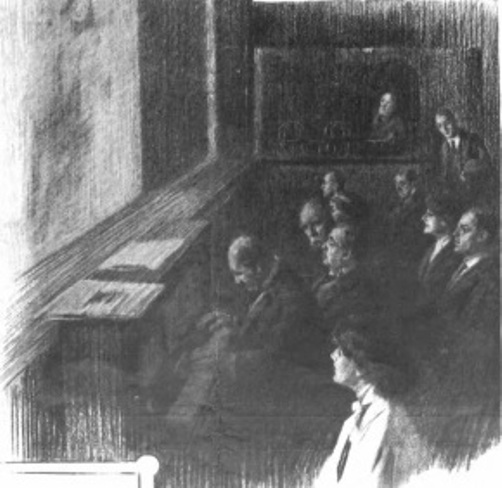
lureofthefilms1

Illustration by Wilson C. Dexter that accompanies the original article

Source: Olivia Howard Dunbar, ‘The Lure of the Films’, Harper’s Weekly, 18 January 1913, pp. 20, 22

Text: Adventures to discover how and where the rest of the world amuses itself are rarely as jocund as they sound. But the adventurer of proper spirit is usually content in witnessing the riotous joy of the multitude, however grimly unmoved his own less facile springs of mirth. Oddly enough, an attempt to share in the delights of “moving pictures,” widely accepted as the most popular of amusements, can scarcely be counted upon to produce even this vicarious satisfaction. For if the adventurer himself gives no sign of being entertained by the “photoplay” or the “art-film,” neither, to his amazement, does the close-packed audience that surrounds him – a fact that is at first inexplicable.

Does all the world demand the “film-show” and then withhold its approval from sheer caprice? And why does it throng so steadily today to the very performance whose lack of stimulus it must have discovered yesterday and the day before?

On the other hand, if a random assemblage of this sort gives mysteriously few evidences of active enjoyment, it gives fewer still of displeasure or ennui. To watch it is to discover that it is infinitely tolerant; completely and blessedly immune to boredom. It even betrays no annoyance on being gently approached from behind by some deputy of the management, and sprayed, as a festal touch, with strong. inalienable scent. Daily and hourly – for their patronage is so great that they open either at noon or at nine in the morning — these theaters offer thousands of cases in disproof of all that has been fallaciously said in regard to the restless energy of the American. You wonder how it can be possible, in an alleged busy world, to secure this magnificent total of leisure – to assemble daily, and for long, blank periods, so many people who have nothing to do and who are obviously not worrying about it. Every day, under these roofs, has the stagnant and misleading air of a holiday. And while it may be true that shirking housewives and truant children are never missing, it is nevertheless an interesting fact that three-fourths of the spectators are always men.

Rarely does such an audience betray animation, scarcely ever awareness. Its posture is indifferent and relaxed; its jaws moving unconcernedly in tune with the endlessly reiterated ragtime ground out by some durable automaton — at least, one prefers to believe it an automaton; its dull eyes unresponsively meeting the shadowy grimaccs on the flickering “ film.”

Are these pleasure-seekers resolutely disguising their enjoyment? Or are they, as they appear to be, half asleep? It is true that all the conditions conduce to semi-somnolence – the unbroken whine of the ragtime; the unnatural “continuousness” of the exhibition, hour after hour, without a moment’s interval; the lack of sequence or climax, as of one oddly literal dream succeeding another — varied, at long intervals, by a bolder picture that introduces the strange, noiseless turbulence of nightmare.

In spite of the lack of enthusiasm, there is an indefinable atmosphere of experience and accustomedness. Nobody but yourself is unfamiliar and inquiring. There is rather less suspense and excitement than you will encounter in a trolley-car. You begin to suspect that the phlegmatic audience, having come a great many times before, is quite prepared for the fact that nine-tenths of the programme will be padding and that it does not mind in the least. There is not so much as a change of its expression, much less a sign of applause, as companies of shadow-soldiers are assembled and drilled; parades of a dozen kinds trail their blurred length across the curtain; foreign cities flash out glimpses of their characteristic scenes; ships are launched, cornerstones are laid, medals are presented, and laboratory experiments demonstrating some feature of popular science are painstakingly performed. All “films,” in fact, that may be classed as educational or even indirectly instructive, as well as the occasional ones that are of a genuinely artistic interest, meet with frank but unrcbellious indifference.

For an hour this may continue. Then you are conscious of a stir in the chairs behind you, and a man’s didactic voice begins to enlighten the woman who is with him, in precisely the same fashion that the couple who have sat behind you at the theater all your life have gratuitously explained and perfunctorily listened. You rouse yourself, look about, even glance at the forgotten curtain to discover what it is that has relieved an apathy so general and so profound; and discover that, far from being some unimagined marvel, it is merelv a street scene in New York. And you wonder why the “Film Trust” should go to the trouble of contriving historical “playlets” in costume, through which audiences sleep contentedly, when what really stirs them is the representation of something that they see every day of their lives – the life-size figure of a policeman, a trolley-car, a crowd on Broadway. But this is not, after all, a new phenomenon. The ecstasy experienced by persons of a certain degree of simplicity in recognizing on the stage a familiar object or character has never been explained, although producers must long have realized and catered to it, as an incident in many kinds of drama. It has so often been apparent that audiences betrayed a keener delight in the introduction into a play of a cow or a horse than in the exploits of the most accomplished actor. During one long afternoon of widely varied cinematographic devices, the only genuine success was achieved by a youth who came out before the curtain made a sound like an automobile! This bit of simple realism did wake the sleeping audience from its dreams and gave them an unmistakably poignant pleasure which they expressed without restraint.

These flashes of sympathetic response are rare and fleeting, but may always be evoked by one other element – the broadly farcical. And it is perhaps unnecessary to explain that, the more nearly this unliteral comedy (for realism plays no part_here) approaches that of the comic supplement, the wilder and more immediate its success. An altercation, a practical joke, a chase, are of course the unvarying themes, a chase of anything by anybody, however meaningless, being the acknowledged favorite. Unfailingly popular are the pictured disputes between an impossible mistress and an unnatural servant, in which the maid tumultuously triumphs; or farcical interruptions of the love-making of an ill-suited couple; or rowdy street scenes in which people tumble over each other and somebody gets beaten for an offense he didn’t commit, while the culprit leers from a. neighboring corner. All this is, of course, more or less vulgar, but in the highly unrealistic sense that the comic supplement is vulgar — a harsh, unlovely, shadow-land, repellent, one would suppose, to intelligence and sanity.

The merriment that was set free by the pictured conflict of boy and policeman subsides again into apathy when the first scene in the more ambitious “photoplay” is flashed upon the curtain. For these fragmentary echoes of melodrama seem to be accepted merely as echoes, dim and undisturbing. Their warmed-over quality enables the spectator to remain entirely cool and disillusioned. And yet these plays often present not only the same type of heroine and villain that the old plays did, but the same actors — one would swear to it. The villain’s throwing back his head in cruel, contemptuous laughter is a trick he must have learned and often practised on Fourteenth Street. And the malign deliberation of his walk is full of an ancient theatric significance that could scarcely be felt by any traditionless cub, hired to play in pantomime before the camera. On the other hand, that intemperate use of the telephone that characterizes the moving-picture play was of course unknown to melodrama.

The “Indian play ” – indeed, the Wild West drama generally — is understood to be a commodity that is ordered in large quantities for contemporary audiences; but the result produces no apparent excitement. While a red man discovers a child left alone in a prairie cabin, and, brandishing cruel weapons, pursues the child through various shadow-scenes, the audience contentedly chews its gum. Further scenes are revealed in which the child’s father appears, rescues the child and slays the Indian — but the onlookers are still unmoved. Even the dramatic adventures of the simpering young girl who is menaced by a nondescript villain and rescued at the critical moment by the humble but hitherto neglected suitor are accepted with complete nonchalance. Endangered girlhood is, however, so frequently and persistently presented that the theory must exist that it is a favorite stimulus with these stodgy audiences.

lureofthefilms2

‘There is not so much as a change of expression, much less a sign of applause.’ Illustration by Wilson C. Dexter that accompanies the original article, with caption

Yet these apathetic groups who now appear, except for their occasional bursts of unjoyous mirth, emotionless, are the same men and women who only a few years ago thronged constantly to the melodramas at the urge of what seemed to be an elemental need, the need of wholesome emotional exercise. No audience was ever disappointed in one of these eminently reliable performances; none was ever bored or critical or sleepy. One knew what one had come for and settled down comfortably to enjoy it. It was of relatively little importance whether the central figure in the tangle of love, danger, sacrifice, villainy, heroism, disaster, and triumph was Nellie, the Beautiful Cloak Model, or Bertha, the Sewing-Machine Girl — the succession of thrills was of practically the same character and intensity. What these audiences unconsciously demanded was an excuse to laugh, weep, pity, resent, condemn, and admire, all in strict conformity with the orthodox moral code; and it was this that was abundantly furnished them. It would surely be a psychological marvel if so deep a need could have vanished as the coincidence of a mere change of fashion in entertainments.

But the best and most satisfying feature of the melodramas was their imaginative scope, their denial of logical limitations. The simple, normal mind while it has felt a childlike delight in the occasional realistic detail, has probably always been charmed by the theater in proportion as its spectacle, as a whole, transcended reality. A world as unfettered as the world of faery, whose characters should have the shape and speech of the ordinary wage-earner, would have at any time a compelling appeal. “What attracted me so strongly to the theater,” Wagner says, speaking of his childhood, “was … the fascinating pleasure of finding mvself in an entirely different atmosphere, in a world that was purely fantastic and often gruesomely attractive. Thus to me … some costume or a characteristic part of it seemed to come from another world, to be in some way as attractive as an apparition.” There is no doubt that this is the expression of a universal experience; and that if a sensitive, impressionable child of six or seven could define and express the emotions (too vaguely recalled by the adult) aroused by its first theater, this would form a human document of thrilling interest. And it may be that melodrama at its best supplied multitudes of adult children with an approximation of this delicious and memorable experience of infancy.

In comparison with the popular drama that it has succeeded and supplanted, the motion picture of course provides little or no emotional outlet. It is far from attempting to “purge with pity and terror” the casual multitudes that it attracts. In most cases the interest that it excites, when it excites any, is shallow, fleeting, two-dimensional, like the pictures themselves. It offers no illusion and no mystery. What is left to those who have had to accustom themselves to this thin and unsatisfying form of emotion, but to acquire, as they have, a self-protective surface of apparent torpor?

It is easy, of course, to recall conspicuously exceptional cases. There is now and then a feverish desire to see the pictured record of some current event of especial interest, particularly when it has to do with sports. But the kind of excitement that would be aroused by the records of a baseball or football game is a very special thing, and is infinity [sic] removed from the mere normal desire for amusement. Yet it is fully shared, as everybody knows, by sophisticated childhood. Indeed, the overpowering desire felt by youthful East Side citizens to see certain celebrated “movies” has more than once led them into tragic difficulty. Not many months ago, just after a much-advertised prize-fight, two little boys, whose uncontrollable longing for the admission fee to a picture-hall had led them to upset a grocer’s display and barter his goods independently, were brought to the Children’s Court. “The price of admittance was five cents?” inquired the judge, examining them. The smaller boy, who was very small indeed, quickly raised his thin, tense face. “Oh, but it was ten cents to see the big fight, judge!” he cried, hoarsely, the tremendous intensity of his manner and expression at once defining the almost irresistible character of his temptation and what he felt to be the manly magnitude of his crime.

But even though its imagination starve, a disaster of which it can scarcely be conscious, it is not difficult to understand why the vast, simple, unexigent public so faithfully follows up the moving picture. Almost any institution that cost so little would probably be patronized, even though the most it did was to provide a convenient and often comfortable lounging place, and, in the poorer quarters of the city, to provide an excuse for social contact. After all, there is no question but that the equivalent of a nickel is usually supplied. Beyond this, there is the fascination of never knowing what one is going to see, which is a far greater lure than an exact knowledge of what is forthcoming. But its strongest hold must be the fact that it makes no demand whatever upon its audiences, requiring neither punctuality — for it has no beginning — nor patience — for it has no end — nor attention — for it has no sequence. No degree of intelligence is necessary, no knowledge of our language, nor convictions nor attitude of any kind, reasonably good eyesight being indeed the only requisite. In the world of amusement, no line of less resistance than this has surely yet been offered.

Comment: Olivia Howard Dunbar (1873-1953) was an American biographer and writer of ghost stories.

The Cinema Audience

Source: ‘The Cinema Audience’, The Evening Telegraph [Dundee], 11 September 1919, p. 4

Text: The Cinema Audience. Screengazers Under An Observant Eye. “Potting the Picturegoer” a Fascinating Sport. (Special to Telegraph and Post.)

“Potting the picturegoer” can be quite a fascinating sport. There is no necessity to don loud tweeds and light brogues or flannel trousers and white shoes. You enter the arena in everyday costume and arm yourself with the only weapon required — the observant eye. Of course, you are merely courting trouble if, when caught at the game in the entrance hall of a picture house, you call yourself a “practical psychologist.” The gold-braided gentleman who is the presiding genius of the place will rightly resent and suspect such language, and probably propel you streetwards. Rather tell him with disarming frankness that you are studying the “screengazer” in his native haunts and that you propose presently to inside and continue your investigations.

Ten minutes near the pay-box will convince you that your “victims” are drawn from every class of society. You soon understand why Mary Pickford can claim to be the “world’s sweetheart.” It this mingling of all sorts and conditions of people that makes the observer’s game worth while. Notice particularly the mood that prevails in the queue. It contrasts strangely with that of the audience passing through a theatre “foyer.”

There no ceremony about picture-going, no air of attending a function. The “pictures” are free and easy in spirit, and the audience is similarly affected. It largely this “come and go as you please” atmosphere that maintains the popularity of the cinema.

Inside the house, you come to close quarters with your “quarry.” Before long you discover that the shrewdest judge of a picture is the audience. You will find, of course, that criticism changes character you pass from back to front of the hall, but really good picture will be recognised and praised by all, while the faults of a film will be unerringly detected.

If a comedy is screened will be interesting to watch the effect on various members of the audience. Not every screen comedy is really humorous, and you may be surprised to find a friend who prides himself on his subtle and refined sense of humour taking advantage of the darkness to grin broadly at what is actually silly horseplay.

He may be comfortably placed in the best seats the house affords, while an occupant of the benches near the screen is only bored by the film. You therefore conclude that appreciation of real humour is not necessarily conferred by the ability, to pay for a “tip-up.”

Things That Annoy.

The “star” film flickers on to the screen. If it is a well-constructed picture the interest of the audience is maintained, but you need not a profound observer to note the sign of impatience when the story “drags. “Padding out” a picture irritates, and a player who takes thirty feet of film to accomplish what could reasonably be done in ten annoys the audience.

Your picture-goer is credulous, although he hates to be asked to swallow too much, He will stand absurd situations which no playwright would dream of foisting on theatre audience. But he is gradually coming to demand from the screen some approach to the happenings of real life, and to reject as impossible many situations that have hitherto passed muster. He likes what is novel, but refuses the wholly improbable.

Suppose that the film is of American production. The fact may account for a mystified and almost angry audience. You watch it vainly trying to grasp the meaning of tho letterpress or “leaders” between the scenes, for the American has entirely forgotten that the British audience, while capable understanding English, makes little of New York Bowery slang. Some of these Americanisms have an undeniable piquancy, but most are unintelligible, and only succeed in annoying the picture goer.

Comment: This curious article was published in Scotland by the Dundee-based Evening Telegraph newspaper. It addresses itself to an audience with seemingly little knowledge of cinema at all, at a time when cinema-going throughout the UK was coming to be adopted widely across the UK and no longer seen as a largely working class entertainment. The audience reported on was presumably in Dundee.

The Cinema

Source: The Cinema: Its Present Position and Future Possibilities (London: Williams and Norgate, 1917), pp. 198-201

Text: [Three South London schoolgirls were examined together].

22. THE CHAIRMAN. How often do you go to the cinema? — I don’t go very often, as it is very injurious to my eyes when I go.
23. Do you sit right in the front? — Well, if they put you there you have to go there.
24. What do you pay generally? — Fourpence.
25. Do you go only for entertainments which are for children? — Not always.
26. Are you a great cinema-goer? — Yes.
27. How often do you go? — Once a week. Sometimes I go once a week for six months and then have a rest, and then start all over again.
28. What seats do you go in; what do you pay? — Sevenpence.
29. You sit right in the front? — No, it is all according to how much you pay. If you pay a low price you go into the front.
30. With your sevenpence, is that not a first-rate seat? — Just about in the middle of the cinema, and I can see all right there.
31. And you don’t find your eyes hurt? — When I go out it generally gives me a headache.
32. How long do you sit in the cinema? — Two and a half or three hours.
33. Do you go very much ? — About once every three weeks.
34. What do you like best? Comic things? — I like pretty pictures about dancing and horses.
35. Do you like seeing people breaking into rooms and taking things? — Not very much.
36. It never gives any of you an idea that what you see you want to go and do yourself? — No.
37. How about your eyes? Do you get a headache? — No.
38. Where do you sit? — I pay fourpence and sit about two or three seats away from the front.
39. What part of London do you come from? — We are all from the middle of South London.
40. Have you any particular picture palace which appeals to you? — I used to go to the Oval Cinema, but now I go to the Queen’s Hall, Newington Butts.
41. Where do you go? — To the Palladium, Brixton, and the Arcadia, Brixton.
42. What kind of things do you have at the Arcadia? — They generally have very good pictures, and I went once and saw “___ ______ __ __ .” It is not a very good picture to go to.
43. Why, what was the matter? — Because I do not like the way they used the crucifix. They used the crucifix to hit one another with, and it might make children think less of religion.
44. That was the principal thing, and you did not notice anything else? — No.
45. Where do you go? — I go to the Queen’s Hall, Newington Butts.
46. Did you see “___ _______ __ __ ” ? — No.
47. Do the girls sit amongst the boys? — Yes, all mixed up, and the attendant comes round, and if the boys start whistling about and do that again he turns them out.
48. I suppose girls never do that sort of thing? — That all depends.
49. Do you go to the late entertainment? — No, mother won’t let me.
50. Do you go late? — I get out about 9 or 9.30. Very often it is 9.30. If I go to Brixton by myself and my sisters are that way they meet me, otherwise I come home by myself.
51. Do you feel the influence next day? — I do not feel any bad effects.
52. SIR JOHN KIRK. Is the place very dark? — Yes, very dark. You can see over it while the performance goes on.
53. What would happen if the boys started fighting? — They would not start fighting, because they are always too anxious to see the pictures.
54. MR. LAMERT. Have you any other amusement to go to beside the cinema? — Sometimes a theatre.
55. Do you pay to go to the theatre ? — Sometimes mother lets us go into the pit, as she doesn’t like us to go up the stairs to the gallery. The price is one shilling and twopence tax.
56. When you go to the theatre what do you see? — Pantomimes, and if there is a revue mother thinks we will understand she will take us to it.
57. At the picture palaces do you take any steps to find out what is on? — No, we take our chance.
58. MONSIGNOR BROWN. What sort of picture do the children like best? — When the cowboys and Indians come on they clap very loudly.
59. Do you like flowers? — No, not very much.
60. Birds’ nests? — No, they don’t like those.
61. Charlie Chaplin? — They like those.
62. Do you get tired when they begin to show views and landscapes? — Sometimes some of them do.
63. Are they short films? — Yes, and sometimes they are the topical budget, and then a lot of them go out.
64. Do they like a long drama? — Yes.
65. How many minutes do the dramas last? — Sometimes one and a half hours.
66. Do they like dramas with a lot of love mixed up? — We don’t care for them very much; some like them and some don’t.
67. Would many like them ? — I should not think many of them would like them. I think they would prefer other pictures.
68. How many different picture houses have you been to? — Sixteen.
69. How many have you been to? — Eight.
70. How many you? — Six in London and Manchester.
71. DR. MARIE STOPES. Have you seen any picture which you thought at the time was bad to see? — No, but I saw a picture once which I thought was vulgar. It was called “_____”
72. Supposing you went into a picture house and you met a fairy at the door who told you you could see any picture you
liked, what kind would you like to see? — I should like to see a picture about a circus.
73. What sort of picture would you like best? — I should like a good drama, but not a love drama. A drama like “Little Miss Nobody,” which I thought was very nice.
74. Why don’t you like love dramas? — There is too much fooling about in them, and there is always a hatred between two men and two women.
75. You don’t like to see two men hating each other? — Well, it is a lot of silliness. I do not think it would happen in real life.
76. You never got any disease at the cinema? — No, but once I got scarlet fever, but not in a cinema.
77. Did you ever get anything? — No, I did not catch my disease there.
78. DR. KIMMINS. What is the, nicest picture you have seen in the cinema? — I think it was “Cleopatra.”
79. And you? — “Little Miss Nobody.”
80. And you? — “The Prisoner of Zenda” and “Rupert of Hentzau.”
MR. NEWBOULD. These three were of British manufacture.
81. Do you like serials? — I have seen “The Broken Coin,” but I did not like that, although I liked the acting.
82. COMMISSIONER ADELAIDE COX. Did you see anything that frightened you? — I saw one picture where a man was in the cell, and he was supposed to have an apparition, which breaks through the wall, and the wall falls over. It was in “Monte Cristo.”
83. And when you went to bed, did you think about these things ? — No, I went to sleep.
84. What do you like the least? — I do not like the topical budget.
85. And you? — Love stories.
86. And you ? — I think the same — love stories.
87. Mr. Graves. Have you seen any pictures which help you at school? — I have seen the picture about Nero.
88. Would you like some singing in between? — I should like to have some singing.
89. MR. NEWBOULD. Are you quite sure it was a crucifix you saw in “___ ______ __ __”? — Yes.
90. Have you any idea why she hit the man with the crucifix? — She was a servant in his father’s house, and he wanted to be in love with her, and he started cuddling and kissing her, and she gets up the crucifix quite unconsciously and hits him with it.
91. Have you ever seen films you do not understand? — Yes, I can never understand pictures on general plays.
92. MR. CROOK. Have you ever had a man who wanted to pay for you at night? — No.
93. PRINCIPAL GARVIE. Have the boys ever been rude to you in the cinema? — No, but they have pulled our hair and taken our hats off.
94. THE CHAIRMAN. Do they only do that in the cinema? — No, and if the attendant is about he puts them outside.

Comment: The Cinema: Its Present Position and Future Possibilities (1917) is a report and summary of evidence taken by the Cinema Commission Inquiry, instituted by the National Council of Public Morals. It includes several passages taken from interviews with children where commission members asked them questions about their cinema-going habits. Here three girls (ages not given) from South London are interview. A.E. Newbould, who speaks up for British films, was one of the British cinema industry representatives on the Commission; one of its members was the birth control campaigner Marie Stopes. Topical Budget was the name of a British newsreel, though ‘topical budget’ is here being used as a generic name for newsreels. Filmed mentioned are The Count of Monte Cristo (USA 1913), The Prisoner of Zenda (UK 1915), Rupert of Hentzau (UK 1915) and Little Miss Nobody (USA 1916), all features. ‘Cleopatra’ is possibly Marcantonio e Cleopatra (Italy 1913) (it is not the Theda Bara film Cleopatra, which was released after these interviews took place). The film with a crucifix has not been identified. The Broken Coin (USA 1915) was a popular serial, mentioned by other interviewees.

The Nickel Madness

Source: Barton W. Currie, ‘The Nickel Madness,’ Harper’s Weekly, 24 August 24 1907, pp. 1246-1247.

Text: The Nickel Madness

The Amazing Spread of a New Kind of Amusement Enterprise Which is Making Fortunes for its Projectors

The very fact that we derive pleasure from certain amusements, wrote Lecky, creates a kind of humiliation. Anthony Comstock and Police-Commissioner Bingham have spoken eloquently on the moral aspect of the five-cent theatre, drawing far more strenuous conclusions than that of the great historian. But both the general and the purity commissioner generalized too freely from particulars. They saw only the harsher aspects of the nickel madness, whereas it has many innocent and harmless phases.

Crusades have been organized against these low-priced moving-picture theatres, and many conservators of the public morals have denounced them as vicious and demoralizing. Yet have they flourished amazingly, and carpenters are busy hammering them up in every big and little community in the country.

The first “nickelodeon,” or “nickelet,” or whatever it was called was merely an experiment, and the first experiment was made a little more than a year ago. There was nothing singularly novel in the ideal, only the individualizing of the moving-picture machine. Before it had served merely as a “turn” in vaudeville. For a very modest sum the outfit could be housed in a narrow store or in a shack in the rear yard of a tenement, provided there was an available hallway and the space for a “front.” These shacks and shops are packed with as many chairs as they will hold and the populace welcomed, or rather hailed, by a huge megaphone-horn and lurid placards. The price of admission and entertainment for from fifteen to twenty minutes is a coin of the smallest denomination in circulation west of the Rockies.

In some vaudeville houses you may watch a diversity of performances four hours for so humble a price as ten cents, provided you are willing to sit among the rafters. Yet the roof bleachers were never so popular or profitable as the tiny show-places that have fostered the nickel madness.

Before the dog-days set in, licenses were being granted in Manhattan Borough alone at the rate of one a day for these little hurry-up-and-be-amused booths. They are categorized as “common shows,” thanks to the Board of Aldermen. A special ordinance was passed to rate them under this heading. Thereby they were enabled to obtain a license for $25 for the first year, and $12.50 for the second year. The City Fathers did this before Anthony Comstock and others rose up and proclaimed against them. A full theatrical license costs $500.

An eloquent plea was made for these humble resorts by many “friends of the peepul.” They offered harmless diversion for the poor. They were edifying, educational, and amusing. They were broadening. They revealed the universe to the unsophisticated. The variety of the skipping, dancing, flashing, and marching pictures was without limit. For five cents you were admitted to the realms of the prize ring; you might witness the celebration of a Pontifical mass in St. Peter’s; Kaiser Wilhelm would prance before you, reviewing his Uhlans. Yes, and even more surprising, you were offered a modern conception of Washington crossing the Delaware “acted out by a trained group of actors.” Under the persuasive force of such arguments, was it strange that the Aldermen befriended the nickelodeon man and gave impetus to the craze?

Three hundred licenses were issued within the past year in the Borough of Manhattan alone for common shows. Two hundred of these were for nickelets. They are becoming vastly popular in Brooklyn. They are springing up in the shady places of Queens, and down on Staten Island you will find them in the most unexpected bosky dells, or rising in little rakish shacks on the mosquito flats.

Already statisticians have been estimating how many men, women, and children in the metropolis are being thrilled daily by them. A conservative figure puts it at 200,000, though if I were to accept the total of the showmen the estimate would be nearer half a million. But like all statisticians, who reckon human beings with the same unemotional placidity with which they total beans and potatoes, the statistician I have quoted left out the babies. In a visit to a dozen of these moving-picture hutches I counted an average of ten babies to each theatre-et. Of course they were in their mothers’ or the nurse-girls’ arms. But they were there and you heard them. They did not disturb the show, as there were no counter-sounds, and many of them seemed profoundly absorbed in the moving pictures.

As a matter of fact, some mothers- and all nurse-girls- will tell you that the cinematograph has a peculiarly hypnotic or narcotic effect upon an infant predisposed to disturb the welkin. You will visit few of these places in Harlem where the doorways are not encumbered with go-carts and perambulators. Likewise they are prodigiously popular with the rising generation in frock and knickerbocker. For this reason they have been condemned by the morality crusaders.

The chief argument against them was that they corrupted the young. Children of any size who could transport a nickel to the cashier’s booth were welcomed. Furthermore, undesirables of many kinds haunted them. Pickpockets found them splendidly convenient, for the lights were always cut off when the picture machine was focused on the canvas. There is no doubt about the fact that many rogues and miscreants obtained licenses and set up these little show-places merely as snares and traps. There were many who though they had sufficient pull to defy decency in the choice of their slides. Proprietors were said to work hand in glove with lawbreakers. Some were accused of wanton designs to corrupt young girls. Police-Commissioner Bingham denounced the nickel madness as pernicious, demoralizing, and a direct menace to the young.

But the Commissioner’s denunciation was rather too sweeping. His detectives managed to suppress indecencies and immoralities. As for their being a harbor for pickpockets, is it not possible that even they visit these humble places for amusement? Let any person who desires- metaphorically speaking, of course- put himself in the shoes of a pickpocket and visit one of these five-cent theatres. He has a choice of a dozen neighborhoods, and the character of the places varies little, nor does the class of patrons change, except here and there as to nationality. Having entered one of these get-thrills-quick theatres and imagined he is a pickpocket, let him look about him at the workingmen, at the tired, drudging mothers of bawling infants, at the little children of the streets, newsboys, bootblacks, and smudgy urchins. When he has taken all this in, will not his (assumed) professional impulse be flavored with disgust? Why, there isn’t an ounce of plunder in sight. The pickpocket who enters one of these humble booths for sordid motives must be pretty far down in his calling- a wretch without ambition.

But if you happen to be an outlaw you may learn many moral lessons from these brief moving-picture performances, for most of the slides offer you a quick flash of melodrama in which the villain and criminal are getting the worst of it. Pursuits of malefactors are by far the most popular of all nickel deliriums. You may see snatch-purses, burglars, and an infinite variety of criminals hunted by the police and the mob in almost any nickelet you have the curiosity to visit. The scenes of these thrilling chases occur in every quarter of the globe, from Cape Town to Medicine Hat.

The speed with which pursuer and pursued run is marvellous. Never are you cheated by a mere sprint or straightaway flight of a few blocks. The men who “fake” these moving pictures seem impelled by a moral obligation to give their patrons their full nickel’s worth. I have seen dozen of these kinetoscope fugitives run at least forty miles before they collided with a fat woman carrying an umbrella, who promptly sat on them and held them for the puffing constabulary.

It is in such climaxes as these that the nickel delirium rises to its full height. You and old follow the spectacular course of the fleeing culprit breathlessly. They have seen him strike a pretty young woman and tear her chain-purse from her hand. Of course it is in broad daylight and in full view of the populace. Then in about one-eighth of a second he is off like the wind, the mob is at his heels. In a quarter of a second a half-dozen policemen have joined in the precipitate rush. Is it any wonder that the lovers of melodrama are delighted? And is it not possible that the pickpockets in the audience are laughing in their sleeves and getting a prodigious amount of fun out of it?

The hunted man travels the first hundred yards in less than six seconds, so he must be an unusually well-trained athlete. A stout uniformed officer covers the distance in eight seconds. Reckon the handicap he would have to give Wegers and other famous sprinters. But it is in going over fences and stone walls, swimming rivers and climbing mountains, that you mount the heights of realism. You are taken over every sort of jump and obstacle, led out into tangled underbrush, through a dense forest, up the face of a jagged cliff- evidently traversing an entire county- whirled through a maze of wild scenery, and then brought back to the city. Again you are rushed through the same streets, accompanying the same tireless pack of pursuers, until finally looms the stout woman with the umbrella.

A clerk in a Harlem cigar-store who is an intense patron of the nickelodeon told me that he had witnessed thief chases in almost every large city in the world, not to mention a vast number of suburban town, mining-camps and prairie villages.

“I enjoy these shows,” he said, “for they continually introduce me to new places and new people. If I ever go to Berlin or Paris I will know what the places look like. I have seen runaways in the Boys de Boulong and a kidnapping in the Unter der Linden. I know what a fight in an alley in Stamboul looks like; have seen a papermill in full operation, from the cutting of the timber to the stamping of the pulp; have seen gold mined by hydraulic sprays in Alaska, and diamonds dug in South Africa. I know a lot of the pictures are fakes, but what of that? It costs only five cents.”

The popularity of these cheap amusement-places with the new population of New York is not to be wondered at. The newly arrived immigrant from Transylvania can get as much enjoyment out of them as the native. The imagination is appealed to directly and without any circumlocution. The child whose intelligence has just awakened and the doddering old man seem to be on an equal footing of enjoyment in the stuffy little box-like theatres. The passer-by with an idle quarter of an hour on his hands has an opportunity to kill the time swiftly, if he is not above mingling with the hoi polloi. Likewise the student of sociology may get a few points that he could not obtain in a day’s journey through the thronged streets of the East Side.

Of course the proprietors of the nickelets and nickelodeons make as much capital out of suggestiveness as possible, but it rarely goes beyond a hint or a lure. For instance, you will come to a little hole in the wall before which there is an ornate sign bearing the legend:

FRESH FROM PARIS
Very Naughty

Should this catch the eye of a Comstock he would immediately enter the place to gather evidence. But he would never apply for a warrant. He would find a “very naughty” boy playing pranks on a Paris street- annoying blind men, tripping up gendarmes, and amusing himself by every antic the ingenuity of the Paris street gamin can conceive.

This fraud on the prurient, as it might be called, is very common, and it has led a great many people, who derive their impressions from a glance at externals, to conclude that these resorts are really a menace to morals. You will hear and see much worse in some high-price theatres than in these moving-picture show-places.

In of the crowded quarters of the city the nickelet is cropping up almost a thickly as the saloons, and if the nickel delirium continues to maintain its hold there will be, in a few years, more of these cheap amusement-places than saloons. Even now some of the saloon-keepers are complaining that they injure their trade. On one street in Harlem, there are as many as five to a block, each one capable of showing to one thousand people an hour. That is, they have a seating capacity for about two hundred and fifty, and give four shows an hour. Others are so tiny that only fifty can be jammed into the narrow area. They run from early morning until midnight, and their megaphones are barking their lure before the milkman has made his rounds.

You hear in some neighborhoods of nickelodeon theatre-parties. A party will set out on what might be called a moving-picture debauch, making the round of all the tawdry little show-places in the region between the hours of eight and eleven o’clock at night, at a total cost of, say, thirty cents each. They will tell you afterwards that they were not bored for an instant.

Everything they saw had plenty of action in it. Melodrama is served hot and at a pace the Bowery theatres can never follow. In one place I visited, a band of pirates were whirled through a maze of hair-raising adventures that could not have occurred in a Third Avenue home of melodrama in less than two hours. Within the span of fifteen minutes the buccaneers scuttled a merchantman, made its crew walk the plank, captured a fair-haired maiden, bound her with what appeared to be two-inch Manila rope, and cast her into the hold.

The ruthless pirate captain put his captive on a bread-and-water diet, loaded her with chains, and paced up and down before her with arms folded, a la Bonaparte. The hapless young woman cowered in a corner and shook her clankless fetters. Meanwhile from the poop-deck other pirates scanned the offing. A sail dashed over the horizon and bore down on the buccaneers under full wing, making about ninety knots, though there was scarcely a ripple on the sea. In a few seconds the two vessels were hurling broadsides at each other. The Jolly Roger was shot away. Then the jolly sea-wolfs were shot away. It was a French man-of-war to the rescue, and French man-of-war’s men boarded the outlaw craft. There were cutlass duels all over the deck, from “figgerhead” to taffrail, until the freebooters were booted overboard to a man. Then the fiancé of the fair captive leaped down into the hold and cut off her chains with a jack-knife.

Is it any wonder, when you can see all this for five cents and in fifteen minutes, that the country is being swept by a nickel delirium? An agent for a moving-picture concern informed the writer that the craze for these cheap show-places was sweeping the country from coast to coast. The makers of the pictures employ great troops of actors and take them all over the world to perform. The sets of pictures have to be changed every other day. Men with vivid imaginations are employed to think up new acts. Their minds must be as fertile as the mental soil of a dime-novelist.

The French seem to be the masters in this new field. The writers of feuilletons have evidently branched into the business, for the continued-story moving-picture has come into existence. You get the same characters again and again, battling on the edges of precipitous cliffs, struggling in a lighthouse tower, sleuthing criminals in Parisian suburbs, tracking kidnapped children through dense forests, and pouncing upon would-be assassins with the dagger poised. Also you are introduced to the grotesque and the comique. Thousands of dwellers along the Bowery are learning to roar at French buffoonery, and the gendarme is growing as familiar to them as “the copper on the beat.”

And after all it is an innocent amusement and a rather wholesome delirium.

Comment: Anthony Comstock was renowned moralist who formed the New York Society for the Suppression of Vice. This article on New York’s nickelodeons was originally made available online via The Silent Film Bookshelf, a collection of transcriptions of original texts on aspects of film history collated by David Pierce. The site is no longer available, but can be traced in its entirety via the Internet Archive.

Explain the Pictures!

Source: ‘Explain the Pictures!’, The Bioscope, 10 December 1908, p. 5

Text: Explain the Pictures!

The Most Pressing Need of the Day is an intelligent description of Film Plots and Travel Pictures

There seems to be a tendency amongst present day managers to quietly lean back on the reputations they built up in the early years of the industry, confident that the impetus which they engendered then by real grit and toil will carry them along and keep them in the front rank for all time. We must always be on the qui vive. We must not be deceived and deluded by a long period of properity, but must watch for fresh and new fields of enterprise. Good pictures and good prices must not be the only consideration.

One of the most urgent requirements to-day is that every picture shall be introduced to the audience in a manner that will ensure the good points of the film being intelligently appreciated. The developments in the selection and the building up of subjects during the last few years have schooled us until we are quite decided that the lay mind – the mind which is not always devoted to the manufacture and the elucidation of screen mysteries – is quite incapable of seeing and of comprehending the inner nature and the underlying humanity which are the life and soul of to-day’s great creations. Nowadays the lecture is an attribute to success. Some managers have seen it already; others are slowly discovering the fact; while as to the remaining many, we are going to explain to them why they should lecture and how. And if they accept our advice, and act on it, we shall not wait long for their thanks.

Verbal explanation is necessary, finally, because it is impossible to place on the screen real pathos and real humanness – these must be preserved from the full glare of people’s eyes or the effect is lost; secondly, because spectators will not trouble to look for these latent qualities unless the search is suggested to them; and, thirdly, because educational travel pictures minus an explanation of why they should be considered important enough to occupy the screen tend to make interest wane and eventually to fade away altogether.

The Greek orator, when asked what was the essence of speech making, answered “Delivery”. The essence of giving a lecture on a bioscope picture is not distinguished by such a word. The lecturer’s key to success is “to tell the tale”. It should be told simply, clearly and intellectually. The lecturer should know the picture well before he attempts to explain it to others. He should keep perfect pace with the projecting machine, should quietly indicate the inner cause when the outer result is taking place. He should indulge in no stock phrases, no personal reminiscences which the picture may recall, no opaque phrases, no drawn-out, windy sentences; in fact, nothing which could possibly lower his description in the estimation of any single member of his audience. Let him always keep well in mind that he is talking to an assembly, not to a few of his acquaintances, who would probably laugh at his jokes and listen to his rhetoric merely for the sake of their friendship. Audiences do not tolerate any admixture of personality. They want the discription [sic] to be clear, unalloyed, to serve the purpose which it is intended to serve.

But while endeavouring to make himself understood by using words which everyone knows and sentences the meaning of which will be readily grasped by all, the lecturer must guard against falling into the opposite error – that of making his explanation too elementary. Either extreme is wrong, and not wanted. By making his story too academical he will run the risk of being thought by a portion of his audience, to be aiming higher than is necessary, and if he is so unfortunate as to lose himself for a moment, the chaos, which is always threatening, comes; while if he goes too far in the other direction his listeners will accuse him of looking down on them. So the only sensible course to pursue is a middle one. Let the words used be ordinary ones, but let the construction of the sentences be perfect. Do not have your lecture “scrappy” and disconnected. The more intellectual people object strongly to this, and never listen to it more than once.

Above all else, make the story bright. Make your explanation worthy of the beautiful picture you are showing. Every description can be made bright and sparkling, for it is not the subject but the way it is exploited that determines the amount of interest the narrative shall be accorded. Travel films can be described with a swing and a healthy raciness which help the listener to persuade himself that he, too, is bounding along and partaking of the pleasure of actual expedition, while the picture of sentiment and pathos lends itself to that terseness and conciseness which, while bordering almost on the abrupt, is the real acme of of pathetic narrative. Do not have your lecture like a few dry old extracts hitched up from a text book, and, without boring the audience, make yourself felt. Be an authority on the subject in hand; be the larger half of the show.

And when you have done all this you have faithfully discharged your duty. You have sown the seed of success and can look forward to the harvest. You begin to reap exactly one week after the inauguration of the lecture, and the crop increases weekly. So try it. Engage a lecturer or improvise one from your own material. Whether you have spoken in public or not matters little. Study your audiences, work on the ideas I have attempted to explain, and watch for the crowds being turned away.

Comment: Lecturers were a common feature in early cinema shows, though they more usually described non-fiction films rather than the dramas implied here. The Bioscope was a British film trade magazine.

The Diaries of a Cosmopolitan

Source: Count Harry Kessler (translated and edited by Charles Kessler), The Diaries of a Cosmopolitan 1918-1939 (London: Weidenfeld & Nicolson). p. 325

Text: Thursday, 11 August 1927 / Berlin
In the evening I saw the American film What Price Glory?, the best war film I have so far seen and the only one that has had the courage to show war as it really is, in the round and from all sides, without concealment. During various scenes the audience broke into stormy applause.

Comment: Count Harry Kessler (1868-1937) was an Anglo-German aristocrat and diplomat. His diaries are an exceptionally vivid and observant account of art and politics in Weimar Germany. What Price Glory? (USA 1926 d. Raoul Walsh) stars Edmund Lowe and Victor McLaglen and tells of the rivalry between two US marines serving in France during the First World War.