This is a movie that ends in the middle…

Source: Terry Gallacher, “This is a movie that ends in the middle…”, from Terence Gallacher’s Recollections of a Career in Film, http://terencegallacher.wordpress.com/2010/12/29/”this-is-a-movie-that-ends-in-the-middle-“/, published 29 December 2010

Text: In the thirties, forties and fifties, there was always visual entertainment available in the cinemas. In Tottenham and Edmonton in London, we had a number of cinemas at our disposal.

There was the Tottenham Palace, which was almost opposite Chestnut Road, Tottenham, which had, originally, been a theatre from 1908 and a cinema from 1926. There was the Bruce Grove Cinema which was just up Bruce Grove Road on the right hand side past the railway bridge. This was built in 1921 as a cinema, then, of course running silent movies.

Then there was the Pavilion which was a very old single story cinema and was situated opposite Argyle Road next to what was Charrington’s Brewery, in Tottenham.

The cinema was partially demolished around 1937 and rebuilt as the Florida, a bright new cinema which opened in 1938. It held 529 people. However, it, too, has been demolished. In Edmonton at the junction of Fore Street, Silver Street (now called Sterling Way) and Angel Road, there were three cinemas. The Regal Edmonton, was opened in 1934 and was extremely well designed. It was to operate as a theatre as well as a cinema. It had sixteen dressing rooms and the largest revolving stage in Europe. It had an audience capacity of almost 3,000.

In contrast to that was the Hippodrome which was just up Angel Road on the right. It was very old, run down and known as the “flea-pit” or “The Hip”. An original theatre , it would have opened for the movies at a very early stage. It was an extremely awful place which had not been given any attention since the silent days. Then there was the Alcazar, another of the exotic names used for cinemas in those days. It would take me forty years to discover what it meant. Al Casr is Arabic for “The Castle”. This was a medium sized cinema located in Fore Street, just north of the Silver Street junction. The frontage was built in the style of an Arab fort. It had glass doors all along its forty yard frontage. The foyer ran the full width of the building and on the dividing wall between the foyer and the auditorium were huge mirrors about six feet wide and from ceiling to floor.

The Alcazar was destroyed by a bomb in August 1940. Two days before War was declared, I was evacuated to Mildenhall in Suffolk with my elder brother. The local cinema in Mildenhall was the Comet and it only showed old films. We returned home for Christmas 1939. While we were away, the Tottenham cinemas were showing the latest films. My brother and I missed them, particularly Gunga Din and The Four Feathers.

We discovered that The Ritz at Turnpike Lane were showing both films in one showing. Off we went. In April, we had returned home and when the bomb went off at the Alcazar, I was woken up. It was the next day that we found out where the bomb had struck. We went off to see the damage. All the glass was blown out of the front and the foyer looked in a very bad state. There was no doubt that it would be a long time before it would re-open. In fact, it never did. There was a theory that the German bomber crew mistook the junction of Fore Street, Silver Street and Angel Road, together with the three cinemas, Alcazar, Regal and Hippodrome, to be an airbase. The cinemas might have looked like hangers. However, such theories abounded in those days.

While attending the cinema, at that time, if there should there be an air raid warning, it would show on the screen that the siren had sounded. I do not recall anyone leaving the cinema as a result of that information.

In the Spring of 1946, my friends and I went to the site where they were clearing away the bomb damage. We knew that there were some good things to collect from there. At the time, we were building a canoe and raw materials were extremely hard to come by. In the Alcazar, the Foyer mirrors had been backed by half-inch laminated plywood. Such material had not been seen since before the War. We bought a complete sheet for 10/- (50 pence).

Finally, there was the Edmonton Empire which was on a hill which had been built to take a bridge over the railway which ran underneath and connected the Edmonton – Southbury line to the Angel Road – Ponders End line. Now the railway line, the hill, the bridge and the Empire are long gone and the site forms the South East corner of Edmonton Green.

There were advantages in having all these cinemas. The Palace, the Bruce Grove and the Pavilion (Florida) all showed different programmes, but the Regal showed the same as the Palace, the Alcazar the same as the Bruce Grove. The Edmonton Empire seemed to be different to all of them. As for the Hippodrome, it showed whatever the distributors would allow it to have. Probably a set of films they did not need to pass on to another cinema somewhere.

Programmes ran from Monday to Wednesday, Thursday to Saturday with another film, usually an old one, showing on Sunday. With the combination of the various cinemas, it was possible to go to a different cinema every night.

While visiting these cinemas, I was able to watch newsreels provided by a variety of producers, such as Gaumont British, Movietonews, Pathe News and Paramount News.

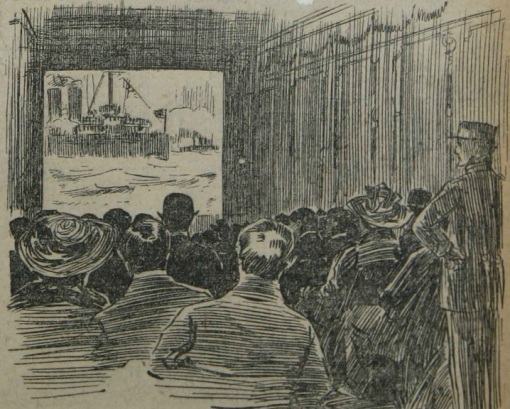
In those days, we had what was known as “continuous performance” which meant that the cinema would start showing a film at around one o’clock in the afternoon to be immediately followed by the main film, which was immediately followed by the first film and the shorts and newsreel. The screen was showing moving pictures from one o’clock until the close of programmes at ten-thirty at night. In effect this meant that people would come in whenever they could. They would pick up the story and see the programme through until they reached the point when they entered. They would then leave. Hence the amusing song by Danny Kaye which had a line which said “This is a movie that ends in the middle for the benefit of the people who came in the middle”.

I would not think these casual comings and goings were by complete choice, I imagine that the picture goers had a good reason to go into a cinemas to be confronted, on arrival, with a film that only had another ten minutes to run.

Of course the result was that throughout the performance, people were coming in and going out. Other disturbances occurred when the ice-cream girl came down the centre isles, in the circle and the stalls, to take up station prior to a short interval. She would arrive before the end of a film and would still be selling when the next film started. During the running of the films, she would still be walking up and down the aisles selling ice creams.

The system of “continuous performance” also allowed that a person could go in at the afternoon start and stay in the cinema until it closed, provided they were not discovered. People were only thrown out of the cinema if they misbehaved.

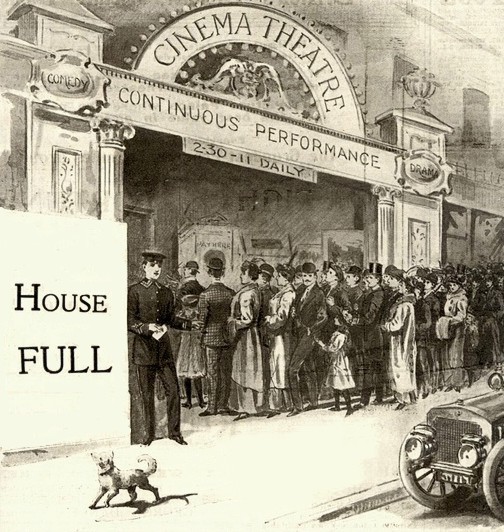
If a film was showing that had had good reports, it was quite common for the cinema to become full and there would be a queue formed outside. There would be a separate queue for each price range of ticket. We all became experts at judging whether it was worthwhile joining the queue or whether to come back another day.

From the late thirties, cinema entrance fees ranged from 1/3d (6 pence) to 1/9d (9 pence) and later from 2/6d (12.5 pence) to 3/6d (17 pence). In 1940, the price of a ticket to the Bruce Grove cinema was 1/9d, but, when they showed “Gone with the Wind”, which runs four hours, they put up the price of a ticket to 2/6d.

For a while, and from time to time, the Regal in Edmonton provided a live variety show. I remember seeing a Music Hall act called “The Seven Eliots” perform, they were musicians and, I think, acrobats. At the organ there would be Sidney Torch who would appear, playing, out of the depths. Later he made a name for himself as an all round musician, conductor and music arranger.

When I see, on television, some of the old films that we paid to go to see, and even queued up for, I often wonder what we saw in them, and yet we enjoyed them at the time. Unlike today’s television schedule, there was always something to look forward to.

Comments: Terence Gallacher is a former newsreel and television news manager and editor who now documents his career through his website http://terencegallacher.wordpress.com. The post is reproduced here with the kind permission of its author.

The Sense of Touch

senseoftouch

Source: ‘Ole Luke-Oie’ [Ernest Dunlop Swinton], extract from ‘The Sense of Touch’, The Strand Magazine, December 1912, pp. 620-631. Illustrations by John Cameron.

Text: ‘Pon my word, I really don’t know what made me go into the place. I’ve never been keen on cinemas. The ones I went to when they first came out quite choked me off. The jiggling of the pictures pulled my eyes out till they felt like a crab’s, and the potted atmosphere made my head ache. I was strolling along, rather bored with things in general and more than a bit tired, and happened to stop as I passed the doors. It seemed just the ordinary picture palace or electric theatre show – ivory-enamelled portico, neuralgic blaze of flame arc-lights above, and underneath, in coloured incandescents, the words, “Mountains of Fun.”

Fun! Good Lord!

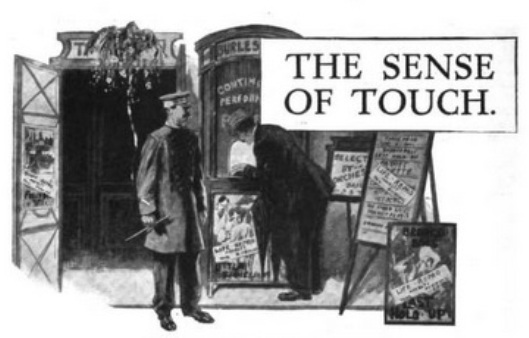
An out-sized and over-uniformed tout, in dirty white gloves and a swagger stick, was strolling backwards and forwards, alternately shouting invitations to see the “continuous performance” and chasing away the recurring clusters of eager-eyed children, whose outward appearance was not suggestive of the possession of the necessary entrance fee. There were highly-coloured posters on every available foot of wall-space – sensational scenes, in which cowboys, revolvers, and assorted deaths predominated – and across them were pasted strips of paper bearing the legend, ” LIFE-REPRO Novelty This Evening.”

I confess that, old as I am, it was that expression which caught me – ” LIFE-REPRO.” It sounded like a new metal polish or an ointment for “swellings on the leg,” but it had the true showman’s ring. I asked the janitor what it meant. Of course he did not know – poor devil! – and only repeated his stock piece: “Splendid new novelty. Now showing. No waiting. Continuous performance. Walk right in.”

I was curious; it was just beginning to rain; and I decided to waste half an hour. No sooner had the metal disc – shot out at me in exchange for sixpence – rattled on to the zinc counter of the ticket-window than the uniformed scoundrel thrust a handbill on me and almost shoved me through a curtained doorway. Quite suddenly I found myself in a dark room, the gloom of which was only accentuated by the picture quivering on a screen about fifty feet away. The change from the glare outside was confusing and the atmosphere smote me, and as I heard the door bang and the curtain being redrawn I felt half inclined to turn round and go out. But while I hesitated, not daring to move until my eyes got acclimatized, someone flashed an electric torch in my eyes, grabbed my ticket, and squeaked, ” Straight along, please,” then switched off the light.

Useful, wasn’t it? I couldn’t see an inch. You know, I’m not very touchy as a rule, but I was getting a bit nettled, and a good deal of my boredom had vanished. I groped my way carefully down what felt like an inclined gangway, now in total darkness, for there was at the moment no picture on the screen, and at once stumbled down a step. A step, mind you, in the centre of a gangway, in a place of entertainment which is usually dark! I naturally threw out my hands to save myself and grabbed what I could. There was a scream, and the film then starting again, I discovered that I was clutching a lady by the hair. The whole thing gave me a jar and threw me into a perspiration – you must remember I was still shaky after my illness. When, as I was apologizing, the same, or another, fool with the torchlight flashed it at my waistcoat and said, “Mind the step,” I’m afraid I told him, as man to man, what I thought of him and the whole beastly show. I was now really annoyed, and showed it. I had no notion there were so many people in the hall until I heard the cries of “Ssshh! ” “Turn him out! ” from all directions.

When I was finally led to a flap-up seat – which I nearly missed, by the way, in the dark – I discovered the reason for the impatience evinced by the audience. I had butted in with my clatter and winged words at the critical moment of a touching scene. To the sound of soft, sad music, all on the black notes, the little incurable cripple child in the tenement house was just being restored to health by watching the remarkably quick growth of the cowslips given to her by the kind-hearted scavenger. Completely as boredom had been banished by the manner of my entrée it quickly returned while I suffered the long-drawn convalescence of ” Little Emmeline.” As soon as this harrowing film was over and the lights were raised I took my chance of looking round.

The hall was very much the usual sort of place – perhaps a bit smaller than most – long and narrow, with a floor sloping down from the back. In front of the screen, which was a very large one, was an enclosed pit containing some artificial palms and tin hydrangeas, a piano and a harmonium, and in the end wall at its right was a small door marked ” Private.” In the side wall on the left near the proscenium place was an exit. The only other means of egress, as far as I could see, was the doorway through which I had entered. Both of these were marked by illuminated glass signs, and on the walls were notices of “No smoking,” “The management beg to thank, those ladies who have so kindly removed their hats,” and advertisement placards – mostly of chocolate. The decorations were too garish for the place to be exactly homely, but it was distinctly commonplace, a contrast to the shambles it became later on. What?

Yes! I daresay you know all about these picture palaces, but I’ve got to give you the points as they appealed to me. I’m not telling you a story, man. I’m simply trying to give you an exact account of what happened. It’s the only way I can do it.

The ventilation was execrable, in spite of the couple of exhaust fans buzzing round overhead, and the air hung stagnant and heavy with traces of stale scent, while wafts of peppermint, aniseed, and eucalyptus occasionally reached me from the seats in front. Tobacco smoke might have increased the density of the atmosphere, but it would have been a welcome cloak to some of the other odours. The place was fairly well filled, the audience consisting largely of women and children of the poorer classes – even babies in arms – just the sort of innocent holiday crowd that awful things always happen to.

By the time I had noticed this much the lights were lowered, and we were treated to a scene of war which converted my boredom into absolute depression. I must describe it to you, because you always will maintain that we are a military nation at heart. By Jove, we are! Even the attendants at this one-horse gaff were wearing uniforms. And the applause with which the jumble of sheer military impossibility and misplaced sentiment presented to us was greeted proves it. The story was called “Only a Bugler Boy.” The first scene represented a small detachment of British soldiers ” At the Front” on ” Active Service” in a savage country. News came in of the “foe.” This was the occasion for a perfect orgy of mouthing, gesticulation, and salutation. How they saluted each other, usually with the wrong hand, without head-covering, and at what speed ! The actors were so keen to convey the military atmosphere that the officers, as often as not, acknowledged a salute before it was given.

Alter much consultation, deep breathing exercise, and making of goo-goo eyes, the long-haired rabbit who was in command selected a position for “defence to the death” so obviously unsuitable and suicidal that he should have been ham-strung at once by his round-shouldered gang of supers. But, no! In striking attitudes they waited to be attacked at immense and quite unnecessary disadvantage by the savage horde. Then, amid noise and smoke, the commander endeavoured to atone for the hopeless situation in which he had placed his luckless men by waving his sword and exposing himself to the enemy’s bullets. I say “atone,” for it would have been the only chance for his detachment if he had been killed, and killed quickly. Well, after some time and many casualties, it occurred to him that it would be as well to do something he should have done at first, and let the nearest friendly force know of his predicament. The diminutive bugler with the clean face and nicely-brushed hair was naturally chosen for this very dangerous mission, which even a grown man would have had a poor chance of carrying out, and after shaking hands all round, well in the open, the little hero started off with his written message.

Then followed a prolonged nightmare of crawling through the bush-studded desert.

Bugler stalled savage foe, and shot several with his revolver. Savage foe stalked bugler and wounded him in both arms and one leg. Finally, after squirming in accentuated and obvious agony for miles, bugler reached the nearest friendly force, staggered up to its commander, thrust his despatch upon him, and swooned in his arms. Occasion for more saluting, deep breathing, and gesticulation, and much keen gazing through field-glasses – notwithstanding the fact that if the beleaguered garrison were in sight the sound of the firing must have been heard long before ! Then a trumpet-call on the harmonium, and away dashed the relief force of mounted men.

Meanwhile we were given a chance of seeing how badly things had been going with the devoted garrison at bay. It was only when they were at their last gasp and cartridge that the relief reached them. With waving of helmets and cheers from the defenders, the first two men of the relieving force hurled themselves over the improvised stockade. You know what they were? I knew what they must be long before they appeared. And it is hardly necessary to specify to which branches of His Majesty’s United Services they belonged. The sorely-wounded but miraculously tough bugler took the stockade in his stride a very good third. He had apparently recovered sufficiently to gallop all the way back with the rescuers – only to faint again, this time in the arms of his own commanding officer. Curtain! “They all love Jack,” an imitation of bagpipes on the harmonium, and “Rule Britannia” from the combined orchestra. As I say, this effort of realism was received with great applause, even by the men present.

As soon as the light went up I had a look at my neighbours. The seats on each side of me were empty, and in the row in front, about a couple of seats to my right, there was one occupant. He was a young fellow of the type of which one sees only too many in our large towns – one of the products of an overdone industrialism. He was round-shouldered and narrow-chested, and his pale thin face suggested hard work carried out in insanitary surroundings and on unwholesome food. His expression was precocious, but the loose mouth showed that its owner was far too unintelligent to be more than feebly and unsuccessfully vicious. He wore a yachting cap well on the back of his head, and on it he sported a plush swallow or eagle – or some other bird – of that virulent but non-committal blue which is neither Oxford nor Cambridge. It was Boat-Race week. He was evidently out for pleasure – poor devil! – and from his incidental remarks, which were all of a quasi-sporting nature, I gathered that he was getting it. I felt sorry for him and sympathized in his entire absorption in the strange scenes passing before his eyes – scenes of excitement and adventure far removed from the monotonous round of his squalid life. How much better an hour of such innocent amusement than time and money wasted in some boozing-ken – eh?

Well, I’m not quite sure what it means myself – some sort of a low drinking-den. But, anyway, that’s what I felt about it. After all, he was a harmless sort of chap, and his unsophisticated enjoyment made me envious. I took an interest in him – thought of giving him a bob or two when I went out. I want you to realize that I had nothing but kindly feelings towards the fellow. He comes in later on – wasn’t so unsuccessful after all.

Then we had one of those interminable scenes of chase in which a horseman flies for life towards you over endless stretches of plain and down the perspective of long vistas of forest, pursued at a discreet distance by other riders, who follow in his exact tracks, even to avoiding the same tree-stumps, all mounted on a breed of horse which does forty-five miles an hour across country and fifty along the hard high road. I forget the cause of the pursuit and its ending, but I know revolvers were used.

The next film was French, and of the snowball type. A man runs down a street. He is at once chased by two policemen, one long and thin and the other fat and bow-legged with an obviously false stomach. The followers very rapidly increase in number to a mixed mob of fifty or more, including nurses with children in perambulators. They go round many corners, and round every corner there happens to be a carefully arranged obstacle which they all fall over in a kicking heap. I remember that soot and whitewash played an important part, also that the wheels of the passing vehicles went round the wrong way.

Owing to the interruption of light, was it? I daresay. Anyway, it was very annoying. Then we had a bit of the supernatural. I’m afraid I didn’t notice what took place, so I’ll spare you a description. I was entirely engrossed with the efforts of the wretched pianist to play tremolo for ten solid minutes. I think it was the ghost melody from “The Corsican Brothers ” that she was struggling with, and the harmonium did not help one bit. The execution got slower and slower and more staccato as her hands grew tired, and at the end I am sure she was jabbing the notes with her aching fingers straight and stiff. Poor girl! What a life!

At about this moment, as far as I remember, a lady came in and took the seat in front of mine. She was a small woman, and was wearing a microscopic bonnet composed of two strings and a sort of crepe muffin. The expression of her face was the most perfect crystallization of peevishness I’ve ever seen, and her hair was screwed up into a tight knob about the size and shape of a large snail-shell. Evidently not well off – probably a charwoman. I caught a glimpse of her gloves as she loosened her bonnet-strings, and the fingertips were like the split buds of a black fuchsia just about to bloom. Shortly after she had taken her seat my friend with the Boat-Race favour suddenly felt hungry, cracked a nut between his teeth, spat out the shell noisily, and ate the kernel with undisguised relish. The lady gathered her mantle round her and sniffed. I was not surprised. The brute continued to crack nuts, eject shells, and chew till he killed all my sympathy for him, till I began to loathe his unhealthy face, and longed for something to strike him dead. This was absolutely the limit, and I should have cleared out had not the words LIFE-REPRO” on the handbill caught my eye. After all it must come to that soon, and I determined to sit the thing out. After one or two more films of a banal nature there was a special interval – called “Intermission” on the screen – and signs were not wanting of the approach of the main event of the show.

Two of the youths had exchanged their electric torches for trays, and perambulated the gangways with cries of “Chuglit— milk chuglit.” A third produced a large garden syringe and proceeded to squirt a fine spray into the air. This hung about in a cloud, and made the room smell like a soap factory. When the curtain bell sounded the curtain was not drawn nor were the lights lowered. A man stepped out of the small door and climbed up on to the narrow ledge in front of the screen, which served as a kind of stage or platform, and much to my disgust made obvious preparation to address the audience. He was a bulky fellow, and his apparent solidity was increased by the cut of his coat. His square chin added to the sense of power conveyed by his build, while a pair of gold-rimmed spectacles gave him an air of seriousness and wisdom. I at once sized him up as a mountebank, and thought I knew what sort of showman’s patter to expect. He did not waste much time before he got busy. Looking slowly all round the room, he fixed my sporting friend with a baleful glare until the latter stopped eating, then cleared his throat and began …

Comments: Ernest Dunlop Swinton (1868-1951) was a British military officer (influential in the development of tanks in the First World War) and a writer, producing fiction under the pseudonym O’le Luk-Oie. The story continues with an announcer promising a natural history film of unsurpassed life-like realism. The film shows a praying mantis and a scorpion which come out of the screen giant-sized and attack the audience, killing those that the narrator disliked before turning on him (see illustration below). In the end it turns out to have been a dream. The description of a cinema show, though sardonic, is filled with useful documentary detail. The garden syringe is a reference to the disinfectant sprays commonly used on cinema audiences at this time.

Links: Copy of the complete story on the Internet Archive
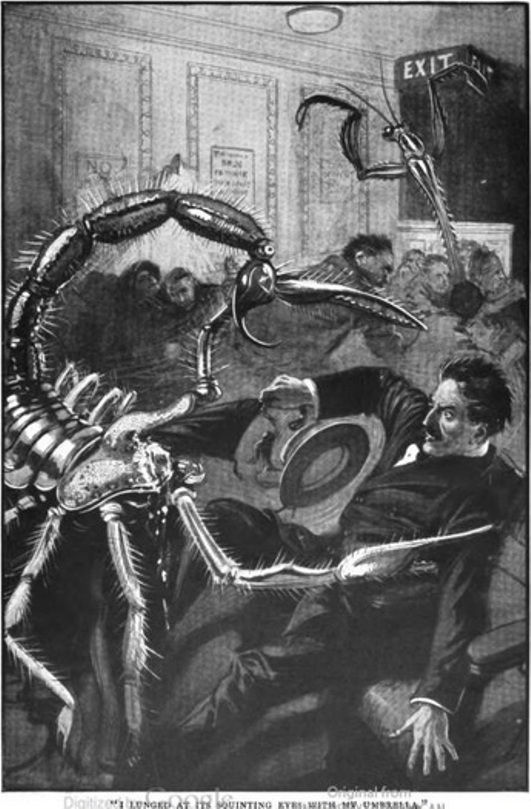
scorpion

Kinomatograph in Paris

Source: Max Brod, extracts from ‘Kinomatograph in Paris’, Der Merker vol. 3 no. 1 (February 1912): pp. 95-98, reproduced in part in Hanns Zischler, Kafka Goes to the Movies (Chicago/London: University of Chicago Press, 2003), pp. 47-51, translation by Susan H. Gillespie

Text: On the very evening that we had set aside as a night off, after so many nocturnal exertions, for a modest meal in the four walls of our hotel and early to bed, we chanced upon a doorway on the boulevard, decked out with little electric light bulbs and a not exactly energetic barker, whose cap, however, bore a title that attracted us more magically than all his words could have. Omnia Pathé … So here we are stood at the source of so many of our enjoyments, once more at the center of a business whose rays shone so powerfully over the whole world that one would almost rather not believe in the existence of a center – a feeling, by the way, that was typical for our Parisian mood; for powerful central firms, (like Pneu Michelin, Douçet, Roger Gallet, Clement Bayard, etc.) besiege the heart of the newcomer with surprising force. We again dispensed with the night off (damned city!) and went in.

It is hard for one darkened hall to differentiate itself from other darkened halls. But for us, who are always firmly set on finding in everything Parisian something special and better than anyplace else, we are soon struck by the spaciousness – no, that’s not it yet – then, that people are disappearing through a dark doorway in the background and a cool draft seems to regulate this continuous movement of the audience – no, that’s how it is at home, too, uninterrupted showings, an entrance and an exit door – but now we feel we are on firmer ground. This freedom of people to be able to position themselves anywhere there is room, even in the aisle between the rows of benches, even on the ramp next to the apparatus, is something decidedly republican, any police force other than the Parisian police would not approve of it. Equally republican, we must admit, is the freedom of the many columns in the hall to be allowed to disturb the audience’s view in whatever way they please …

A girl in the uniform of a soldier in an operetta, on the cap, this time, the ambiguous inscription “Omnia,” accompanies us to our seats, sells us an (according to good Parisian custom, inexact) program. And already we are under the spell of the blindingly white, trembling screen in front of us. We nudge each other. “Say, the show is better here than at home.” Naturally, after all, in Paris everything has to be better.

[Brod describes some of the film programme, including travel films]

We saw, indeed we saw a great deal – by analogy to the Comédie, which puts eight acts on stage almost without intermission. We saw the doctor visit the poor sick child and turn around melodramatically several times in the doorway, with a distinctly pitying expression. We saw the mercifulness of some English king or other, hand-colored, sandwiched between some theatrical armor and a ruin (which had been created from a burned-out suburban cottage), enjoying life.

[…]

At the end , after the usual revolver shots, chases, fisticuffs, came the news. Naturally she was not absent – the one you now see on all the advertisements, candy boxes, and postcards in Paris: Mona Lisa. The picture opened with the presentation of M. Croumolle (everyone knows that it means “Homolle,” and no one protests against the perfidious way they are going after the gray-haired Delphi scholar). Croumolle is lying in bed, his stocking cap pulled down over his ears, and is startled out of sleep by a telegram: “Mona Lisa Stolen.” Croumolle – the Delphi scholar, if you please, but I am not protesting, I was laughing so hard – dresses himself with clownlike agility, now he puts both feet into one leg of his pants; now one foot into two socks. In the end, he runs into the street with his suspenders trailing, all the bystanders turn around to look at him, even those who are far in the background and evidently not in the pay of Pathé … It is a longing that ever since the emergence of the cinema lives on in me with the force of my early childhood wishes – I would like just once, by chance, to turn a street corner where such a staged cinematographic scene is taking place. What wouldn’t it be possible to improvise there! And in any case, what a sight! But to continue. The story is set in the hall of the Louvre, everything excellently imitated, the paintings and, in the middle, the three nails on which the Mona Lisa is hung. Horror; summoning of a comical detective; a shoe button of Croumolle’s as red herring; the detective as shoeshine boy; chase through the cafés of Paris; passers-by forced to have their shoes shined; arrest of the unfortunate Croumolle, for the button that was found at the scene naturally matches his shoe buttons. And now the final gag – while everyone is running through the hall at the Louvre and acting sensational, the thief sneaks in, the Mona Lisa under his arm, hangs her back where she belongs, and takes Velázquez’s Princess instead. No one notices him. Suddenly someone sees the Mona Lisa; general astonishment, and a note in one corner of the rediscovered painting that says, “Pardon me, I am nearsighted. I actually wanted to have the painting next to it.” … Croumolle, poor man, is released.

[…]

Then, in addition, the Journal Pathé. And so that everything quite resembles a newspaper, the title page and “Year III” are solemnly projected beforehand. We see demonstrations against inflation in France, which look like they have been arranged by Pathé; everyone is grinning in the direction of the audience. …

Comments: Max Brod (1884-1968) was a Czech author, best known as the friend and literary executor of Franz Kafka. His essay ‘Kinomatograph in Paris’ describes a visit to the Omnia Pathé cinema in Paris made by Brod and Kafka on 10 September 1911. The Mona Lisa was stolen from the Louvre on 21 August 1911. The Pathé film company rapidly issued Nick Winter et le vol de la Joconde (Nick Winter and the Theft of the Mona Lisa) the following month, as a title in its ‘Nick Winter’ detective series. Théophile Homolle (parodied in the film as Croumolle) was the director of the Louvre. Brod and Kafka had visited the Louvre the day before to witness the scene of the crime. The painting was recovered in 1913. The Omnia Pathé luxury cinema was the first cinema in the Pathé circuit to be in opened in Paris, in 1906.

Links: Copy of full original article (in German) at Hathi Trust

Will you take me in, mister?

Source: David Rayner, contributed by the author.

Text: My earliest memory of picturegoing was on my fourth birthday in April, 1951, when I was taken by my mother and my godmother to the Essoldo, Wellington Road South, Stockport, to see Victor Mature and Hedy Lamaar in Cecil B. DeMille’s Technicolor epic “Samson and Delilah”. I can still remember being very impressed by the sight of Samson pushing apart the pillars of the temple of Dagon and quite literally bring the house down (or in this case, the temple)! I also remember I kept turning around in my seat and looking up at the dancing beam of blue light that came from way up there and that seemed to have something to do with the happenings on the large screen, never dreaming at the time that, eleven years later, I, too, would become a cinema projectionist (although not at the Essoldo, Stockport).

“Will you take me in, mister?”

I began going to the pictures on my own in 1957, when I was ten years old. Going to the pictures in those days was a very different experience to what such things are like today. For my ninepence admission money, I could get to see a feature; a supporting feature; a cartoon; a newsreel; a short and the adverts and trailers. Performances were continuous from 1 p.m. until 10:15 p.m. and you could go into the cinema at any time and, if, when you got inside, the feature was halfway through, you simply sat through the rest of the programme until the feature came on again and then you watched it around to the part where you had come in. I had moved from Stockport to Stoke-on-Trent by that time and, with around 25 cinemas in the Stoke-on-Trent area in the 1950s, there were plenty of films to choose from, especially with most cinemas changing their programme three times a week, on a Sunday, Monday and Thursday.

Of course, I was too young to be allowed in to see an X certificate film, but when an A certificate film was showing (children not allowed in unless accompanied by an adult), I, like many other youngsters at the time, used to wait outside the cinema and ask a man going in if he would take me in with him. None ever refused and, if the man took a liking to me, he would pay for my ticket, thus saving me having to spend my pocket money. After you got inside, sometimes the man would go and sit somewhere else and leave you to it, or sit alongside you and share a bag of sweets with you. These days, modern parents would be totally horrified by such a then commonplace practice. However, incidents of being groped by a man who had taken a boy in to see an A film were rarer than you might think, and, although it did happen to me a couple of times, when I was 12 and 13, I never heard of it happening to any other boy.

Comment: David Rayner was born in 1947 and in adult life became a cinema projectionist (now retired). X certificates were introduced in the UK in 1951, limiting exhibition to those aged over 16 (raised to over 18 in 1970).

Handling the Visitor

Source: ‘Handling the Visitor’, Moving Picture World, 9 October 1909, pp. 482-483

Text: The first impressions are the most durable. When we enter a moving picture house the impression formed on our minds at the threshold of the theater is the one that lasts. If we meet a polite and courteous usher, who shows us to our seats, we are disposed ab initio to take a favorable view of the entertainment. If there is not too much light in the auditorium but just light enough to enable us to distinguish surrounding objects and persons, then we are disposed to compliment the management upon its adroitness in striking the happy mean between darkness and light. For the proper lighting of a moving picture house is a problem of adjustment. You do not want total darkness; you do not want too much light. You want just enough to be able to see your way about without impairing the brilliancy of the picture.

Sometimes you are allowed to find your seat as best you may ; then you run the risk of treading upon a man’s corns or a lady’s dress, and then are proportionately cursed. As a rule, however, it is to the credit of moving picture theater owners that they have courteous ushers and attendants. The more vigorous these latter are in excluding undesirable visitors, the better for the reputation of the house. We have more than once had to complain of the presence of people under the influence of strong waters or who go to sleep and snore, thus disturbing the enjoyment of their fellow visitors. But moving picture theaters are rising so much in popular esteem that this sort of thing is rapidly becoming a feature of the past. Many picture theater exhibitors are vying with each other in the proper care of their audiences.

Too much attention cannot be erven to the cleanliness of the house; to its proper ventilation, and, then to the preservation of quiet and order amongst the audience. Again the sale of candies, with the noisy vocal accompaniments of the vendors is, we think, generally to be deprecated. Many high class moving picture theater exhibitors refuse to do this on the ground that the better kind of visitor is excluded by these cheap jack methods. Others again have objected to the lantern slide advertisements of candies which are put on the screen. Personallv we object to this sort of thing, as we think it tends to lower the dignity of a moving picture theater.

The eternal feminine hat is always a source of much irritation to mere man. It is difficult to see how the admonition to the fair creatures to remove their hats can be dispensed with, for in this regard the average woman is quite a savage person. It is a matter of pure indifference to her as to how much inconvenience the person sitting behind her may be put to by the wearing of her hat. She bought it to wear; to be looked at; to be admired and envied on all and any occasion, and if she has to remove it “hell hath no fury like a woman” deprived of her pet hat.

We have sat behind rows of these things in a church, as well as in a moving picture theater, and our profanity has been too deep for vocal expression. Clergymen anathematize them; caricaturists make fun of them; men curse and criticise them. So what are we to do, except suggest that wherever possible before a woman enters a moving picture theater she must be made to understand that she must remove her hat. He will be a brave moving picture exhibitor who always successfully does this.

On general principles, therefore, we put it that the less advertising matter there is thrown on the screen, the less an audience is made to feel that the object of a moving picture theater exhibitor in getting them into his house is to extract something more than the admission money from them, the more likely that house will find public favor and continuous support. It is annoying, to say the least of it, to an average person of refinement to have a considerable part of his time taken up in reading announcement slides about ladies’ hats, candies and the like. What we are insisting upon is the exclusion as far as possible of the mere huckstering element of a moving picture entertainment, and the making for everything possible in the way of orderliness, neatness, good sanitation, plenty of light, but not too much of it, courtesy on the part of the ushers and in short the general atmosphere of comfort, if not luxury, which the public at large always looks for in a place of entertainment and pleasure. There is one little convenience which we think the public would always appreciate, and we are surprised that it is not taken up, namely the circulation amongst the audience of synopses of the stories of the films shown. Of course, these things could not be read in a dark house, but there is no reason why even in a continuous performance there should not be brief intermissions when the programme, if such we may call it, could be read by the audience. Some moving picture houses we know supply programmes, but none that we are aware of print anything about the stories of the films. This is a point we commend to the enterprising moving picture exhibitor. Anything which makes for the comfort of an audience is bound to result in a continuous patronage and the building of the family support which is one of the surest roads to success in conducting places of public entertainment.

Comment: This article in chapter four in a Moving Picture World series, ‘The Modern Moving Picture Theatre’.

Links: Available from the Internet Archive

The Picture-Palaces of London

picturepalace

Illustration accompanying the original article

Source: ‘The Picture-Palaces of London’, The Daily Chronicle, 9 April 1910

Text: The Picture-Palaces of London. Have They Comes to Stay?

Pricked out in electric lights, on an imposing brand new structure of white stucco, you read the words “Cinematograph Theatre.” You wonder where the thing has come from. Like Aladdin’s Palace, it seems to have sprung up in a single night. On yesterday there was a block of old houses on that very spot. You remember looking in a the greengrocer’s window as you sauntered home to dinner, wondering what kind of fruit the children would like.

Well, no, it could not have been yesterday, but it was certainly the week before last!

A few weeks later the white stucco erection appears to have budded. There are two of the now, side by side. The matter is worth further enquiry, so you cross over, and read the “bill of fare” at either door. The rival attendants, gorgeously arrayed, glance at you with enticing eyes, but you regard not their mute entreaties. Then you are probably taken by surprise. The charm of the things catches you. Perhaps it is best set down as a free-and-easiness. Go when you will, after the door is opened, you are never late; never in anxiety over a seat. The show goes on continuously. There is a set of pictures for the day – six perhaps, or eight – and if you miss numbers one and two, why, you will see them for certain after number eight.

Entertainment Ad Lib.

The set may last an hour, to an hour and a half, but you need not go out at that time unless you have a mind to. You may sit still, if you choose, and see the whole set over again. I dare say you won’t, unless it is pouring wet outside, and you have forgotten your umbrella, but it is something to know that you can.

The cinematograph theatre fills a gap in our scheme of amusement. It may be a small gap, but still it was there, and now it is filled. It catches the leakage from the theatres and halls, the unfortunately who are sent sorrowfully away by the unwelcome announcement of “House full.”

It gives the tired sightseer an hour’s respite from the noise and fatigue of the streets, and in some cases it dangles the tempting bait of “afternoon tea[“] gratis before this type of prospective patron. To the regular theatre it stands in the same relationship as a “snack” does to a formal luncheon. It is the resource of the man with only an hour to spare, the lady who doesn’t like to be out late, the girl whose papa doesn’t approve of theatres, the little boy who must be in bed at six, the hospital nurse who only has two hours off duty, and the family party from the provinces, whose train starts at ten sharp.

Oh, and one must not forget the lovers! Humble lovers, perhaps, with a few shillings to spare. one sees them often in the sixpenny seats, holding hands in the friendly dark. They watch the films go spinning on, with absent eyes and beatific smiles. They haven’t come there for the show, but to find a corner to sit in, out of the wet. One can’t always go round and round the Inner Circle with a penny ticket without catching the eye of the cute conductor!

The Aristocratic Sixpence.

There are differences in the quality of these as of all other types of amusement. There are the second-raters in the outlying streets, just beyond the radius of West-end style. The modest sum of threepence will gain you admittance here, and if you indulge yourself to the tune of sixpence you are “a swell.” The pictures are usually quite up to the average, but the environment is not. The dark is not friendly, but apprehensive. One is suspicious of one’s neighbour, and keeps a tight clutch on one’s belongings. There is every prospect of carrying away with you less than you ought, and more than you bargained for. Reminiscences of the place are forced upon you next day by the odour of stale and indifferent tobacco that clings to your clothes. As you near the vicinity of Oxford-street there is a decided attempt at luxury in the internal appointments of the “Palaces.” The goods are not all in the shop window. Decidedly, too, the “orchestra” plays better. It consists usually of a girl with a piano, the latter very much at her mercy. In some of the theatres visited by the writer, it would be only charitable to suppose that the lady pianist had fallen a victim to the prevalent disease newly christened by a London daily as “The Hump.” She played in spasms, with a reckless disregard of time and tune, and an obvious idea that her function was merely to drown out the silence.

In the West they have changed all that, and, incidentally, the prices have gone up. We may now pay two shillings for a “fauteuil” (which is a horrid, awkward word to spell, and means exactly the same as seat, anyway!). Along with the fauteuil we have the advantage of being shone upon by rose-shaded electric lights, vastly improving to the complexion, and of feasting our eyes on the artistic decorations of the walls when we tire of the pictures.

People do not laugh so boisterously here as they do in the north and east. At most they chuckle. On the whole, there is a remarkable absence of all kinds of noise in these cinematograph theatres. Applause seems to be a thing unknown. It is a relief to hear the voice of a child imperiously demanding, as the name of the film appears, “Read it, mother. Read it quick!”

Child’s Living Picture Book.

The little folks are mostly to be found at the afternoon performances. It must all seem a kind of glorified picture book to them. How they roar over the man who knocks down everything, or the fat old lady pursued by some strange fatality, who is knocked down by everybody! They have a wonderful aptitude, too, for following the “story” in some of the more ambitious pictures. The kidnapped child is one of their favourites. “Did they find him, mother? Are you sure?” a little lad asks in a tearful voice, to the kindly amusement of all who sit near by. The tragic subjects find favour with young ladies, one fancies, and indeed they are sometimes admirably conceived – real dramas, in which the words are hardly missed. The marvellous power of facial expression to convey an emotion in all its subtle shades is brought home to the mind with striking force by the intense interest one feels in these “mimed” plays. Of course it is hard to forget that the pictures are “faked.” One could never for a moment admit the possibility of pictorial drama affecting the taste for the drama of the regular stage. Too much talk may be bad, as was instanced in a recent much-criticised production, but no talk at all is the worse evil of the two.

Perhaps most successful of all are the travel pictures, where the scenery is absolutely realistic, and the sense of motion admirably conveyed. No “book of views,” however beautiful, can fascinate as this moving panorama does. It is as good as a holiday – and somewhat cheaper!

Have the pictures come to stay? Yes, they have filled a gap. It will be long before anything more novel or more entertaining appears to fit that precise niche in the House of Pleasure.

Comment: The inner Circle refers to a London underground train line.

Yesterday's Sunshine

Source: Verne Morgan, Yesterday’s Sunshine: Reminiscences of an Edwardian Childhood (Folkestone: Bailey Brothers and Swinfen, 1974), pp. 122-126

Text: The Moving Pictures, as we called them, first came to Bromley when I was about seven. They made their début at the Central Hall, and the performances took place on Friday nights. There were two houses, one at five o’clock for the children and one at seven for the grown-ups. The programmes lasted approximately one hour, and consisted of a succession of short films. Indeed some of them would last no longer than three or four minutes and there would be an appreciable wait in between while the man in the box got busy threading the next reel.

The Central Hall was a vast place with a huge gallery encircling it. It was used mostly for political meetings and the like, and quite often a band concert would be held there too. But it also had a pronounced ecclesiastical leaning and the man who owned it belonged in some way to the church and was avidly religious. He was an elderly man and wore pince-nez spectacles to which were attached a long black cord. He was a man of extremely good intentions and loved to stand upon the platform making long speeches spouting about them. Unfortunately, he had the most dreadful impediment and it was quite impossible to understand a word he said. But I well remember the enthusiastic claps he got when he eventually sat down, not because we had appreciated what he said so much as the fact that he had at last finished. The film programme could then begin.

The operating box was a temporary affair, and was perched up at the rear of the gallery. I used to get a seat as close to it as possible so that I could see how it was all done. The lighting was effected by a stick of black carbon, about the size of a piece of chalk, which lit up the small box with a brilliant blueish-white light and had a blinding effect if you looked right at it. Occasionally it would burn low and the operator would push it up a bit; this would be reflected by the density of light on the screen. The screen itself was also of a temporary nature, it was in fact little more than a large white sheet weighted at the bottom to keep it taut. Any movement close to it would cause it to wobble, and the picture would go a little peculiar. We were not critical of such minor details. The very fact that the picture moved was enough to satisfy us.

As each small reel was finished the operator would place it outside for re-winding, his box being of limited dimensions. On account of this I was able to study the technique as to how the pictures appeared to move. It was so simple I could hardly believe it. I told my Brother about it; I told my Mother about it; I told lots of people about it. But no one believed me. So, to prove myself right, I set about editing a film on my own account. I drew a succession of pictures in pencil on the bottom of a hymn book in church. Each one was just that little bit different, so that when the pages were flicked over the overall picture appeared to move. This technique, in ‘flicker’ form, has, of course, been used in many ways since then, but at the time it was entirely my own idea, and I was middling proud of it. I can’t say that anybody was particularly impressed, but at the time it thrilled me beyond description. In due course I pictorialised all the hymn books I could lay my hands on, during the sermon and other breaks in the church service. They consisted mostly of football matches with someone scoring a goal. Or it might be a boxing match with someone getting knocked out. Or an exciting race with a hectically close finish. Anything that inspired my sporting instincts was in course of time recorded in the hymn books of St. Luke’s Church, Bromley. I have often wondered since what the effect must have been on the boy who eventually took my seat in the choir pew when he found what he had inherited. I can only hope that he had as much enjoyment out of watching animated pictures as I had got out of drawing them.

The Central Hall was situated close to the top of Bromley Hill, nearly three miles from where we lived. It was a long walk for small legs, and there was no public transport at that time. Yet, whatever the weather, we never missed. Every Friday, shortly after school hours, a swarm of happy-faced youngsters were to be seen all heading in the same direction. The Central Hall had become the centre of a new culture. But, as yet, only the school kids had caught on to it.

Then quite suddenly, the Grand Theatre in Bromley High Street, which up till then had housed nothing more spectacular than stage dramas of the “Maria Marten” and “Sweeney Todd” kind, put up the shutters and announced that in future Moving Pictures would take over. They would be put on once nightly with a full programme of films. A new firm moved in calling itself Jury’s. The old Grand was given a face-lift and transformed into a picture house.

This was revolutionary indeed.

The grown-ups were sceptical. But the programmes were of a higher standard than those at the Central Hall, and would sometimes have a two-reeler as the star attraction. The films began to take on a more realistic angle, with interesting stories, love scenes, cowboys and Indians, exciting battles and lots of gooey pathos.

People began to go.

When they announced a showing of the famous story “Quo Vadis” in seven reels, all Bromley turned out to see it. Even my father condescended, and grumbled volubly because he had to “line up” to get it (the word “queue” had not yet come into circulation).

It was the beginning of a new era. Very soon a place was built in the High Street, calling itself a cinema. Moving pictures were firmly on the map, and shortly to be called films. We watched with astonishment as the new building reached completion and gave itself the high-flown title of “The Palaise [sic] de luxe”.

Most of us pronounced it as it was spelt, “The Palace de lux”, but my cousin Daisy, who was seventeen and having French lessons twice a week, pronounced it the “Palyay dee Loo”. And she twisted her mouth into all sorts of shapes when she said it.

That being as it may, the Palaise de Luxe put on programmes that pulled in the crowds from far and near, and it wasn’t long before they engaged a pianist to play the piano while the films were in progress. I remember him well. A portly gentleman who hitherto had earned a precarious living playing in local pubs. He soon got into his stride and began to adapt his choice of music to the particular film that was being shown. If it was a comedy he would play something like “The Irish Washerwoman”; if it was something sad, he would rattle off a popular number of the day like, “If your heart should ache awhile never mind”, and if it was a military scene, he would strike up a well-known march. The classic example came when a religious film was presented and we saw Christ walking on the water. He immediately struck up a few bards of “A life on the ocean wave”.

Later on, all cinemas worthy of the name included a small orchestra to accompany the films, and in due course, a complete score of suitable music would be sent with the main feature film so as to give the right effect at the right moment.

The Palaise de Luxe was indeed a palace as far as we were concerned. We sat in plush tip-up seats and there were two programmes a night. Further, you could walk in any old time and leave when you felt like it. Which meant, of course, that you could, if you so desired, be in at the start and watch the programme twice through (which many of us did and suffered a tanning for getting home late). It was warm and cosy, and there was a small upper circle for those who didn’t wish to mix!

The projector was discreetly hidden away behind the back wall up in the circle, and no longer could you see the man turning the handle. We became conscious for the first time of the strong beam of light that extended from the operating box to the screen. It was all so fascinating and mysterious. The screen, too, was no longer a piece of white material hanging from the ceiling, it was built into the wall, or so it appeared, and it was solid, so that no amount of movement could make it wobble.

It quickly became the custom to visit the cinema once a week. It was the “in” thing, or as we said in those days, it was “all the rage”.

We learnt to discriminate. My Brother and I became infatuated with a funny little man who was just that bit different from the others. His tomfoolery had a “soul” we decided, and whereas we smiled and tittered at the others comics, we roared our heads off with laughter whenever this one came on the screen. We went to a great deal of trouble to find out who he was, for names were not very often given in the early days.

“He’s called Charlie Chaplin”, the manager of the cinema told us, a little surprised no doubt that one so young could be all that interested.

Comment: Verne Morgan lived in Kent, and became a writer of pantomimes and theatre sketches. Palais de Luxe cinemas were a chain, run by Electric Theatres (1908) Ltd. Jury’s Imperial Pictures was a producer and distributor, but did not manage cinemas. The period described is the early to mid-1910s: the Italian film Quo Vadis was made in 1913 and Chaplin’s first films were released in 1914. The mention of a piano player being introduced suggests that the earlier screenings had been watched without musical accompaniment.

The Lure of the Films

lureofthefilms1

Illustration by Wilson C. Dexter that accompanies the original article

Source: Olivia Howard Dunbar, ‘The Lure of the Films’, Harper’s Weekly, 18 January 1913, pp. 20, 22

Text: Adventures to discover how and where the rest of the world amuses itself are rarely as jocund as they sound. But the adventurer of proper spirit is usually content in witnessing the riotous joy of the multitude, however grimly unmoved his own less facile springs of mirth. Oddly enough, an attempt to share in the delights of “moving pictures,” widely accepted as the most popular of amusements, can scarcely be counted upon to produce even this vicarious satisfaction. For if the adventurer himself gives no sign of being entertained by the “photoplay” or the “art-film,” neither, to his amazement, does the close-packed audience that surrounds him – a fact that is at first inexplicable.

Does all the world demand the “film-show” and then withhold its approval from sheer caprice? And why does it throng so steadily today to the very performance whose lack of stimulus it must have discovered yesterday and the day before?

On the other hand, if a random assemblage of this sort gives mysteriously few evidences of active enjoyment, it gives fewer still of displeasure or ennui. To watch it is to discover that it is infinitely tolerant; completely and blessedly immune to boredom. It even betrays no annoyance on being gently approached from behind by some deputy of the management, and sprayed, as a festal touch, with strong. inalienable scent. Daily and hourly – for their patronage is so great that they open either at noon or at nine in the morning — these theaters offer thousands of cases in disproof of all that has been fallaciously said in regard to the restless energy of the American. You wonder how it can be possible, in an alleged busy world, to secure this magnificent total of leisure – to assemble daily, and for long, blank periods, so many people who have nothing to do and who are obviously not worrying about it. Every day, under these roofs, has the stagnant and misleading air of a holiday. And while it may be true that shirking housewives and truant children are never missing, it is nevertheless an interesting fact that three-fourths of the spectators are always men.

Rarely does such an audience betray animation, scarcely ever awareness. Its posture is indifferent and relaxed; its jaws moving unconcernedly in tune with the endlessly reiterated ragtime ground out by some durable automaton — at least, one prefers to believe it an automaton; its dull eyes unresponsively meeting the shadowy grimaccs on the flickering “ film.”

Are these pleasure-seekers resolutely disguising their enjoyment? Or are they, as they appear to be, half asleep? It is true that all the conditions conduce to semi-somnolence – the unbroken whine of the ragtime; the unnatural “continuousness” of the exhibition, hour after hour, without a moment’s interval; the lack of sequence or climax, as of one oddly literal dream succeeding another — varied, at long intervals, by a bolder picture that introduces the strange, noiseless turbulence of nightmare.

In spite of the lack of enthusiasm, there is an indefinable atmosphere of experience and accustomedness. Nobody but yourself is unfamiliar and inquiring. There is rather less suspense and excitement than you will encounter in a trolley-car. You begin to suspect that the phlegmatic audience, having come a great many times before, is quite prepared for the fact that nine-tenths of the programme will be padding and that it does not mind in the least. There is not so much as a change of its expression, much less a sign of applause, as companies of shadow-soldiers are assembled and drilled; parades of a dozen kinds trail their blurred length across the curtain; foreign cities flash out glimpses of their characteristic scenes; ships are launched, cornerstones are laid, medals are presented, and laboratory experiments demonstrating some feature of popular science are painstakingly performed. All “films,” in fact, that may be classed as educational or even indirectly instructive, as well as the occasional ones that are of a genuinely artistic interest, meet with frank but unrcbellious indifference.

For an hour this may continue. Then you are conscious of a stir in the chairs behind you, and a man’s didactic voice begins to enlighten the woman who is with him, in precisely the same fashion that the couple who have sat behind you at the theater all your life have gratuitously explained and perfunctorily listened. You rouse yourself, look about, even glance at the forgotten curtain to discover what it is that has relieved an apathy so general and so profound; and discover that, far from being some unimagined marvel, it is merelv a street scene in New York. And you wonder why the “Film Trust” should go to the trouble of contriving historical “playlets” in costume, through which audiences sleep contentedly, when what really stirs them is the representation of something that they see every day of their lives – the life-size figure of a policeman, a trolley-car, a crowd on Broadway. But this is not, after all, a new phenomenon. The ecstasy experienced by persons of a certain degree of simplicity in recognizing on the stage a familiar object or character has never been explained, although producers must long have realized and catered to it, as an incident in many kinds of drama. It has so often been apparent that audiences betrayed a keener delight in the introduction into a play of a cow or a horse than in the exploits of the most accomplished actor. During one long afternoon of widely varied cinematographic devices, the only genuine success was achieved by a youth who came out before the curtain made a sound like an automobile! This bit of simple realism did wake the sleeping audience from its dreams and gave them an unmistakably poignant pleasure which they expressed without restraint.

These flashes of sympathetic response are rare and fleeting, but may always be evoked by one other element – the broadly farcical. And it is perhaps unnecessary to explain that, the more nearly this unliteral comedy (for realism plays no part_here) approaches that of the comic supplement, the wilder and more immediate its success. An altercation, a practical joke, a chase, are of course the unvarying themes, a chase of anything by anybody, however meaningless, being the acknowledged favorite. Unfailingly popular are the pictured disputes between an impossible mistress and an unnatural servant, in which the maid tumultuously triumphs; or farcical interruptions of the love-making of an ill-suited couple; or rowdy street scenes in which people tumble over each other and somebody gets beaten for an offense he didn’t commit, while the culprit leers from a. neighboring corner. All this is, of course, more or less vulgar, but in the highly unrealistic sense that the comic supplement is vulgar — a harsh, unlovely, shadow-land, repellent, one would suppose, to intelligence and sanity.

The merriment that was set free by the pictured conflict of boy and policeman subsides again into apathy when the first scene in the more ambitious “photoplay” is flashed upon the curtain. For these fragmentary echoes of melodrama seem to be accepted merely as echoes, dim and undisturbing. Their warmed-over quality enables the spectator to remain entirely cool and disillusioned. And yet these plays often present not only the same type of heroine and villain that the old plays did, but the same actors — one would swear to it. The villain’s throwing back his head in cruel, contemptuous laughter is a trick he must have learned and often practised on Fourteenth Street. And the malign deliberation of his walk is full of an ancient theatric significance that could scarcely be felt by any traditionless cub, hired to play in pantomime before the camera. On the other hand, that intemperate use of the telephone that characterizes the moving-picture play was of course unknown to melodrama.

The “Indian play ” – indeed, the Wild West drama generally — is understood to be a commodity that is ordered in large quantities for contemporary audiences; but the result produces no apparent excitement. While a red man discovers a child left alone in a prairie cabin, and, brandishing cruel weapons, pursues the child through various shadow-scenes, the audience contentedly chews its gum. Further scenes are revealed in which the child’s father appears, rescues the child and slays the Indian — but the onlookers are still unmoved. Even the dramatic adventures of the simpering young girl who is menaced by a nondescript villain and rescued at the critical moment by the humble but hitherto neglected suitor are accepted with complete nonchalance. Endangered girlhood is, however, so frequently and persistently presented that the theory must exist that it is a favorite stimulus with these stodgy audiences.

lureofthefilms2

‘There is not so much as a change of expression, much less a sign of applause.’ Illustration by Wilson C. Dexter that accompanies the original article, with caption

Yet these apathetic groups who now appear, except for their occasional bursts of unjoyous mirth, emotionless, are the same men and women who only a few years ago thronged constantly to the melodramas at the urge of what seemed to be an elemental need, the need of wholesome emotional exercise. No audience was ever disappointed in one of these eminently reliable performances; none was ever bored or critical or sleepy. One knew what one had come for and settled down comfortably to enjoy it. It was of relatively little importance whether the central figure in the tangle of love, danger, sacrifice, villainy, heroism, disaster, and triumph was Nellie, the Beautiful Cloak Model, or Bertha, the Sewing-Machine Girl — the succession of thrills was of practically the same character and intensity. What these audiences unconsciously demanded was an excuse to laugh, weep, pity, resent, condemn, and admire, all in strict conformity with the orthodox moral code; and it was this that was abundantly furnished them. It would surely be a psychological marvel if so deep a need could have vanished as the coincidence of a mere change of fashion in entertainments.

But the best and most satisfying feature of the melodramas was their imaginative scope, their denial of logical limitations. The simple, normal mind while it has felt a childlike delight in the occasional realistic detail, has probably always been charmed by the theater in proportion as its spectacle, as a whole, transcended reality. A world as unfettered as the world of faery, whose characters should have the shape and speech of the ordinary wage-earner, would have at any time a compelling appeal. “What attracted me so strongly to the theater,” Wagner says, speaking of his childhood, “was … the fascinating pleasure of finding mvself in an entirely different atmosphere, in a world that was purely fantastic and often gruesomely attractive. Thus to me … some costume or a characteristic part of it seemed to come from another world, to be in some way as attractive as an apparition.” There is no doubt that this is the expression of a universal experience; and that if a sensitive, impressionable child of six or seven could define and express the emotions (too vaguely recalled by the adult) aroused by its first theater, this would form a human document of thrilling interest. And it may be that melodrama at its best supplied multitudes of adult children with an approximation of this delicious and memorable experience of infancy.

In comparison with the popular drama that it has succeeded and supplanted, the motion picture of course provides little or no emotional outlet. It is far from attempting to “purge with pity and terror” the casual multitudes that it attracts. In most cases the interest that it excites, when it excites any, is shallow, fleeting, two-dimensional, like the pictures themselves. It offers no illusion and no mystery. What is left to those who have had to accustom themselves to this thin and unsatisfying form of emotion, but to acquire, as they have, a self-protective surface of apparent torpor?

It is easy, of course, to recall conspicuously exceptional cases. There is now and then a feverish desire to see the pictured record of some current event of especial interest, particularly when it has to do with sports. But the kind of excitement that would be aroused by the records of a baseball or football game is a very special thing, and is infinity [sic] removed from the mere normal desire for amusement. Yet it is fully shared, as everybody knows, by sophisticated childhood. Indeed, the overpowering desire felt by youthful East Side citizens to see certain celebrated “movies” has more than once led them into tragic difficulty. Not many months ago, just after a much-advertised prize-fight, two little boys, whose uncontrollable longing for the admission fee to a picture-hall had led them to upset a grocer’s display and barter his goods independently, were brought to the Children’s Court. “The price of admittance was five cents?” inquired the judge, examining them. The smaller boy, who was very small indeed, quickly raised his thin, tense face. “Oh, but it was ten cents to see the big fight, judge!” he cried, hoarsely, the tremendous intensity of his manner and expression at once defining the almost irresistible character of his temptation and what he felt to be the manly magnitude of his crime.

But even though its imagination starve, a disaster of which it can scarcely be conscious, it is not difficult to understand why the vast, simple, unexigent public so faithfully follows up the moving picture. Almost any institution that cost so little would probably be patronized, even though the most it did was to provide a convenient and often comfortable lounging place, and, in the poorer quarters of the city, to provide an excuse for social contact. After all, there is no question but that the equivalent of a nickel is usually supplied. Beyond this, there is the fascination of never knowing what one is going to see, which is a far greater lure than an exact knowledge of what is forthcoming. But its strongest hold must be the fact that it makes no demand whatever upon its audiences, requiring neither punctuality — for it has no beginning — nor patience — for it has no end — nor attention — for it has no sequence. No degree of intelligence is necessary, no knowledge of our language, nor convictions nor attitude of any kind, reasonably good eyesight being indeed the only requisite. In the world of amusement, no line of less resistance than this has surely yet been offered.

Comment: Olivia Howard Dunbar (1873-1953) was an American biographer and writer of ghost stories.

Brixton Scala

brixtonscala

Source: Advertisment, Brixton Free Press, 1914 [no day or month given], reproduced at http://www.urban75.org/brixton/history/posters4.html

Comment: This image comes from advertisement for the Brixton Scala cinema, London, in the Brixton Free Press, 1914. The cinema opened in 1911. The widespread ‘continuous show’ policy, whereby audiences could drop in on a cinema show, played a huge role in early cinema’s popularity and adoption by those who felt excluded from many other forms of public entertainment.

The Cinema Audience

Source: ‘The Cinema Audience’, The Evening Telegraph [Dundee], 11 September 1919, p. 4

Text: The Cinema Audience. Screengazers Under An Observant Eye. “Potting the Picturegoer” a Fascinating Sport. (Special to Telegraph and Post.)

“Potting the picturegoer” can be quite a fascinating sport. There is no necessity to don loud tweeds and light brogues or flannel trousers and white shoes. You enter the arena in everyday costume and arm yourself with the only weapon required — the observant eye. Of course, you are merely courting trouble if, when caught at the game in the entrance hall of a picture house, you call yourself a “practical psychologist.” The gold-braided gentleman who is the presiding genius of the place will rightly resent and suspect such language, and probably propel you streetwards. Rather tell him with disarming frankness that you are studying the “screengazer” in his native haunts and that you propose presently to inside and continue your investigations.

Ten minutes near the pay-box will convince you that your “victims” are drawn from every class of society. You soon understand why Mary Pickford can claim to be the “world’s sweetheart.” It this mingling of all sorts and conditions of people that makes the observer’s game worth while. Notice particularly the mood that prevails in the queue. It contrasts strangely with that of the audience passing through a theatre “foyer.”

There no ceremony about picture-going, no air of attending a function. The “pictures” are free and easy in spirit, and the audience is similarly affected. It largely this “come and go as you please” atmosphere that maintains the popularity of the cinema.

Inside the house, you come to close quarters with your “quarry.” Before long you discover that the shrewdest judge of a picture is the audience. You will find, of course, that criticism changes character you pass from back to front of the hall, but really good picture will be recognised and praised by all, while the faults of a film will be unerringly detected.

If a comedy is screened will be interesting to watch the effect on various members of the audience. Not every screen comedy is really humorous, and you may be surprised to find a friend who prides himself on his subtle and refined sense of humour taking advantage of the darkness to grin broadly at what is actually silly horseplay.

He may be comfortably placed in the best seats the house affords, while an occupant of the benches near the screen is only bored by the film. You therefore conclude that appreciation of real humour is not necessarily conferred by the ability, to pay for a “tip-up.”

Things That Annoy.

The “star” film flickers on to the screen. If it is a well-constructed picture the interest of the audience is maintained, but you need not a profound observer to note the sign of impatience when the story “drags. “Padding out” a picture irritates, and a player who takes thirty feet of film to accomplish what could reasonably be done in ten annoys the audience.

Your picture-goer is credulous, although he hates to be asked to swallow too much, He will stand absurd situations which no playwright would dream of foisting on theatre audience. But he is gradually coming to demand from the screen some approach to the happenings of real life, and to reject as impossible many situations that have hitherto passed muster. He likes what is novel, but refuses the wholly improbable.

Suppose that the film is of American production. The fact may account for a mystified and almost angry audience. You watch it vainly trying to grasp the meaning of tho letterpress or “leaders” between the scenes, for the American has entirely forgotten that the British audience, while capable understanding English, makes little of New York Bowery slang. Some of these Americanisms have an undeniable piquancy, but most are unintelligible, and only succeed in annoying the picture goer.

Comment: This curious article was published in Scotland by the Dundee-based Evening Telegraph newspaper. It addresses itself to an audience with seemingly little knowledge of cinema at all, at a time when cinema-going throughout the UK was coming to be adopted widely across the UK and no longer seen as a largely working class entertainment. The audience reported on was presumably in Dundee.