Flashback

Source: George Pearson, Flashback: The Autobiography of a British Film-maker (London: George Allen & Unwin, 1957), p. 130.

Text: Of all the moments in my narrative, the Two Minutes’ Silence was by far the most important, the keystone of the whole structure. If that failed, all failed. Only by a sincerity of utter simplicity could that great spiritual moment capture the understanding contribution of a theatre audience. The supreme test came at the film première. Emotional music had illuminated the film throughout, led by that master of his craft, Louis Levy. At the vital instant, his baton stopped. Melody ceased with lightning suddenness … dead silence in that great packed auditorium … the screen telling only of things that spoke to the heart alone. An old quavering mother at a little open window, old eyes seeking the heavens, worn hands against her aged breast … silence … and then a faint breeze stirring the thin muslin curtain, wafting it gently to touch her cheek … to kiss it … and wipe away a tear … and falls as silently as it had lifted … and still, the silence … exactly two minutes … an audience seemingly spellbound. Then Louis Levy’s baton lifted … struck … and the Reveille broke the magic of silence … Music spoke its consolation. Hardened as I was by the making of the film, that frozen silence had moved me to tears.

Comments: George Pearson (1875-1973) was a British film director. His silent feature film Reveille (UK 1924) followed the lives of some British soldiers during and after the First World War. Its dramatic high-point was where the accompanying music stopped and the audience, like the characters on the screen, marked the two minutes’ silence out of respect for the dead. Louis Levy was a cinema conductor who went on to become musical director at Gainsborough Pictures.

Silent Magic

Source: Ivan Butler, Silent Magic: Rediscovering the Silent Film Era (London: Columbus Books, 1987), pp. 27-31

Text: During the early part of the 1920s my own cinema-going was restricted by the confinements of boarding-school during term time, and in the holidays (to a lesser extent) by the fact that at least in our neighbourhood ‘the pictures’, though tolerated and even enjoyed, were still regarded as a poor and slightly dubious relative of the live theatre, the picture gallery and the concert hall. Their passage towards respectability was not helped by scandals in Hollywood such as the ‘Fatty Arbuckle Affair’. I can still recollect the atmosphere of something sinister and shuddersome that surrounded the very word ‘Arbuckle’ long after the trials (and complete acquittal) of the unfortunate comedian, even though my innocent ideas of what actually took place in that San Francisco apartment during the lively party on 5 September 1921 were wholly vague and inaccurate – if tantalizing. In his massive history of American cinema, The Movies, Richard Griffith writes, “During the course of the First World War the middle class, by imperceptible degrees, became a part of the movie audience.’ ‘lmperceptible’ might be regarded as the operative word. However, when it comes to paying surreptitious visits a great many obstacles can be overcome by a little guile and ingenuity, and I don’t remember feeling particularly deprived in that respect. I managed to see most of what I wanted to see.

Our ‘local’ was the cosy little Royal in Kensington High Street, London – a bus journey away. The Royal has been gone for half a century, its demise hastened by the erection of a super-cinema at the corner of Earl’s Court Road. To the faithful it was known not as the Royal but as the Little Cinema Under the Big Clock in the High Street. The clock itself is gone now, but on a recent visit I though I could spot its former position by brackets that remain fixed high in the brick wall. The entrance to the cinema was through a passageway between two small shops, discreetly hidden except for two frames of stills and a small poster. A pause at the tiny box-office, a turn to the left, a step through a swing door and a red baize curtain, and one was in the enchanted land – not, however, in sight of the screen, because that was flush with the entrance, so you saw a grossly twisted pulsating picture which gradually formed itself into shape as, glancing backwards so as not to miss anything, you groped your way up to your seat. To the right of the screen was the clock in a dim red glow, an indispensable and friendly feature of nearly all cinemas in those days, and a warning – as one was perhaps watching the continuous programme through for the second run, that time was getting on. Prices were modest: from 8d (3p), to 3s (15p). This was fairly general in the smaller halls; cheaper seats were available in some, particularly in the provinces, others – slightly more imposing demanded slightly more for the back rows, possibly with roomier seats and softer upholstery, but such elitism was not, to my memory, practised at the Royal.

Projection was to our unsophisticated eyes generally good, preserving the often marvellously crisp and well graded black-and-white photography. Programmes were changed twice weekly (but the cinemas were closed on Sundays, at any rate during the early years) and continuous from about 2 o’clock. They consisted as a rule of a newsreel such as the Pathé Gazette with its proudly crowing cockerel (silent, of course), a two-reel comedy (sometimes the best part of the entertainment), Eve’s Film Review, a feminine-angled magazine the high spot of which was the appearance of Felix the Cat walking, and, finally, the feature film. This was before the days when the double-feature programme became general. Somewhere between the items there would be a series of slide advertisements – forerunner of Messrs Pearl and Dean – which always seemed to include a glowing picture of Wincarnis among its local and ‘forthcoming’ attractions. The average moviegoer of those days (much as today, though perhaps to a greater extent) went to see the star of a film rather than the work of its director; Gish rather than Griffith, Bronson more than Brenon, Bow more than Badger, Swanson more than DeMille though as the years went by the names of the directors became more familiar and their importance more fully recognized. Criticism was often surprisingly informed and uncompromising.

Musical accompaniment at the Royal was provided by a piano during the less frequented hours, supplanted by a trio who arrived at a fixed time regardless of what was happening on the screen. I remember well the curious uplift we felt as the three musicians arrived, switched on their desk lights, tuned up and burst into sound, perhaps at a suitable moment in the story, perhaps not. Meanwhile the pianist (always, I recollect, a lady) packed up and left for a well deserved rest and cup of tea. The skill of many of these small cinema groups, even in the most modest conditions, was remarkable; their ability to adapt, week after week, often with two programmes a week and with little or no rehearsal, to events distortedly depicted a few feet before them, was beyond praise. The old joke about William Tell for action, ‘Hearts and Flowers’ for sentiment, the Coriolan overture for suspense and that’s the lot, was an unfair and unfunny gibe.

I have described the old Kensington Royal in some detail as it was fairly typical of modest cinemas everywhere in Britain at that time. Most were at least reasonably comfortable and gave good value for little money, maintaining decent standards of presentation. Very few deserved the derogatory term ‘flea-pit’, though ‘mouse parlour’ might sometimes have been an accurate description. On one occasion the scuttering of mice across the bare boards between the rows of seats rather disturbed my viewing of a W.C. Fields film (Running Wild, I think it was), though the print was so villainously cut and chopped about that the story was difficult to follow in any case. But such cases were infrequent. I have forgotten the name of the cinema, and the town shall remain anonymous.

Sometimes, in early days, films would be shown in old disused churches, and it is supposedly through this that the employment of an organ for accompaniment in larger cinemas became general. The first exponent was probably Thomas L. Talley, who in 1905 built a theatre with organ specifically for the screening of movies in Los Angeles. It was soon discovered that such an organ could be made to do many things an orchestra could not: it could fit music instantaneously to changes of action, and simulate doorbells, whistles, sirens and bird-song, as well as many percussive instruments. On one later make of organ an ingenious device of pre-set keys made available no fewer than thirty-nine effects and even emotions, including Love (three different kinds), Anger, Excitement, Storm, Funeral, Gruesome, ‘Neutral’ (three kinds), and FULL ORGAN. This last effect, with presumably all the above, plus Quietude, Chase, China, Oriental, Children, Happiness, March, Fire, etc. all sounding together, must have been awesome indeed. […] Before long the organ interlude became an important part of any programme, as the grandly ornate and gleaming marvel rose majestically from the depths of the pit in a glowing flood of coloured light.

Nothing, however, could equal the effect of a large orchestra in a major cinema, which could be overwhelming. The accompaniment (of Carl Davis conducting the Thames Silents Orchestra) to the 1983 screening of The Wind, for instance, was a revelation that will never be forgotten by those who had never before ‘heard’ a silent film in all its glory, particularly at the climax of the storm.

Admittedly, at times, particularly from the front seats, the presence of a busy group of players could be distracting; their lights would impinge on the screen, their busy fiddle bows and occasionally bobbing heads would make concentration on what the shadows behind them were up to a little difficult. In general, however, their mere presence, apart from the music, added immeasurably to the sense of occasion and until one got used to it the cold vacancy below the screen in the early days of sound had a chilling effect. Those cinema musicians are surely remembered with warm affection and regard by all of us who were fortunate enough to have heard them.

[…]

In these days of multi-screen conglomerates it is difficult to imagine the awe and excitement that could be aroused by the greatest of the old-style movie palaces; the thick-piled carpets into which our feet sank, the powdered flunkies and scented sirens who took our tickets with a unique mixture of welcoming smile, condescending grace and unwavering dignity, the enormous chandelier-lit entrance halls, the statues, the coloured star portraits, the playing fountains, the rococo kiosks – all leading through cathedral-dim corridors to the dark, perfumed auditorium itself, the holy of holies where we would catch our first glimpse of Larry Semon plastering Fatty Arbuckle with bags of flour.

Prices, of course, were rather grander than in the smaller, humbler houses, roughly (for variations were wide) from about 1s 3d (6p) or 2s 4d (12p) to 8s 6d (43p) or even 11s 6d (57p); but once you had paid your tribute to the box-office every effort was made to see that you felt you were welcome, were getting your money’s worth and were someone of importance – that this whole occasion was especially for you.

Comments: Ivan Butler (1909-1998), after a career as an actor, went on to become a notable writer on the art and history of cinema. His Silent Magic is a particularly evocative memoir of the silent films he could remember when in his eighties. The American comedian Roscoe ‘Fatty’ Arbuckle was accused of the rape and manslaughter minor actress and model Virginia Rappe. Though acquitted, thanks to lurid reporting his career was ruined. The scandal helped lead to the formation of the Motion Picture Producers and Distributors of America to self-govern the American motion picture industry. The Eve’s Film Review cinemagazine was produced by Pathé, who also made Pathé Gazette. Thames Silents was the name given to a series of theatrical screenings and broadcasts of restored silent films with orchestral scores by Carl Davis, produced by Photoplay Productions and Thames Television over 1980-1990.

"Gerald Cock Presents" – Review of Television Programmes

Source: Kenneth Baily, ‘”Gerald Cock Presents” – Review of Television Programmes’, The Era, 14 October 1936, p. 1

Text: Experimental programmes from the Television Station made by the B.B.C. during the past week have cast some illuminating light on things to come when the television service starts properly on November 2.

As watched on a Baird televisor in my own home, the programmes have, more than anything else, proved that real entertainment value is derived from television only when television technique is scrupulously adhered to and when subjects exclusively suited to the new medium are chosen.

This may sound obvious, but, in its planning and in these experiments, the B.B.C. is already drawing on other spheres of entertainment for television material. I believe that a few more weeks’ experience will show that television is an indifferent foster-mother for the conventional arts, and that it must conceive its own dream-children.

The unsuccessful programmes have been those where stage pieces and films, it seemed, just placed before the television cameras and transmitted. The first of “The Two Bouquets,” for instance, was not a success, and when “The Picture Page,” a pure television production, was shown later, that stage excerpt, in comparison, assumed the unmistakable guise of failure.

And films are made on too grand a scale to fit in to a screen 2 inches by 9 in the corner of the parlour. The sound track heard in proportion in a cinema, is too pronounced and obvious in comparison with the little picture by the fireside.

Half an hour of Henry Hall and the BBC Dance Orchestra proved without much doubt that Henry’s gentle and smiling personality is going to be a television attraction. Dan Donovan made an outstanding television début too. Dance band vocalists, hugging the mike in permanent close-up, will tend to bore viewers; but Dan’s mannerisms, and just the way he sings his numbers, are full of that which is going to be at a premium for television soloists – personality.

On the other hand, a fervent lady admirer of George Elrick – as he is heard – was disappointed by his television appearance.

Because of its personalities, Henry Hall’s band should avert the difficulties facing most televising bands – the viewer’s easy assumption that all bands look the same, and lack movement and “picture points”.

In a different way Younkman’s band, which I also saw, succeeded by filling the picture with agility and plenty of “gipsy” abandon.

Leonard Henry knew what he was about when he took his dummy gas mask to the television studio. Even his patter will need visual additions in television, and the mask gave them to it.

The real achievement to date, however, was “The Picture Page.” Its success came of its having been devised and produced exclusively for television. It would be impossible anywhere else – even in film – and that is as it should be with all material for televising.

Its very beginning was a hit, scored by specialised ingenuity. A boy bugler from off the Warspite was seen blowing a fanfare as he stood before a Union Jack, filling the whole screen; then he dissolved into the title of the programme in the form of a magazine page. Credit titles followed as the pages were turned.

Then came the only mistake. As link between the items in the programme, Joan Miller sits as a telephone operator before a switch board, plugging-in viewers to the items they are supposed to be calling for.

Instead of leaving the “pages” for a direct shot of Miss Miller, another “page” was turned, bringing into view a full-page photograph of her at the switchboard.

The direct shot followed this, and Miss Miller was supposed to be in the identical pose of her photograph. The effect was disjointed, and betrayed quite obviously which was photograph and which Miss Miller in the flesh.

Among the personalities seen were Fight-Lieutenant Swain, altitude record breaker of the RAF; Prince Ras Monolulu (I Gotta Horse); Mrs. Flora Drummond, suffragette leader; a Siamese cat; and Diana Sheridan, the photographer’s model.

“The Picture Page” is really “In Town To-Night” gone visible: but, though it inherits from its sound sister the successful basic idea, as it was devised for televising it was literally an eye-opener for this viewer, who, expecting but experimental programmes, was amazed when such a polished production bewitched his screen.

Comments: Kenneth Baily was a radio journalist, editor in the 1950s of the Television Annual and author of an early history of the medium, Here’s Television (1950). His brother Leslie was a well-known radio producer. The BBC Television Service launched officially on 2 November 1936, but was preceded by test broadcasts, with the first broadcast of the magazine programme Picture Page taking place on 8 October 1936. The Two Bouquets was an operetta by Eleanor and Herbert Farjeon. Gerald Cock was the BBC’s first Director of Television. Picturegoing normally does not reproduce reviews, but because of the domestic details, the description of what may have been an afternoon’s (?) programming, and the very early use of the word ‘viewer’ in a television context, an exception has been made.

The Journals of Arnold Bennett

Source: Arnold Bennett, journal entry 6 March 1924, in Newman Flower (ed.), The Journals of Arnold Bennett: 1921-1928 (London: Cassell, 1933)

Text: Thursday, 6 March – German film last night at Polytechnic Cinema. One has the idea that all films are crowded. The balcony here was not 15% full. Front row, where Duff Tayler and I were, 8s. 6d. for 1½ hours’ entertainment. A gloomy place, with gloomy audience. No style or grace in them. All lower middle class or nearly so. The hall tricked out with a silly sort of an ikon, illuminated, of Death, to advertise or recall or illustrate the film. The orchestra most mediocre. Played all the time, and three performances a day! Hell for the players I should think. Also the habit of illustrating certain points musically, or noisily. The clock must strike, etc. And a special noise as a sort of leit motif for death. Lastly three small common Oriental mats (probably made in England) laid in front of the screen on the stage to indicate that much of the story was Oriental. The captions, etc, were appalling, and even misspelt, such as ‘extention’, ‘Soloman’ etc. The phrasing! Good God. The City of Yesteryear meant, I believe, the cemetery.

Comments: Arnold Bennett (1867-1931) was a British writer, best known for his novels of life in the Potteries with its ‘five towns’ that now equate with Stoke-on-Trent. The Polytechnic Cinema was part of what was originally the Royal Polytechnic Institution, a venue for popular science lectures and entertainments, which hosted the UK debut of the Lumière Cinématographe in February 1896. It operated as a cinema in the 1920s, and was recently re-furbished and relaunched as the Regent Street Cinema. The film Bennett saw was Fritz Lang’s Der müde Tod aka Destiny (Germany 1921), which features Death as a character and a sequence set in Persia.

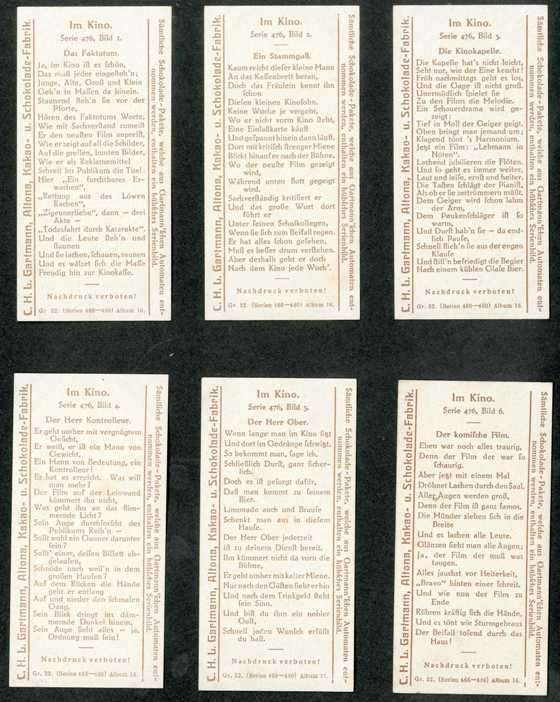
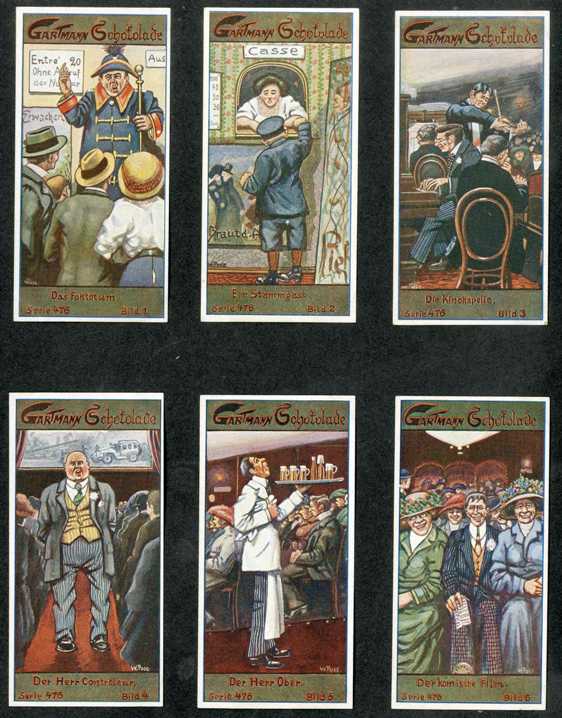
Im Kino

Source: ‘Im Kino’ series of chocolate cards, dated c.1916, from the Nicholas Hiley collection

Comments: Gartmann was, and still is, a German chocolate manufacturer, based in Hamburg. These cards were given out with chocolate from vending machines. The series depicts various scenes in a typical cinema of the period: the barker, the ticket office, the musicians, the manager, a drink-seller, and the audience. Each is described in verse on the back of the cards.

The March of Japan

Source: Edgar Lajtha, The March of Japan (New York: Frederick A. Stokes, [1936]), pp. 109-114

Text: The twentieth century has allowed the Japanese to live again their middle age through the cinema, and when the Japanese wants to escape from glaring modernity, he can find solace in the world of the Japanese fighting-spirit films when he sees the virtues of his ancestors rise up from their graves.

In Tokyo’s film street, where every building is a cinema, there are posters with gigantic coloured photographs of the stars and dramatic scenes from the film displayed at every entrance. Japan’s history lives again on these façades, and sometimes a large flaming sword covers the front of one cinema, or two warriors’ heads, or simply the head of a weeping woman. But the swords predominate, for in these eventful days the sword is the matinée idol of the people.

Between two historic heroes a good looking Tarzan may be jumping naked out of the jungle on to a crocodile’s back, laughing down at the blonde head of Greta Garbo, his vis-à-vis. The heads of the Western stars look unfamiliar; for the Japanese the faces of Garbo, Barrymore and Bergner would lack character, and the poster-artist retouches their faces, as the Japanese photographer does his portraits, thereby suppressing their true personalities.

The Chinese use other methods, and when I saw the Garbo’s head outside a Hongkong cinema, she had wrinkles at the side of her mouth and almond-shaped eyes.

An endless stream of people pass through the Asakusa from morning till night, the men in grey kimonos, the women in colour, and the children most brightly dressed of all. The clatter of their wooden sandals on the hard street blends with the music from the cinema doors. Flags displaying the tides of the films in large letters flutter in profusion in the glare of street-lights. Sometimes the names are written in Japanese characters on net flags and fly like dragons above the heads of the crowds.

As the people pass along on both sides of the streets, they often stop in front of one cinema trying to decide whether to go in. It is no easy decision, for the choice is so wide and the prices so cheap, seats can be had from five sen. The propaganda in the street is cleverly conceived and it dims their eyes. Who can withstand the power of a flaming sword as big as a rowing-boat? So I, too, reeled into a cinema.

A samisen orchestra accompanies the silent historical films and an announcer, who stands following the film like one of the audience, speaks the actors’ parts out of the darkness. He follows the lip-movements of men, women and children and adjusts his voice accordingly. As I was at the last evening performance, the announcer was becoming hoarse.

The audience had their eyes fixed on the screen. Women clutched crumpled handkerchiefs, wrapt in another world. In these warrior-films Japan is again shut off from contemporary life. Japanese fight only Japanese; the clock has been put back a hundred years.

The Japanese landscape was unfolded before us in black and white. We could see silver lakes glinting in the light, dark islands and black trees. White steam rose out of a deep crater and rice fields basked in the sun. Suddenly the black silhouette of a Samurai overshadowed this peaceful picture. Two swords hung at his side, the long one for his enemy, the short one for himself; for the Japanese warrior is never taken alive. The excitement began when a speck could be seen on the horizon, gradually becoming bigger and bigger, till we could see that it was the enemy of our Samurai.

The two Japanese warriors were now face to face, staring silently with unwinking eyes and proud mouths. Only their fingers twitched, convulsively clutching their swords.

The moment they drew their swords with a lightning movement the scene became alive with other warriors jumping from behind bushes and rocks. There were about fifty of them, Japanese against Japanese, and if one was threatened in the back, he whipped round as if he had eyes there too. The Samurais’ training in fencing, which lasted for years, was no ordinary one, for it taught them to concentrate their five senses on one thought, so that they learnt to feel the sword-point in their backs the instant before it was thrust.

The Samurai turned round with a sudden spring that repulsed his enemies for a yard or so; while he cut in two the man who had been about to kill him, the others had time to regain breath. Swords clashed. This catlike stratagem came off again and again; if he did it once, he did it five times until he had reduced his fifty enemies to ten.

In a short time they fled and disembowelled themselves.

Similar warriors attacked the Samurai on his way home through the countryside. When he finally reached his village, he found that his home had been plundered of his goods and his loved ones. He knew at once that it was the work of these same enemies, and set out to find his young lover.

A steep coast on the ocean. A weeping girl was wandering under the steep cliffs, dressed in a light striped kimono, with her hair arranged in the old style, above her white, oval, classical Japanese face.

She strayed from one rock to another. Sometimes jumping down, and sometimes springing from stone to stone to keep her kimono from trailing in the sea. At other times she would be high up, where one false step meant certain death. She had been wandering on this coast for days, for every minute represented months, and her hair began to fly in the wind. Now she held a new born infant in her arms, her tears falling on its little face while she stood far above high rocks and the surging sea. She looked down hopelessly at the waves. Then a strong hand drew her back.

The Samurai had at last found his lover. He laughed and wept with joy, but she no longer wept but only laughed shrilly. She was mad. She handed him the child, and even as he bent down to see the first smile on his first-born’s lips, the waves were surging over the woman’s head.

The Samurai, still wearing his two swords in his belt, and with the child in his arms, looked down dumbly at the waves. They soon surged over his head too.

The Samisen orchestra burst into jazz, for the second film on the programme was more modern.

Two marriages seemed to be going awry! In one the husband was too Westernised and the wife too conservative, in the other the situation was reversed. After an hour of complications the husbands and wives reached a compromise and the film closed with a happy ending.

The third film was at last a sound film. It was concerned with the problems which Western civilisation have brought to Japan, the problems of the middle-class youth who are still undergoing wedekindian trials. A “modern boy” had fallen in love with a “modern girl.” When the girl’s father found his daughter in the boy’s flat, he shot her, whereupon the boy came out of his hiding place and shot the father. The youthful murderer then became a haunted wanderer of the night. Homeless and at the end of his strength, he fled to a friend’s house. The friend forgave him and the murderer wept on his breast. Later he gave himself up to the authorities and was acquitted.

The films were not directed properly and the stories were drawn out to appalling length with streams of dialogue. But that did not seem to disturb my neighbours who must have been paragons of patience. The great fault of all film producers is also committed by Japanese directors. They do not stick to realities, and their players are not true types. The sets in the films are always ultra-modern milieus where the Japanese would like to live but will never see in all their life. A foreigner is particularly struck by the absence of mimicry and gesticulation. The gamut of passions is never expressed with more than a nervous twitching of the lips, and kissing does not exist. In love scenes two heads nestle together and tears fall, and one comes away from the Asakusa cinemas with the impression that the sons of one of the manliest nations in the world weep more than any of their fellow men.

But if the photography of Japanese films is considered by itself, all the faults are forgotten. Every picture is a feast for the eye and even the most prosaic scenes are filled with poetry.

The educational films are the most beautifully photographed of all. They enlighten the people and they pulsate with the force of Japanese life. The possibilities of expansion are pointed out in a lovely series of pictures, showing an immense landscape of cherry blossom. Suddenly a volcano erupts: “Strengthen your spirit. … That is the fate of the Japanese.”

The young Japanese intellectuals do not often frequent the Asakusa for its cinemas cater for provincial tastes; but provincials are typical of the Japanese taste as a whole.

The cinemas outside the Ginza district show American films principally. Two hundred and fifty films are imported annually from Hollywood, and while the Japanese film predominates in the suburbs and the provinces, American productions are more popular in the better quarters of the large towns. These films teach the youth about the latest developments of Western civilisation, and pleasure is a secondary consideration. They are also useful as a means of giving English lessons to those who cannot go abroad. But the mogas find them useful for showing the latest Hollywood fashions.

Comments: Edgar Lajtha (1910-?) was a Hungarian travel writer. His account includes a description of a benshi performer, who provided audiences with Japanese an interpretation of the action. Silent films continued for a longer period in Japan than they did in the West, and programmes in the mid-1930s could comprise a mixture of silent and sound films. I have not been able to identify the films he describes.

Links: Copy at Hathi Trust

The Land of Haunted Castles

Source: Robert J. Casey, The Land of Haunted Castles (New York: The Century Co., 1921), pp. 239-255

Text: They don’t go to the opera.

Luxemburg has no opera.

They go to the cinema!

Luxemburg is by history and environment a cinema in itself,—in the midst of natural grandeur is the omnipresent conspiracy of the story-books.

The larger powers play for a great stake and the existence of this tiny duchy is tolerated for purely strategic reasons. A war is waged and a great army sweeps over it—confident of victory—and back, inglorious in defeat. A charming duchess plays politics and loses. Strangers sit in conference in a strange land and calmly determine the fate of her abandoned throne. The while petty conspirators plan revolutions, installing new governments, reinstating old, vacillating betwixt republic and monarchy, immensely proud of themselves and all unmindful of the exterior forces that work their ruin.

Had the novelists designed this country to suit themselves they could have done no better.

A gendarme—or was it a general?—surveyed all comers with a critical eye from a point of vantage in the shelter of a high battlemented building. There was snow in his cerise plume and frost upon the shoulders of his green overcoat that robbed his silver epaulets of their effect. But in his serene dignity he stood as Ajax might have stood in his celebrated dispute with the lightning.

He was impressive enough to have spoiled the business of many a European moving-picture house and brilliant enough to have attracted great quantities of dimes to the cinema palaces of the United States.

One had only to see the disdainful glance which he bestowed upon the Luxembourgeoise questing the joys of the film to see that he disapproved of such idle pursuits. The grown-ups passed him with haughty antagonism. The children hurried by with sidelong glances as if fearful that this splendid figure might interpose himself between them and the doorway behind which flickered the delectable movies.

Once one had braved the guardian at the gate, the way led up three little stone steps to a door common enough in American cottages of twenty years ago,—three panels of wood, a pane of glass, and a wealth of iron grating.

It didn’t look much like the entrance to a theater, but, for that matter, nothing in Graystork looks like what it’s supposed to be. The house was a narrow, three-story stone affair with slim windows and green shutters. A sign over the door proclaimed it to be a cafe. A second sign, obviously a generation or two younger, conveyed the added information that the cinema might be found here and that English was spoken.

I pushed down on the brass lever—there are no door-knobs in Luxemburg—and stepped in out of the blizzard.

There was an instant impression of bar glass, electric lights, tables, straight-backed chairs, and warmth, with an all-pervading atmosphere of hot rum. Some civilians in velour hats and tight-fitting overcoats looked up from their steaming drinks as we added ourselves to the party.

The Kellner, whose memory of Americans hadn’t been entirely obliterated by the long hiatus in the tourist business, came running over from the cage-like bar to bid us welcome.

But we hadn’t come to study the liquid nourishment of Ettelbruck. A book may be written on that particular subject some day, if some brave soul manages to live through the dangers of personal research. Meerschaart instantly removed Herr Kellner’s doubts concerning the cause of our visit with a question:

Ou est la cinema?

Herr Kellner looked shocked, then turned to me.

“You will find the moving pictures,” he said in a good brand of Minnesota English, “at the end of the hallway through that little door.” He indicated a door behind the bar, and added graciously as we started to follow his directions:

“For ten years I lived in the United States.”

We walked behind the bar, and a narrow squeeze it was between the porcelain counter and the shelf of glass-ware. With the venturesome air that befitted the circumstances, I opened the door and crossed the threshold into a cold corridor.

Here was a foyer unique in the world of theatricals. Meerschaart may have been prepared for it—for, after all, his country and this are half-sisters—but nothing in my experience had given me warning. Women’s clothes, some very intimate articles of wearing-apparel, hung upon a row of hooks along one side of the hall. I hesitated a moment.

“We’re breaking into somebody’s bedroom,” I declared.

“Maybe that’s where they have the cinema,” returned the Belgian, in a matter-of-fact tone. “Either there or in the kitchen.”

The atmosphere of the corridor, redolent of garlic and boiled cabbage, seemed to give assurance that supper was to be served somewhere soon, but as yet we had no right to leap at conclusions. Anything might happen before we came to the exit.

Beyond the clothes-hooks was another door. We passed through it into a big bare room with plain white walls hung with ancient champagne advertisements. On the side opposite the entrance was a double doorway curtained with red chenille hangings, and at one side of it was a table where a woman, probably the owner of the clothes in the hallway, sold tickets.

The entrance fee was three francs apiece. The original cost, however, was the only expense that had to be figured in the afternoon’s entertainment. No tip was expected by the “usherette” inasmuch as there was no “usherette,” and there was no charge for the program, that being salvaged from the floor in the vicinity of one’s seat.

A reel of post-war comedy showing the triumph of President Wilson over a caricature of the kaiser—an animated cartoon of the French school—was just flickering to a close as we entered. The spectators, whom we could not see in the gloom, were dutifully applauding. How much of this frantic enthusiasm was due to inward faith and how much to public policy it would be difficult to say.

National ideas in a country like Luxemburg are bound to change as conditions which affect the national existence are altered. Tastes in moving pictures as in governments are likely to be decided by artillery duels a hundred miles across the frontier.

The lights flashed up and we got a glimpse of what our three francs had brought us to.

We were standing in a sort of low balcony along one side of a rectangular room. The screen was stretched across the corner opposite the door. On the main floor the seating-facilities consisted of two benches and perhaps fifty straight-backed wooden chairs. A bar with china fixtures, similar to the one in the room through which we had passed, occupied one end of the room, leading one to suspect that this place had not always been a temple of the cinema.

It is not altogether correct to infer that all of this was immediately visible. For all the brilliance of perhaps a dozen incandescent lamps, we had been in the place some minutes before the salient features of it began to impress themselves upon us. The atmosphere was a vast, well-nigh impenetrable cloud of tobacco smoke.

We found some seats on a bench at the edge of the balcony and disposed ourselves as best we could. The seats in the pit were occupied mostly by children, little girls about ten years old predominating, with a scattering representation of adults. There was an incessant chattering among the youthful patrons, but no functionary in brass buttons came to interrupt them. There seemed to be any number of little black velvet bonnets in the house, some of them trimmed with pink ribbons, some with blue. A minority of small boys in the round cap of the French-marine type assisted in the manufacture of the din, making one notable contribution in the way of a fist fight before we had been in the place five minutes.

I took advantage of the wait between pictures to look at the red program.

The information conveyed in three assorted languages was little short of astonishing. I learned from the English part of it that there would be:

MOVING PICTURES
at Sunday
In the Afternoon at 3 o’Clock
at night 8 o’clock
at SATURDAY and MONDAY
at Evening at 8 o’clock

ECLAIR JOURNAL
The Kaiser and President Wilson

Sherlock Holmes
the greatest american detektiv in:
ON THE LINE OF THE FOUR
In 2 Parts

Casimir and the Fireman
Humorist in 1 act

THE BLACK CAPTAIN
Far West Drama

and
Flottes Orchester
1 Platz, 3 Fr.; 2 Platz, 2 Fr.; 3 Platz, 1.50 Fr.

And there were further words in German to the effect that children would be admitted to matinee performances at half-price.

It was in the French part of the bill of fare, however, that the true eloquence of the cinema management showed itself. To begin with, the pedigree of the films was presented to the attention of the public. To a stranger in the land, an itinerant who might be interested in the English program, a film would be merely a film. It was in the nature of the tourist to take what one gave him and pay well for the privilege. The native sons, how-ever, must be advised of the quality of the product that they were asked to purchase. Hence they were told with-out preliminary waste of space upon the topics of the pictures that the films were from Paris. To cinema-fanciers who for four long years had gazed upon flickerings from Prussia, the name Paris probably carried a magic appeal.

The kaiser and President Wilson, on this side of the dictionary, were passed over in small type. So was Sherlock Holmes, “the greatest american detektiv.” But Le Capitaine Noir came in for a great deal of publicity of the circus-poster variety.

This feature was billed as “A great drama of adventure in four acts and a prologue,—a number of sensational scenes: Chases on the Plains; the Ambush; The Mark of Fire; The Escape; The Burning Granary.” One would be a sensation-seeker indeed who could wish for more excitement for his three francs.

I suspected from the first that “On the Line of the Four,” however much it might promise as a war picture, was very likely our old friend and neighbor “The Sign of the Four,” and so it was.

The original nationality of the piece was a doubtful matter. There was hardly enough of it left to give one a consecutive idea of the plot, and the French captions were so worn that little was to be gained from them. It may have been an American film of that era when there were no stars. At any rate, no latter-day favorites appeared in it. It may have been English. Certain elements in the “locations” suggested England forcibly. But whatever its pedigree, its days of usefulness were nearly done.

The Anglo Saxons in the house, to whom the name Sherlock Holmes was a sufficient guaranty of story action and plot, could not get very far with the titles in French. Those who had mastered enough of the language to surmount this difficulty were certain to become hopelessly muddled in the aimless mixing of scenes that seemed to be the result of many years of “cut and patch.”

The children, however, enjoyed the piece just as young America used to enjoy pictures of fleeting express-trains and dashing fire-engines. The doings of the “greatest american detektiv” as marvels of mental acrobatics appealed to them not a whit. But the doings of the East Indian murderer with his shiny black hide, his wicked eye, and his deadly poisoned dart, were truly delightful.

Der Schwarze,” as they nicknamed him, could not so much as twist a finger from the moment of his first entrance into the drama until the last ghostly glimmer of Dr. Watson’s romance, without arousing an excited hum throughout the house.

The children wildly applauded his capture and cast upon him any number of maledictions in German and French. They commented volubly upon the flashes supposed to show the theft of the rajah’s jewels in India, and stood up in their seats and yelled when the Black was shown in the act of shooting the fatal dart.

They may have gathered something from the torn film to give them an inkling of the motive of revenge that underlay the murderer’s desire to kill. But from their point of view the motives were immaterial. This Indian person was downright murderous. They had seen him in his deadly but interesting pastime of shooting poisoned arrows,—truly a reprobate. And he was chased and caught and turned over to the gendarmes. Served him right! A very excellent picture!

We learned, too, that the burghers are a romantic people, as befits their surroundings and traditions. They sighed with sympathy when Dr. Watson breathed words of love into the ear of Mary Marston. They murmured approbation when he put his protecting arm about her in that tense moment just before the discovery of the murder; and they howled with startling intensity, adults and infants alike, when the film snapped off short before the climacteric embrace.

The flottes Orchester was the greatest disappointment in the show. It failed to arrive. A small boy with a typical toy harmonica attempted to remedy the deficiency with plaintive notes that filtered unpleasantly through the other noises.

Between films we got another glimpse of our surroundings.

On the wall near the entrance there were yellowing posters of past feature pictures. They were uniformly German and slipshod, the type one used to see before the nickelodeons of a decade ago. One bore the title “Schwer Gepruft” and showed a Prussian villain staring through a brick wall at a blonde girl playing a piano. Another was a sketch in black and white advertising “Der Gestreifte Domino.” The domino was a doleful-looking person whose activities in the film were not described.

In a far corner was a French advertisement for “Deux Ames de Poupée” played by a “notable cast of three” from some theater in Paris. None of these posters looked new, though the theater undoubtedly had been in use during the German occupation. This led us to believe that any films shown in Luxemburg since the autumn of 1914 must have been worn-out stock, hastily salvaged from the waste-heaps to struggle through four years more of life. The conviction remained with us even after the proprietor had assured us that a Copenhagen distributor had given him a choice of first-run productions during the entire period in which the French supply was unavailable.

The adventures of the Black Captain started inauspiciously. The picture was improperly framed during the first few seconds and the lower half appeared on top and the upper half below, as is the universal custom with unframed cinema.

Immediately the ensemble of spectators yelled out, “Hoch!” with a unanimity that shook the ancient rafters.

The film presently slid into its proper groove, and, save for the normal clatter of the children and their parents, quiet was restored. To a visitor the incident was worthy of note as something odd in the system of communication between the house and the management.

It has its points of superiority over the good old American custom of kicking chair backs, whistling, and foot-stamping, as any one will admit. It is no easier on the ears, perhaps, but its effect is quicker. No operator, not even a German operator, can stand the concerted shrieking of half a hundred excited youngsters.

The prologue of this “adventurous picture”—the words are those of the opening caption—extended through about a reel and a half of the total four. Whether out of deference to an artistic color scheme or not we cannot say, but Monsieur Violet, a French actor, was cast in the role of Capitaine Black. The girl in the piece, whose name we have forgotten, and the deep-dyed villain who stole her love, were the only important figures in the story aside from the colorful captain. The lady appeared to be at least as old as the film, which was old enough, and had a sharp nose a trifle too long for her own good. But she suited the spectators in the seventy-five centime seats, and from that time forward we knew that the picture was going to be well received.

Monsieur Violet, as the Duke of Chablis, is in love with Miss Arabella, a circus rider. He marries her, much to the grief of his best friend,—another duke whom, for the purpose of identification, we shall call the Duke of Ornans.

After the inevitable elopement of Lady Arabella with the Duke of Ornans, Monsieur Violet meets the wrecker of his home and kills him in a duel. The two former friends become reconciled in the death scene and the wrecker, after the fashion of wreckers, warns the wronged husband to beware of the woman who is “the cause of it all.”

The husband encounters the faithless wife as he is carrying the body of the betrayer into the chateau whither the erring couple have fled. It is a strong scene in many ways, about as well acted as it is original, with many flashes of raised fists and kneeling supplication. Here the prologue ends in a hysterical burst of recrimination and anathema.

None of this was in keeping with the moral code of Luxemburg, where marriages are pretty sure to be permanent. But it was romantic, passionate, bombastic, and was applauded with shouts.

The next scene showed the arrival in America of the Lady Arabella, who had journeyed into the Far West to claim an estate left her by the traitorous friend.

And it was truly a wonderful America in which she found herself.

An official with a uniform like that of a milkman carried her suit-cases from an unfamiliar railway platform to a stage-coach. The coach was a long, slim thing like the French army’s “Fourgon, Mile. 1887.” It was drawn by three horses and greatly resembled the American vehicle it was supposed to represent in that both of them had wheels.

In the meantime the Duke of Chablis had become the chief of a band of Mexican outlaws, and, under the name of the Black Captain, was spreading terror along the borders of the United States,—a splendid revenge for a husband whose home had been wrecked, but a bit hard on Texas or New Mexico.

The Luxemburgers could not understand this idea of vengeance. But theirs not to question why. It was action they wanted and action they got.

The bandits attacked the stage-coach.

Artful bandits they were. They kept themselves informed of the movements of the coach by a clever system of espionage. If the girl had only noted the dark figure at the corner of the station platform, what excitement she might have saved herself! She would have recognized him at once for a foe. For he was attired in a fedora hat with a feather in it, and even a timid European knows that the Indians who have for their tribal insignia the fedora hat are the most bloodthirsty of all.

Of course there was a battle. It wasn’t a very good battle at first, because both sides failed to show any marksmanship until they warmed up to their work. But after about a kilometer of chase things were different. Nearly everybody on both sides dropped dead at once. It was a thrilling climax.

The few passengers left alive clambered out of the coach to permit themselves to be robbed, the Lady Arabella confronting the mysterious Black Captain. And the house actually approached silence. One could have heard an anvil drop, so quiet was that tense moment when he lifted his mask and showed the once trusted but treacherous love, his sneering lips and hate-filled eyes.

He was very deliberate about it,—always the gentleman, the duke, outlaw or not. He was so deliberate that he turned his back upon her momentarily and she escaped.

The outlaws held a brief conference and leaped to horse in pursuit as she sped down the glistening road.

The house had a wild time about it.

American moving-picture men used to hold long news-paper debates concerning the propriety of applauding the silent drama. But I have never yet seen a decision relative to the etiquette of starting a riot at a thrilling moment. The young Luxemburgers stood up in their chairs and howled.

The people of the grand duchy are not so volatile as those of France. Superficially they bear a closer resemblance to their German neighbors. But they stand proved a race apart to one who has ever seen them at the cinema. They feel deeply and express themselves energetically regardless of time or place. They leap from stolidity to intense animation with the quickness of a flash of light.

The girl outdistanced all the bandits save the Black Captain, and this relentless pursuer chased her through a few Italian villas and other little-known parts of Mexico. Just as he caught up with her the film broke and the cheering spectators subsided with a deep sigh.

That gave us a chance to escape without being trampled upon and we made the best of our opportunity.

It was snowing when we reached the street. The braided gendarme stood as we had left him, his silver epaulets glistening like diamonds with the frost.

Comments: Robert Joseph Casey (1890-1962) was an American journalist and soldier, who served during the First World War and went on to write several books on his travels around the world. The Land of Haunted Castles documents a tour of Luxembourg not long after the war, with this visit to a film show taking place in the town of Ettleburck. The Sherlock Holmes film referred to is unclear but it may have been the American film Sherlock Holmes Solves The Sign of Four (1913), produced by Thanhouser and featuring Harry Benham as Holmes. The French film may be Le capitaine noire (1917), though this did not feature a M. Violet in the cast. However it was produced by the French Éclair company, as was the Éclair Journal newsreel and the ‘Casimir’ series of comedies listed on the programme. There was an Éclair series of Sherlock Holmes films, but none was based on ‘The Sign of the Four’.

Links: Copy at Hathi Trust
Working North from Patagonia

Source: Harry A. Franck, Working North from Patagonia; being the narrative of a journey, earned on the way, through southern and eastern South America (New York: The Century Co., 1921), pp. 261-266

Text: The “Companhia Brazileira” advertized extensively, and the Kinetophone was well patronized from the start. Brazilians take readily to novelties, especially if they can be made the fashion, and our audiences of the second day included both priests and “women of the life,” which is a sure sign of popular success in Brazil. As our doubled entrance fee of two milreis was high for those times of depression, also perhaps because the “Cinema Pathé” was considered a gathering place of the élite, we entertained only the well dressed, or, perhaps I should say, the overdressed. They were blasé, artificial audiences, never under any circumstances applauding or giving any sign of approval; they always gave me the impression of saying, “Oh, rather interesting, you know, as a novelty, but I could do much better myself if I cared to take the time from my love-making and risk soiling my spats and my long, slender, do-nothing fingers.” But as they continued to bring us as our share of the receipts more than a conto of reis a day, it was evident that they found the performance pleasing.

[…]

The motion-picture having come after all the business part of Rio was built, there was no room to erect “movie palaces” which have elsewhere followed in the train of Edison’s most prostituted invention. All the cinemas along the Avenida Central are former shops, without much space except in depth, and as the temperature quickly rises when such a place is crowded, the screen often consists of a curtain across what used to be the wide-open shop door, so that one on the sidewalk may peep in and see the audience and even the orchestra, though he can see nothing of the projected pictures within an inch of his nose. Alongside the “movie” house proper another ex-shop of similar size is generally used as a waiting-room. Here are luxurious upholstered seats, much better than those facing the screen, and some such extraordinary attraction as a “feminine orchestra specially contracted in Europe.” For the waiting-room is of great importance in Rio. It takes the place in a way of a central plaza and promenade where the two sexes can come and admire one another, and it is often thronged immediately after the closing of the door to the theater proper, by people who know quite well they must sit there a full hour before the “section” ends. In fact, young fops sometimes come in and remain an hour or two ogling the feminine charms in the waiting-room and then go out again without so much as having glanced at the show inside. In contrast, many cinemas have “second-class” entrances, without waiting-room and with seats uncomfortably near the screen, where the sockless and collarless are admitted at reduced prices.

It does not require long contact with them to discover that Latin films are best for Latins, for both audience and actors have a mutual language of gestures and facial expressions. The lack of this makes American films seem slow, labored, and stupid, not only to Latins, but to the American who has been living for some time among them. It is a strange paradox that the most doing people on the earth are the slowest in telling a story in pantomime or on the screen. What a French or an Italian actress will convey in full, sharply and clearly, by a shrug of her shoulders or a flip of her hand, the most advertised American “movie star” will get across much more crudely and indistinctly only by spending two or three minutes of pantomimic labor, assisted by two or three long “titles.” The war quickly forced the “Companhia Brazileira,” as it did most of its rivals, to use American films; but neither impresarios nor their clients had anything but harsh words for the “awkward stupidity” and the pretended Puritanic point of view of those makeshift programs — with one exception, Brazilian audiences would sit up all night watching our “wild west” films in which there was rough riding. Curious little differences in customs and point of view come to light in watching an American film through South American eyes. For instance, there is probably not a motion-picture director in the United States who knows that to permit a supposedly refined character in a film to lick a postage stamp is to destroy all illusion in a Latin-American audience. Down there not even the lowest of the educated class ever dreams of sealing or stamping a letter in that fashion. An American film depicting the misadventures of a “dude” or “sissy”, was entirely lost upon the Brazilian audiences, because to them the hero was exactly their idea of what a man should be, and they plainly rated him the most “cultured” American they had ever met. Bit by bit one discovers scores of such slight and insignificant differences, which sum up to great differences and become another stone in that stout barrier between the Latin and the Anglo-Saxon divisions of the western hemisphere.

[…]

Sunday is the big theater or “movie” day in Brazil, for then the families of the “four hundred” turn out in full force. On our seventh day they were standing knee-deep in the waiting-room most of the afternoon and early evening. The congestion increased that part of my duties which had to do with auditing, for the head of a family often paused to shake hands effusively with the door-keeper, after which the entire family poured boldly in, and it became my business to find out whether there had been anything concealed in the effusive hand, and if not, why the box-office had been so cavalierly slighted.

One afternoon the Senhor Presidente da Republica came to honor the fourth performance of the day with his patronage, and to give us the official blessing without which we had been forced to open. A corps of policemen was sent first to hang about the door for nearly two hours — giving passers-by the impression that the place had been “pinched.” There followed a throng of generals, admirals, and unadmirables in full uniform, who waited in line for “His Excellency.” The president came at length in an open carriage, his girl wife beside him, two haughty personalities in gold lace opposite them, and a company of lancers on horseback trotting along the Avenida beside them. The waiting line fawned upon the leathery-skinned chief of state, bowed over the hand of his wife, then the whole throng surrounded the loving pair and, pushing the humble door-keeper scornfully aside, swarmed into the cinema without a suggestion of offering to pay the entrance fee. Luckily the doors were not high enough to admit the lancers, who trotted away with the red of their uniforms gleaming in the afternoon sunshine. It was my first experience with the official “deadheads” of Brazil, but by no means my last.

We quickly found, too, that the official gathering was bad for business. Surely any American theater holding 510 persons would fill up when the President of the Republic and his suite were gracing it with their presence! Yet here there was only a scattering of paying audience as long as the “deadheads” remained, which, thanks perhaps to a film showing them in the recent Independence Day parade, was until they had heard the entire program once and the Kinetophone twice. The president, it seemed, was hated not only for his political iniquities, but the élite looked down upon him for marrying a girl little more than one-fourth his own age and letting her make the national presidency the background for her social climbing; and to enter the theater while the president and his retainers were there was to risk losing both one’s political and social standing as a high class Brazilian.

Comments: Harry Alverson Franck (1881-1962) was an American travel writer, whose journeys took him China, Latin America, Europe and the USSR. For the journey through South America described in this book Franck served as an agent for the Edison Kinetophone, a film projection system synchronised with musical discs, and there are many descriptions of the operation of the Kinetophone and its mixed reception across the continent in Franck’s characteristically sardonic style. Although the publication date of the book is 1921, the trip must have occurred around 1913-14. The president of the Brazilian republic referred to is Hermes da Fonseca.

Links: Copy at Hathi Trust

A Ragged Schooling

Source: Robert Roberts, A Ragged Schooling (Fontana, 1978; orig. pub. Manchester University Press, 1976), pp. 59-60

Text: Mr Higham, we also heard, had played piano in hotels, and opulent picture palaces now opened in the city, but ‘bad luck’ had reduced him latterly to performing at our local fleapit. There, we learned, in the course of the evening, he was plagued by a problem of hygiene unknown in bourgeois entertainment circles – our ‘Kinema’ floor had, he complained, to be swilled out and disinfected every morning. And no wonder! Owner-managers of slum cinemas, out for every penny they could get, crushed their youngest patrons so tightly along the cheap benches that no child dared get up for fear of losing his seat. In our establishment, even before the lights went out, retaining position could be difficult. Theoretically, no standing was allowed. The chucker-out would bring in a small paying customer to an already packed bench, push his posterior against the end occupant and make room for the newcomer; but this sent pressure running along the row, and another child slid off the other end. Once in the dark, no one dreamed of going to the lavatory. Through need or mischief children relieved themselves where they sat, and often the lower reaches ran awash. Down slope, before the silver screen, Mr Higham, we understood, battled on at his music, feet upon the pedals, powerless, despite threats, as King Canute. But already he seemed to have grown tolerant, looking upon the phenomenon as a mere occupational hazard. Indeed, at a later date, he referred to it airily as the ‘Falls of Lodore,’ which shows one can get used to almost anything.

Comments: Robert Roberts (1905-1979) became an English teacher following a Salford childhood, where his parents ran a corner-shop. His book The Classic Slum is a classic combination of autobiography and historical account of the lives of the Edwardian poor. A Ragged Schooling is a further autobiographical account of his childhood. The city referred to is Manchester. In a footnote to the above section, he writes “Strangers to the town were puzzled when invite to patronise a local picture house referred to by all as the ‘By Joe’ – our native rendering of ‘Bijou’, a name chosen for high inappropriateness on every count.”

A Holiday in Burma

Source: C.M. Leicester, A Holiday in Burma, with a chapter on a visit to Calcutta (Exeter: A. Wheaton and Company, 1928), pp. 44-49

Text: After dinner there is time for an entertainment of some sort, as the hours kept in Rangoon are not early. An opportunity offers of seeing a Burmese film by Burmese actors, and the party is attracted to this in preference to any more usual entertainment.

There are several picture houses in Rangoon. Some display posters familiar in London and give inside the comfort of plush upholstery. There is also an Indian cinema house where may be seen perhaps a presentment of Hindu folk lore. The Burman has his own favourite resort, his own film favourites whose deeds of valour and daring are recorded vividly on the hoardings. The film appears to have caught the imagination of the Burman, and he has recently embarked on the production of native films. After some experience of partial failure due to the difficulty of lighting, the strong sunlight being insufficient to show up details and to do justice to the jewels which are worn in the legendary tales of kings and princes, it was decided that there must be a visit to America to study methods of production and lighting. Recently films have been produced which have done great credit to the Burmese producers.

The building of the Burmese cinema is neither beautiful or very comfortable, and ten rupees has secured the luxury of a ‘box,’ a sort of loose box with concrete walls and wooden sides, containing half-a-dozen seats. There is some unaccountable delay in starting the show, and the orchestra fills in the time playing on the native instruments what are evidently popular airs, for the audience breaks in and sings the refrains. At last a start is made, and the local news is shewn in pictures with descriptions in Burmese, and, as a finale to this prelude, there appears the cause of the delay — a slide, unearthed from some dim recess, with ‘Welcome’ in colour and
garlands: a friendly greeting to the intruding West.

Then follows the film, a record of the adventures of a very popular hero who appears to combine in his attractive person all the daring of a Jack Sheppard and a Dick Turpin with the adventurous spirit of the desperado who has for the past year successfully eluded justice for wild deeds committed in the Thazi district. Dressed in his native lungyi and gaung baung, and complete with pistol and mask, he pursues his exciting career and accomplishes a series of desperate flights and escapes; capturing a horse and riding bareback; dropping from a roof into a waiting motor car; tearing with open throttle along country roads whilst from the back he peppers his pursuers with shots from his revolver. Breathless, exciting adventure in accordance with the accepted tradition of another hemisphere, but with the scenes laid in less familiar settings.

The orchestra faithfully records the emotions aroused in the audience, who from time to time break into the music with song. To unaccustomed ears it appears impossible that there can be any definite scheme in the sounds produced by the instruments, and one experiences an involuntary tribute to the intelligence of these people, who evidently are more sensitive to cadences than we are ourselves.

The sub-titles, in Burmese characters, stretch across the screen like chains, their meaning elusive and intriguing.

The pictures must unfold their own story. The youth is evidently the pampered son of a family of high respectability. His parents, in Western dress, are seated in padded comfort, in a room replete with ‘occasional’ tables, lace covers and anti-macassars. The father is reading a newspaper and the mother is toying with a piece of embroidery, when the news comes of their son’s escapades. Shocked and distressed, there is much talk but no action. They seem hampered by their unaccustomed garments and the chairs. It would seem more natural for them to be squatting on the floor in their native costume.

Then follow more hair-breadth adventures and escapes and the introduction of the love interest. There are meetings in a garden with a charming little lady with flower-decked hair. Passionate appeals are made and tender glances are exchanged — and that is all there is to a love scene in Burma. It would certainly fail to ‘grip’ a Western audience, for the lover does not approach his lady nearer than a couple of yards — so etiquette decrees. There is a parting and the lady is sad. The lover leaves her, to continue his thrills in another reel.

By this time it is after ten o’clock, and half-time. Already the young man has committed crime enough to hang him many times over. He seems certainly to be heading for disaster. It is impossible that so gallant a figure should end ignominiously on the scaffold, and it would appear to be equally impossible that the authorities can be hoodwinked into allowing him to escape his due and settle down into domesticity with his waiting lady love. A solution is difficult. But endurance is at an end, and with the full knowledge that the next reel will produce the thrill of the hero placing his enemy on the rails in front of an on-coming train, the box is vacated and escape effected into the night air.

Outside are lined up the cars of the Burmese merchants, their drivers asleep, awaiting the end of the performance, which will be about midnight.

Comments: Burma (now Myanmar) was a British colony in the 1920s. Fiction film production began in the country in 1920. It is unclear whether the news referred to was a newsreel or news relayed through slides. I have not been able to find any information on C.M. Leicester, except that he was British and probably came from Devon. His visit to Burma and India took place over 1926-27.

Links: Copy at Hathi Trust