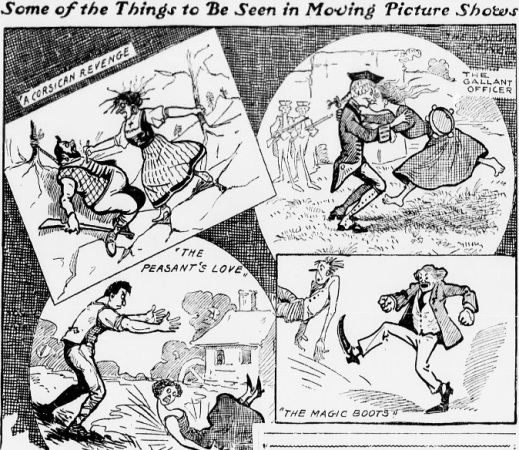
This City has over 500 Moving Picture Shows; Do YOU Know WHY?

someofthethings

Illustration that accompanies the original article

Source: Charles Darnton, ‘This City has over 500 Moving Picture Shows: Do YOU Know WHY?’ The Evening World [New York], 16 January 1909, p. 9

Text: “I like to see a story.”

A long tramp bad led to a short answer. And the woman with a shawl about her head and a wide-eyed child clutching her hand was probably right about the appeal of the moving picture.

How wide this appeal has become may be judged from the fact that there are more than 500 moving picture shows in New York. From one end of the town to the other the “manager,” with little more than a lantern to his name, is holding the screen up to nature and occasionally turning a trick that goes nature one better. Although vaudeville audiences take the moving picture as their cue to move toward home, true lovers of art in action take all they can get for five or ten cents and then come back for more next day.

They like to see a story.

That’s the explanation – thanks to the woman with a shawl over her head. They feed upon mechanical fiction. They read as they look. Sensational melodrama, with the villain doing his worst in a plug hat, is an old story to them. They know it by heart. And so, theatres in which virtue used to take a back seat until the last act have felt the power of moving pictures. Only one remains to tell the blood-and-thunder tale in all Manhattan and it was obliged to get down to “workingmen’s prices” before it could compete with its noiseless rivals. From the start the moving picture show had a double advantage – lower prices and a daily change of bill. Then it went further and produced “talking pictures,” but in most cases this feature has been done away with audiences preferring to take their plays in peace and not be disturbed by the man behind the megaphone. What they want is action. Their attitude goes to show that it is always well to leave something to the imagination. They like to see a story from their own point of view.

In New York nearly every neighborhood has its “show,” and the craze has spread throughout the country until no town is too small to do the moving picture honor. Here, according to the word of a Sixth avenue showman, “picture fiends,” who keep a record of what they have seen and protest against “repeaters,” are an outgrowth of the craze. Their criticism of the Sunday exhibitions at which only educational pictures may be shown, in accordance with the stupid law, is often expressed in the simple term “Rotten!” They insist upon getting action for their money. The pictures must get “a move on” to win success. Patrons of the picture-drama want to see a story with plenty of action in it. From the Bowery to the Bronx tastes and pictures are much the same.

Bowery Wants Bank Robberies

But hero and there of course individual taste asserts itself. The proprietor of a little hall on the Bowery confessed that while his clientele showed a due appreciation of comedy and tragedy they had from time to time expressed a deep yearning for bank robberies. Unfortunately safe-cracking is not included in the picture-maker’s repertoire, and so the regretful “manager” has not been able to supply the demand for that particular form of art. However his audience made the best of things on a recent afternoon and seemed rather pleased with “A Corsican Revenge.”

The Corsican who caused all the trouble by killing a fellow fisherman and then got knifed by his victim’s wife, a husky lady with a fine stroke, looked like Caruso in “Cavalleria Rusticana.” According to the hospitable custom of the country, she was obliged to entertain her husband’s slayer when he sought refuge in her home. But once she got him outside she made short work of him. The lively little tragedy was worked out with neatness and dispatch. Five or six Chinamen who could qualify as Broadway first-nighters without putting on boiled shirts watched “A Corsican Revenge” without the slightest change of expression. In fact, the audience made no sign until two energetic gentlemen were flashed upon the scene and began kicking each other in the stomach. This light comedy was received with roars of laughter. The drummer emphasized each kick with a thump and the “professor” came down hard on the piano. “Comedy” won the occasions.

A placard on the wall warned the visitor to “Beware of Pickpockets.” Another made this polite request: Gentlemen Will Please Refrain from using Profane Language. The gentlemen did.

Accordion Breathes Hard.

In front of another temple of art across the street was the sign: “Positively No Free List During This Engagement.” You had to have a nickel to get inside. Down in front sat a Bowery artist with an accordion that was drawing its breath with great difficulty. During the overture he addressed facetious remarks to the audience.

“Hey, there!” yelled one of the crowd. “Cut out that comedy and give us some music.”

“Anyt’ing doin’?” inquired the performer, holding out his hat. “Come on, now,” he urged, ” trow in a little sumt’in fer de dear ones wot are dead and gone.”

“Ferget it!” yelled the unsympathetic mob.

“The Gallant Guardsman” presently drew attention from the accordion artist. At the first appearance of a Spanish soldier on the screen the accordion began wheezing “Die Wacht am Rhein.” When the guardsman rescued a dancing girl from the embraces of a low-browed citizen the tune changed to “Marching Through Georgia.” A dash of “Trovatore” cheered the guardsman on his way. The low-browed citizen waited behind a wall and killed the first soldier that came along. But he got the wrong man and the hero was about to be shot when the barefooted dancing girl ran to the rescue and explained the situation in a few hand-made gestures.

The audience followed the story with intense interest, and only the accordion was heard until a picture showing a young man who was carried off in a wardrobe appealed to the Bowery sense of humor. The hero of this adventure found himself in the bedroom of a loving couple who finally accepted his explanation and then had him sit down to supper with them.

French but Chaste.

All of the pictures seen on the lower east and west sides were French but chaste. Nothing more shocking than a murder occurred in any of them.

At a place in Grand street “The Peasant’s Love” was the chief feature of the bill. All went well until the peasant’s sweetheart promised to meet a newly arrived sailor “down by the pond.” His note to her was revealed on the screen. But the jealous peasant got to the pond first and when the girl came along he sneaked up behind her and threw her into the pond. The inevitable gendarmes first arrested the sailor, of course, but after a long chase they nabbed the guilty peasant.

Nearly all of the pictures showed gendarmes in pursuit of somebody. The principal figure was usually obliged to “run for it,” and suspense was kept up until the capture of the fugitive. The “story” was kept on the jump.

In “The Magic Boots” a happy individual was seen eluding his pursuers by walking on water, telegraph wires – wherever his fancy led him. His wonderful boots defied the French and all other laws. But down in Grand street it was the serious pictures that gripped the spectators.

“Dremma,” answered one manager when asked what appealed to his patrons most of all. And a woman whom he described as one of his best customers said: “I like to see a story. The funny pictures – they are funny, yes, but you don’t remember them. I like to remember what I see. You don’t forget a story – it goes home with you.”

Take Them Seriously.

This serious interest in story-pictures was apparent in other halls along Grand street. But a desire to be cheerful under all circumstances was suggested by this announcement over the door of one place: “The Bride of Lammermoor – A Tragedy of Bonnie Scotland.”

In a Mulberry street “theatre,” conducted under Italian auspices, the pictures were similar to those in Grand street. A coal stove filled the place with gas but no one seemed to notice it. Another Italian place in West Houston street sported this sign: “Caruso Moving Pictures.” But Caruso wasn’t among those present on the screen. The name, apparently, was merely a delicate tribute to the Metropolitan’s sobbing tenor.

Bessie Wynn’s name was prominently displayed in front of an imposing theatre in Fourteenth street. But Bessie was there only in voice and picture. You could recognize her picture but her voice had to be taken for granted. When they canned Bessie’s voice they evidently forgot to screw down the lid, and so it had soured and curdled and lost its flavor.

“The Wild Horse” filled up on oats at the Manhattan Theatre and developed from a weak skinny nag into a fat and fearful animal that kicked everything to pieces. It was the “big laugh.”

Harlem Likes to Laugh.

But here as elsewhere serious pictures with now and then a shooting or stabbing incident for excitement outnumbered the comic subjects. Harlem showed the greatest fondness for funny pictures. The Bronx appeared to be more serious minded.

Some of the places open their doors as early as 9 in the morning and keep going until after 11 at night. The shows are continuous and so are the privileges that go with a ticket. Only the pictures are compelled to move.

Comment: Among the films described are Âmes corses [The Corsican’s Revenge] (France 1908 p.c. Eclair) and Le galant garde français [The Gallant Guardsman] (France 1908 p.c. Pathé Frères). Bessie Wynn was an American singer and stage comedienne. The mention of ‘talking pictures’ presumably refers to a short vogue in a few theatres for having actors speak behind the screen rather than synchronised sound films (i.e. films, usually of singers, synchronised to a gramophone recording).
Links: Available online at Chronicling America

A Look into the Kinetoscope

Source: ‘A Look into the Kinetoscope’, The Salt Lake Herald, 3 September 1894, p. 1

Text: A LOOK INTO THE KINETOSCOPE

[From the Boston Herald]

I you have not looked into Edison’s kinetoscope delay not but plank down your nickels and behold the wonder of the age. Verily it makes the blood run hot and cold. Edison is well named the wizard; he is the great magician of science and we have grown somewhat accustomed to his inventions through daily and constant use, but when you look into this toy that represents the work of unfathomed genius the average man believes the time has come to get excited. Nothing that I had read about the kinetoscope gave any idea of it, and it is only by personal examination that is by seeing these human pictures of absolute events for one’s self that its marvelous effect can be appreciated. The fight in the bar room, the skirt dancing at Koster & Bial’s, Sandow’s exhibition and the cats’ boxing match are as real as life. If the pictures could be on a larger scale the pleasure would be enhanced, though effect of distance does not destroy the perfection of movement or lessen any detail. The soft fluttering drapery of the dancing girl, her graceful poses and the familiar high kick, are all there, and above the sound of the electricity one can imagine the voices, the aplause [sic], the music, and also maybe the squeak of belligerent cats! It is quite possible to believe, as Mr Edison says, that the time is not far away when a grand opera can be acted and sung in a box, under our very eyes. At all events the kinetoscope will preserve what has never been preserved before save in the word painting of variable writers.

Comment: The first Kinetoscope parlour opened to the public at 1155 Broadway, New York City on 14 April 1894. The films are Boxing Cats, Sandow, Bar Room Scene and possibly Carmencita (all USA 1894).

Links: Available on Chronicling America

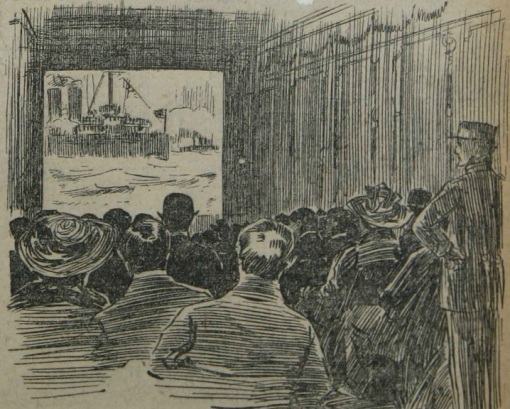
The Picture-Palaces of London

picturepalace

Illustration accompanying the original article

Source: ‘The Picture-Palaces of London’, The Daily Chronicle, 9 April 1910

Text: The Picture-Palaces of London. Have They Comes to Stay?

Pricked out in electric lights, on an imposing brand new structure of white stucco, you read the words “Cinematograph Theatre.” You wonder where the thing has come from. Like Aladdin’s Palace, it seems to have sprung up in a single night. On yesterday there was a block of old houses on that very spot. You remember looking in a the greengrocer’s window as you sauntered home to dinner, wondering what kind of fruit the children would like.

Well, no, it could not have been yesterday, but it was certainly the week before last!

A few weeks later the white stucco erection appears to have budded. There are two of the now, side by side. The matter is worth further enquiry, so you cross over, and read the “bill of fare” at either door. The rival attendants, gorgeously arrayed, glance at you with enticing eyes, but you regard not their mute entreaties. Then you are probably taken by surprise. The charm of the things catches you. Perhaps it is best set down as a free-and-easiness. Go when you will, after the door is opened, you are never late; never in anxiety over a seat. The show goes on continuously. There is a set of pictures for the day – six perhaps, or eight – and if you miss numbers one and two, why, you will see them for certain after number eight.

Entertainment Ad Lib.

The set may last an hour, to an hour and a half, but you need not go out at that time unless you have a mind to. You may sit still, if you choose, and see the whole set over again. I dare say you won’t, unless it is pouring wet outside, and you have forgotten your umbrella, but it is something to know that you can.

The cinematograph theatre fills a gap in our scheme of amusement. It may be a small gap, but still it was there, and now it is filled. It catches the leakage from the theatres and halls, the unfortunately who are sent sorrowfully away by the unwelcome announcement of “House full.”

It gives the tired sightseer an hour’s respite from the noise and fatigue of the streets, and in some cases it dangles the tempting bait of “afternoon tea[“] gratis before this type of prospective patron. To the regular theatre it stands in the same relationship as a “snack” does to a formal luncheon. It is the resource of the man with only an hour to spare, the lady who doesn’t like to be out late, the girl whose papa doesn’t approve of theatres, the little boy who must be in bed at six, the hospital nurse who only has two hours off duty, and the family party from the provinces, whose train starts at ten sharp.

Oh, and one must not forget the lovers! Humble lovers, perhaps, with a few shillings to spare. one sees them often in the sixpenny seats, holding hands in the friendly dark. They watch the films go spinning on, with absent eyes and beatific smiles. They haven’t come there for the show, but to find a corner to sit in, out of the wet. One can’t always go round and round the Inner Circle with a penny ticket without catching the eye of the cute conductor!

The Aristocratic Sixpence.

There are differences in the quality of these as of all other types of amusement. There are the second-raters in the outlying streets, just beyond the radius of West-end style. The modest sum of threepence will gain you admittance here, and if you indulge yourself to the tune of sixpence you are “a swell.” The pictures are usually quite up to the average, but the environment is not. The dark is not friendly, but apprehensive. One is suspicious of one’s neighbour, and keeps a tight clutch on one’s belongings. There is every prospect of carrying away with you less than you ought, and more than you bargained for. Reminiscences of the place are forced upon you next day by the odour of stale and indifferent tobacco that clings to your clothes. As you near the vicinity of Oxford-street there is a decided attempt at luxury in the internal appointments of the “Palaces.” The goods are not all in the shop window. Decidedly, too, the “orchestra” plays better. It consists usually of a girl with a piano, the latter very much at her mercy. In some of the theatres visited by the writer, it would be only charitable to suppose that the lady pianist had fallen a victim to the prevalent disease newly christened by a London daily as “The Hump.” She played in spasms, with a reckless disregard of time and tune, and an obvious idea that her function was merely to drown out the silence.

In the West they have changed all that, and, incidentally, the prices have gone up. We may now pay two shillings for a “fauteuil” (which is a horrid, awkward word to spell, and means exactly the same as seat, anyway!). Along with the fauteuil we have the advantage of being shone upon by rose-shaded electric lights, vastly improving to the complexion, and of feasting our eyes on the artistic decorations of the walls when we tire of the pictures.

People do not laugh so boisterously here as they do in the north and east. At most they chuckle. On the whole, there is a remarkable absence of all kinds of noise in these cinematograph theatres. Applause seems to be a thing unknown. It is a relief to hear the voice of a child imperiously demanding, as the name of the film appears, “Read it, mother. Read it quick!”

Child’s Living Picture Book.

The little folks are mostly to be found at the afternoon performances. It must all seem a kind of glorified picture book to them. How they roar over the man who knocks down everything, or the fat old lady pursued by some strange fatality, who is knocked down by everybody! They have a wonderful aptitude, too, for following the “story” in some of the more ambitious pictures. The kidnapped child is one of their favourites. “Did they find him, mother? Are you sure?” a little lad asks in a tearful voice, to the kindly amusement of all who sit near by. The tragic subjects find favour with young ladies, one fancies, and indeed they are sometimes admirably conceived – real dramas, in which the words are hardly missed. The marvellous power of facial expression to convey an emotion in all its subtle shades is brought home to the mind with striking force by the intense interest one feels in these “mimed” plays. Of course it is hard to forget that the pictures are “faked.” One could never for a moment admit the possibility of pictorial drama affecting the taste for the drama of the regular stage. Too much talk may be bad, as was instanced in a recent much-criticised production, but no talk at all is the worse evil of the two.

Perhaps most successful of all are the travel pictures, where the scenery is absolutely realistic, and the sense of motion admirably conveyed. No “book of views,” however beautiful, can fascinate as this moving panorama does. It is as good as a holiday – and somewhat cheaper!

Have the pictures come to stay? Yes, they have filled a gap. It will be long before anything more novel or more entertaining appears to fit that precise niche in the House of Pleasure.

Comment: The inner Circle refers to a London underground train line.

The Journals of Sydney Race

Source: Ann Featherstone (ed.), The Journals of Sydney Race 1892-1900: A Provincial View of Popular Entertainment (London: The Society for Theatre Research, 2007), pp. 78-79

Text: Saturday January 20th, 1897
Caldwells have been showing the ‘Living Pictures’ in their shop on Long Row for some time past now and tonight I went there to see them. This marvellous invention which only appeared last year is, I take it, a development of Edison’s Kinetoscope. In each case, I believe, an enormous number of photographs, taken consecutively, are whirled with speed of lightning, before your eyes. In this case the pictures are thrown onto a screen by a magic lantern. The screen at Caldwells was placed between us and the operator and when all the lights had been put out the pictures were thrown on it, in size about five feet by three or four I should think. The following were among the views I saw:

Place of the Opera, Paris with numerous buses, cabs and passengers continuously passing.

Some children skipping with a gentleman or two playing about with others, a boy watering the garden with a hose, and at the rear the traffic of a street seen through the railings.

Two gentlemen playing cards in a Restaurant. One accuses the other of cheating and after an argument they fight, the table, etc., at the finish being cleared off by a grinning waiter.

The sea washing over the promenade and some watering place. The photograph did not bring out the waves very clearly, but we could see them dashing up and down and at times leaping the promenade.

Three girls in a skirt dance. These showed up well.

Fire engines turning out of the Fire Station.

Two men wrestling.

A scene, apparently at an Exhibition; a fountain in the centre and a circular train coming in and discharging its passengers.

The Czar in Paris. This was very good. We first saw the road lined on each side with mounted soldiers. At his side was a row of Cuirassiers and it was very strange to see a horse shake its head while the man sat quite motionlessly. The effect of standing figures making a sudden movement was the most curious of all in the pictures. Down this road pressed by the military came the procession; squadrons of cavalry, carriages, a troupe of Arabs (easily distinguished by their dress and manner of riding), more carriages and more cavalry and then the Czar and Czarina and their escort. The cavalry rode in bunches and you could almost hear them trotting so lifelike was their manner, and it was curious to notice officers, every now and then, forging ahead of their troops.

A railway station. A porter and one or two officials came bustling along and then the train came slowly in. Passengers got out and hurried off and others got in and after an interval the train moved off, some in carriages put their heads out of the windows as it did so. It was funny to see a door open and a lady and gentleman jump out, apparently from a flat surface containing nothing.

There were other scenes which I do not remember and the affair was distinctly novel and wonderful. The pictures lasted about a minute and unlike the Kinetoscope did not seem to disappear almost as soon as they appeared. You had time to take in the scene fully and there was a leisurely air about it though you know that the operator was working as fast as his machine would allow him.

Comment: Sydney Race (1875-1960) was the working-class son of a cotton mill engineer and worked as an insurance clerk in Nottingham. His private journal documents the different kinds of entertainment he witnessed in Nottingham. This show featured either Lumière or possibly Pathé films.

Family Life and Work Experience Before 1918

Source: Excerpt from interview with Jack Brenner, C707/391/1-2, Thompson, P. and Lummis, T., Family Life and Work Experience Before 1918, 1870-1973 [computer file]. 7th Edition. Colchester, Essex: UK Data Archive [distributor], May 2009. SN: 2000, http://dx.doi.org/10.5255/UKDA-SN-2000-1

Text: A: Amusements at the time I’m speaking about, that is to say between the 1900’s going on – were actually the only type of amusement was either – dance halls – cinemas, in their early beginnings, and we as children paid a penny – to go to the cinema, and some cinemas we paid a ha’penny. Now I went to a cinema once – and we children, they put us at the back of the screen, so the words were – double dutch, because we couldn’t understand the words, you understand. All you could see was just the pictures of the silent altogether – there was also – we used to play cards …

Q: … Did your mother ever go out by herself to enjoy herself?

A: Oh we used to take her to the cinema. Or theatre. Variety.

Q: You, her sons?

A: Oh yes yes yes. Yes. Yes, very often …

Q: … Did you ever go to any concerts or theatres or music halls when you were young?

A: Well I think I told you I did used to go to music halls. There used to be the London – the London in Shoreditch. The Olympia, also in Shoreditch. The Cambridge Theatre in – Commercial Street. There was the Wonderland, in the Whitechapel Road. That was also – a boxing – for boxing, all kinds of sport – a few booths outside with – snake charmers and things like that. And there was one fellow in particular, a very good boxer, his name was Hack – Hackensmitt …

A: … Then the – then the Wonderland in the Commercial Road – that – that would – that was also changed after the first world war and come – and become a cinema. It was called the Reveille, and next the – next to that used to be – the old – it used to be a station called St Mary’s station.

Q: Did you go to the cinema at all?

A: Oh yes. Yes, yes. Quite a lot.

Q: Would there be quite a lot of cinemas at the same time as music halls?

A: Then were hun – there were hundreds, hundreds of cinemas. All over the place. In the Whitechapel Road there must have been about – ten or twelve cinemas, say from the Whitechapel Road – up to – what they called Burdett Road. There was also a cinema in Aldgate itself, from – from the Leman Street, up to Mansell Street. There was a cinema there. And there was quite a lot of provision shops and – tobacconist shops and all that. Tea shops.

Q: I suppose this was the great age of the cinema wasn’t it when it first started?

A: Oh yes, yes, yes, sure.

Q: Did they used to be crowded?

A: Oh definitely.

Q: How much would it cost to go in?

A: About ninepence. About ninepence. Nine old pennies.

Q: Could people afford that?

A: Well, they managed, they managed all right, yes.

Comment: Jack Brenner was born in 1900, the sixth of seven children of a Jewish family living in London’s East End. His father came from Lithuania and met his wife there. Father was a small master-builder and did oven work. Mother was expert cook and pastry maker. He was interviewed on 11 April and 5 July 1972, one of 444 people interviewed by Paul Thompson and his team as part of a study of the Edwardian era which resulted in Thompson’s book The Edwardians: The Remaking of British Society (London: Weidenfeld and Nicolson, 1975). Wonderland was a renowed boxing and amusements arena in Whitechapel Road. It converted into the Rivoli super-cinema.

A Childhood at the Cinema

Source: Voldemars Puce, ‘Kinojauniba’ [A Childhood at the Cinema], Literatura un Maksla, 10 September 1982, p. 16, quoted (and translated) in Yuri Tsivian, Early Cinema in Russia and its Cultural Reception (Chicago/London: University of Chicago Press, 1998), p. 114

Text: The viewers were never at a loss for pithy interjections: they shouted, applauded loudly, egged on the heroes and booed the villains. Whenever they thought a picture lacked sound or text they did their best to provide their own sound effects. In the love scenes they would encourage a faint-hearted lover and express their approval of decisive action. When lovers kissed on the screen loud smacking noises resounded all round the auditorium and people tried to time their kisses to synchronise exactly with those on the screen. When this happened there would be laughter and applause throughout the auditorium.

Comment: Voldemars Puce was a Latvian film director. The period describes appears to cover the 1910s.

Movies and Conduct

Source: ‘Female, 19, white, college sophomore’, quoted in Herbert Blumer, Movies and Conduct (New York: Macmillan, 1933), pp. 75-76

Text: My very earliest recollection of a movie is vague in a way and yet one part is very vivid. I do not even know where I saw my first movie, but it was in some very small theater in Englewood. I do not know who the heroine was, but I do remember that at the most dramatic part she was bound, laid on a pile of sticks and burned. At this point, I became hysterical and had to be taken from the theater. I never knew if the unfortunate girl was rescued or burned to death, but I never forgot the smoke and flames curling around her slender body. This little episode characterizes to a great extent my reactions to my early movies. I never could be convinced that the actors were not really suffering the horrible tortures depicted in many films and my sympathy knew no bounds.

Comment: American sociologist Herbert Blumer’s Movies and Conduct presents twelve studies of the influence of motion pictures upon the young, made by the Committee on Educational Research of the Payne Fund, at the request of the National Committee for the Study of Social Values in Motion Pictures. The study solicited autobiographical essays, mostly from undergraduate students of the University of Chicago, and presented extracts from this evidence in the text. Most of the evidence relates to picturegoing in the 1920s. The interview above comes from the chapter ‘Emotional Possession: Fear and Terror’.

Links: Copy on Internet Archive

The King and Kinemacolor

Source: D.L.W., ‘The King and Kinemacolor’, Cinema News and Property Gazette, June 1912, p. 14

Text: THE KING AND KINEMACOLOR

ROYALTY SEES ITSELF UPON THE SCREEN.

The recent visit of the King and Queen to the Scala Theatre to witness the Kinemacolor pictures of the Durbar is a unique event in the annals of Cinematography. No less than eight other Royal personages, including Queen Alexandra and the Dowager Empress of Russia, accompanied Their Majesties. The following impressionist sketch is written by a member of THE CINEMA staff whose privilege it was to be present.

A MOST interesting evening, and one that will live long in the memory.

I had heard so much about the Kinemacolor pictures of the Durbar, but like so many others I had not yet seen them. And now that I have done so words fail altogether to express one’s feelings, as one sat comfortably in a cushioned armhair and witnessed all the grand pageantry of what was, perhaps, the greatest gathering of Indian personalities that has ever been drawn to the presence of their Sovereign. Such a feast of gorgeous colouring has surely never been seen in a London theatre before. It was all very wonderful. A short journey to the Scala Theatre, which stands on the site of the old Prince of Wales’ Theatre, reminiscent of the Bancrofts and their palmy days. The lights are turned down and we are transported to that great Indian Empire which is the envy of every other civilised country in the world. Before our wondering gaze are unfolded all the magnificence, all the splendour, all the beauty of Oriental colouring, which were so remarkable a feature of the crowning of our King and Queen in India. So perfect was the reproduction of the natural colours of the scene upon the screen that it required but little effort of the imagination to see oneself a member of that vast and orderly crowd of dusky sightseers, waiting patiently with the rays of the sun beating mercilessly down upon their heads till the Emperor of all the Indies, and his Consort, appear in the vast arena.

The Royal Party.

One could almost hear the great shout of welcome from hundreds of thousands of the King’s loyal subjects as the Royal procession made its way to the beautiful canopy upon which all eyes were fixed, and Majesty seated itself upon the waiting thrones; and only a few minutes before the self-same ceremony of ushering Royalty to its seats had been enacted here before our eyes. To the Scala Theatre had come the King and Queen, with a large family party, to see once again all the glories of the great ceremony in which they had played the leading parts. In the Royal box, within a few feet of us, sat King George and Queen Mary, Queen Alexandra, the Dowager Empress of Russia, Princess Henry of Battenberg, Princess Victoria, the Grand Duchess Olga, Prince Peter, and the Duke and Duchess of Teck. Seldom, if ever, have so many Royalties been present at an ordinary performance in any theatre. The Queen wore a gown of shell pink brocade with pearl and diamond embroideries, and a diamond and sapphire tiara and necklace. Queen Alexandra was attired in dull black, but her widow’s cap was relieved in front by a small pair of diamond wings, and she wore a diamond dog collar. This, I believe was one of Her Majesty’s first appearances at a theatre since the death of King Edward.

A Memorable Occasion.

To witness the Durbar pictures in the actual presence of the King was the next best thing to seeing it in reality. Only those who were present on this memorable occasion can appreciate to the full how absolutely real the whole scene seemed. It almost lived with all its marvellous movement and sense of expansiveness, its perfect atmosphere, and its blaze of Oriental colouring, as one saw it in the company of those who had been the chief actors upon this beautiful stage. I am quite sure that everyone must have felt the same.

Silencing the King.

We were near enough to the Royal box to see how thoroughly the King and Queen and their party enjoyed the novel experience of seeing themselves as others saw them. One could also clearly hear the remarks passing between the King and Queen Alexandra, who sat next to him. Owing to the Queen Mother’s sad affliction, the King had to raise his voice somewhat in order that she might hear what he said. This led to a somewhat disconcerting — although amusing — incident. Sounds of “Ssh! Ssh!” arose from different parts of the house, and it was some little time before the audience realised that it had been endeavouring to silence the King! Such remarks as floated down to us in the stalls were full of interest, and show how thoroughly human Royalty is.

“Is that me?”

“Is that me?” — with the accent on the me. We heard the Queen distinctly ask the question of her Royal spouse. Then Queen Alexandra’s voice — soft and sweet — “Did you have to read something?” as the pictures on the screen showed Lord Hardinge handing a scroll to the King at the Durbar Shamiana, when the high officials and ruling chiefs did homage to their Sovereign. The scene which, however, seemed to impress the Royal visitors most was the review of 50,000 troops, and they applauded frequently as the wonderful picture of probably the most wonderful review which the world has ever seen unfolded itself. It is something stupendous, and the effect left upon the mind was one of inexpressible wonderment as to how it could all be reproduced so faithfully.

Mr. Charles Urban’s Greatest Film.

Of all the many pictures which Mr. Charles Urban secured in India, this is certainly the greatest and the one of which he has reason to feel most proud, for it shows more than all the others put together — fine as many of them are — how great are the possibilities of the Kinemacolor process. And mention of the inventor calls to mind the feeling of regret which was felt by all who knew the reason which prevented Mr. Charles Urban being present to share in the triumph of which this memorable evening was a fitting termination. May he soon be himself again, renewed in health and strength, to go on developing the wonderful process which he has made his own.

A Word in Conclusion.

A word in conclusion. The Royal Party came and went without ceremony. At the Scala Theatre they were received by Dr. E. Distin Maddick, and the Royal box, designed by Mr. Frank Verity, F.R.I.B.A., the architect of the theatre, was so arranged as to create the impression that the visitors were seated under the same canopy as at the Durbar. The colour scheme of the interior was pale biscuit; the roof was supported by bronze columns, and the whole was draped with a crimson valance, and decked with a profusion cf flowers and plants. As the Royal party left at the close of the performance and one made one’s way out again into the drab surroundings of Tottenham Court Road, the beautiful scenes of the Durbar floated away — away — away! But the memory of the evening with the King at the Pictures remains.

Comment: Kinemacolor was a ‘natural’ colour process, managed by producer Charles Urban, which enjoyed great commercial and social success 1909-1914, in part by targeting high society audiences. The Scala Theatre in London was used as a showcase theatre for Kinemacolor. The Delhi Durbar was a spectacular ceremony held in Delhi on 12 December 1912 to mark the coronation of King George V, and was attended by the King and Queen. The royal couple went to see themselves on the screen at the Scala on 11 May 1912. Charles Urban had fallen ill with a perforated gastric ulcer and so missed the occasion. Edmund Distin Maddick was the owner of the Scala. The film was entitled With Our King and Queen Through India.

Links: Available on the Internet Archive

The Movies in the Age of Innocence

Source: Edward Wagenknecht, The Movies in the Age of Innocence (New York: Limelight Editions, 1997 [orig. 1962]), pp. 12-13

Text: I saw my first motion picture, somewhere along about 1905 0r 1906, in a little barn-like theater at “The Chutes,” a small amusement park, at Kedzie Avenue and Van Buren Street, Chicago, where the West Side carbarns now stand. It was all about the adventures of the devil and a beautiful girl whom he had lured to his picturesque domains. From its general resemblance to the French Pathé films which I was soon to see at my first neighborhood theater, I judge it to have been of French manufacture. The devil was a prominent character in many of these early films. He was essentially the Faust operatic devil – with horns and a very realistic tail – and he usually appeared and disappeared in a puff of smoke, which, to us who were new to the movies, was in itself a very wonderful photographic effect. Indeed I have often said that the devil was the first movie star and that if we had known some of the things that the future had in store for us, we might have appreciated him more than we did.

Hell, it appeared in this old French film, was a very beautiful place, full of couches and bowers and drapes and hangings. Indeed it might be described as a kind of Frenchified version of the notion Bernard Shaw was almost contemporaneously presenting in Man and Superman. I remember very well that I, who had been taught to fear hell, and was doing my best – intermittently at least – to keep out of it, at once began to wonder if it was not possible that the place might have been maligned. I can personally testify, therefore, that the very first time I approached the movies, they proved themselves the insidiously corrupting influence which their critics have always declared them to be.

Comment: Edward Wagenknecht (1900-2004) was an American literary critic.

Louis Olivier to Louis Lumière

Source: Louis Olivier, in Jacques Rittaud-Hutinet (ed.), Letters: Auguste and Louis Lumière (London: Faber and Faber, 1995), translation by Pierre Hodgson, pp. 21-22

Text: Paris, 13 July 1895

Dear Sir,

I am writing to thank you once more for the enchanting evening you gave me and my friend last night. Wherever I was yesterday and again this morning, people said what a brilliant session it was, and how enthusiastic the audience was, as you know from the extent of the applause. We were delighted to discover these marvels, never before seen in Paris. I am sure that they will spread throughout the country.

I am most grateful to you for having given my guests a preview of this fine show which is an important landmark in the story of the photographic sciences. Allow me to compliment you, you and your brother, on the magnificent results you have obtained and to express the pleasure which I ex[p]erienced on viewing them.

Further, I enclose all the letters I received in response to my invitations, filed according to whether they are acceptances or not. Several people who said they would come did not and others who did not reply, did come. The entire Bouvier dinner came as a gang. All in all, about one hundred and fifty people probably passed through the rooms where the projection was held on Thursday night. A pleasure for everyone.

Yours etc.

Louis Olivier

Comment: The Cinématographe Lumière was shown to the Revue Générale des Sciences Pure et Appliquées in Paris on 11 July 1895. The films exhibited were La Voltige, Un Incendie, Les Forgerons, Place des Cordeliers, Répas de Bébé and Pêche aux Poissons Rouges. This was its fifth showing to private audiences. Other private shows followed before the first commercial screening on 28 December 1895.