An Autobiography

Source: Hymie Fagan, An Autobiography, n.d. [typescript] (Brunel University Library, 2-261), pp. 18-20, 41-42

Text: The Picture Palaces, as cinemas were then known, or the Bioscopes, were becoming very popular. I vaguely remember once going with my father to one in Shoreditch High Street, where I was given a bag of sweets, and he a packet of Woodbines to popularise the cinema still more. After his death I used to go to one in Brick Lane. Admission was one ha’penny. Only one film was shown, usually a cowboy and Indian film. We cheered the cowboys like mad and hissed and booed the Indians, for they were always the baddies.

The one-film shows were for the childrens’ matinees. When the film ended the lights went on, and the children ushered out, to enable the next show to start, but some of the boys hid under the seats, so that they could see the film again without paying. Finally the manager became aware of this, and at the end of each performance the attendant would poke under the seats with a long pole to flush out the stowaways, who were then somewhat forcibly removed.

There was another, more expensive, picture palace in Commercial Street, where the gallery cost one penny and the stalls sixpence. A full programme was shown, and not only cowboy and Indian films. Such dramas as “Leah the Forsaken” all about the plight of a Jewess caught in the toils of the Spanish Inquisition. Another was “The Indiarubber Man” who could scale high walls with amazing jumps and disguise himself by changing the shape of his face. Then there were the serials. The heroine in most of these was a star named Pearl White. She was usually left tied to the rails whilst an express came thundering down towards her. I remember her in one serial named “The Perils of Pauline”, and I underwent agonies of suspense each week, until I learned how she managed to escape in the following episode.

Real picture lovers, but poor like me, went into the gallery. Others, who simply wanted to snog in the dark, went into the stalls. Looking down into it, it seemed that nearly all the seats were empty, as indeed they were, for the snoggers preferred the walls round the stalls. The floors from the gallery to the stalls were knee-deep in orange peel and pea-nut shells.

To keep Pearl White’s image before the public the P.R.O. [?] composed a song about her. It went

My Little Pearl of the Army,
Pearl of my heart so true.
You’re the queen of the picture screen
And the pride of the whole world too.
Whilst the band plays Yankee Doodle
Rule Britannia too
There’s many a lad, who to die would be glad
For a Pearl of a girl like you …

… Apart from reading and swimming, another joy was the cinema. It was becoming very popular indeed and there was a children’s matinee every Saturday afternoon. Admission was one penny and since mother had no objection because of the Sabbath, I went regularly. I used to arrive almost before anyone else, queuing up impatiently at the box-office, and as the crowd of children grew, so did the yells demanding that it opened, which at last it did, dead on two o’clock. Chaplin was always shown since he was the favourite, and I remember falling off my seat, helpless with laughter at “Champion Charlie”. Then there was Douglas Fairbanks, whose athletic exploits I tried to emulate. Once after he had escaped from his enemies by jumping down a cliff by a series of ledges, I tried to do the same thing on our pitiful crumbling cliffs, but when I jumped onto the first ledge it crumbled under me and I hobbled home on a badly sprained ankle.

Comment: Hymie Fagan was born in Stepney, 1903 of a Jewish working class family. This is two extracts from his unpublished autobiography, the manuscript for which is held by Brunel University Library. The first section describes the pre-WWI period, second covers the war years.

The Suicide of a Projectionist

Source: D.L., ‘Samoubiistvo mekhanika’ [The Suicide of a Projectionist], Cine-Phono, 1910/11, no. 5, p. 11, quoted in Yuri Tsivian, Early Cinema in Russia and its Cultural Reception (Chicago/London: University of Chicago Press, 1998), p. 110

Text: On 15 November, after the end of a performance in the Kirsanov Theatre of Illusions, the projectionist, N. Melioransky, tried to poison himself. His only pleasure in life was the knowledge that he was a useful member of the local community, which had always been delighted with his excellent work. But the very last night of the season turned into total disaster: one of the pictures, Cupid’s Darts [Strely amura] was so badly worn that it kept on breaking off inside the projector, each break being greeted by the audience with loud laughter and rude remarks. Not understanding the real reason for the breakdowns, they turned on their former hero and made him the butt of their derision. The proud youth was overcome with shame and went off to poison himself. Luckily his life was saved.

Comment: Tsivian notes that this incident was much discussed in the film press.

Rosedale Theater, 1938

Source: L.E. Sissman, ‘Rosedale Theater, 1938’, in Peter Davison (ed.), Hello, Darkness: The Collected Poems of L. E. Sissman (Boston, Mass.: Little, Brown, 1978)

Text: Feet on the parapet of the balcony,
We cup free sacks of penny candy, gum,
And unshelled peanuts, all included in
Our dime admission to the Saturday
Kids’ matinée, and see the Bounty heave
And creak in every block and halyard. Waves
Of raw sensation break upon each white
Face that reflects the action, and our ears
Eavesdrop upon the commerce of a more
Real world than ours. The first big feature ends;
We trade reactions and gumballs with friends
Above the marching feet of Movietone,
Which now give way to a twin-engine plane
That lands as we half watch, and Chamberlain
Steps out, in his teeth, Homburg, and mustache,
A figure of some fun. We laugh and miss
His little speech. After the Michigan-
Ohio game, Buck Rogers will come on.

Comment: Louis Edward Sissman (1928-1976) was an American poet. Five of his cinema-related poems are published in Philip French and Ken Wlaschin’s The Faber Book of Movie Verse. Bounty refers to Mutiny on the Bounty (USA 1935). Movietone is the Fox Movietone newsreel, with the reference being to the celebrated film showing British prime minister Neville Chamberlain at Heston aerodrome telling reporters about his discussions with Hitler and waving a piece of paper with a signed agreement “symbolic of the desire of our two peoples never to go to war with one another again”. The Buck Rogers serial was produced in 1939.

Growing up with Southall

Source: R.J. Meads, Growing-up With Southall From 1904 (Southall, 1979), pp. 6-7

Text: 1910, Southall’s first cinema, the “Gem” was built in the Green opposite Osterley Park Road (seating about 150 on knifeboard seats; manager, Mr Murch). 1911, the “empire” Cinema was opened. This was in the Uxbridge Road, corner of Northcote Avenue. It quickly got a bad reputation by the films shown, and closed after 6 years. I was told that the last film shown, “The Exploits of Elaine” was very daring, the ladies revealing about 4 inches of leg and very low cleavage. Yet another cinema opened in 1912, the “Paragon Palace” built in the South Road; this was on some of the frontage of Townsend House. It was a very up-to-date building and very comfortable, showing in those days only silent films and the action on the screen being accompanied by a pianist playing the appropriate music. One of the ladies whose job that was a Mrs. Creech. It seated 300 with tip-up seats, with 1 penny matinee Saturday afternoons and thrilling serials. It is still going today, very much altered and named the “Liberty”.

Comment: The Empire Picture Theatre was in Uxbridge Road. The Liberty Cinema closed in 1982, reopened at the Himalaya Palace Cinema in 2001, showing ‘Bollywood’ films, but closed again in 2010.

My Childhood in Hoxton

Source: Ted Harrison, ‘My Childhood in Hoxton from 1902-1918’, in When We Were Kids on the Corner of the Street (London: Hoxton Hall and Hackney Adult Education Institute, n.d.), p. 20

Text: Later on you had the cinema. There was a picture palace, nicknamed the ‘Fleapit’, on the corner of Forest Road in Dalston, where you could get in for a half penny. There were different coloured tickets for each performance, and a man would come round and check to make sure you didn’t stay for two performances. They were silent films and there was an old lady of about seventy who used to play the piano with appropriate music for the different scenes.

Comment: The cinema may have been the Dalston Picture Theatre, Dalston Lane, Hackney.

The Lure of the Films

lureofthefilms1

Illustration by Wilson C. Dexter that accompanies the original article

Source: Olivia Howard Dunbar, ‘The Lure of the Films’, Harper’s Weekly, 18 January 1913, pp. 20, 22

Text: Adventures to discover how and where the rest of the world amuses itself are rarely as jocund as they sound. But the adventurer of proper spirit is usually content in witnessing the riotous joy of the multitude, however grimly unmoved his own less facile springs of mirth. Oddly enough, an attempt to share in the delights of “moving pictures,” widely accepted as the most popular of amusements, can scarcely be counted upon to produce even this vicarious satisfaction. For if the adventurer himself gives no sign of being entertained by the “photoplay” or the “art-film,” neither, to his amazement, does the close-packed audience that surrounds him – a fact that is at first inexplicable.

Does all the world demand the “film-show” and then withhold its approval from sheer caprice? And why does it throng so steadily today to the very performance whose lack of stimulus it must have discovered yesterday and the day before?

On the other hand, if a random assemblage of this sort gives mysteriously few evidences of active enjoyment, it gives fewer still of displeasure or ennui. To watch it is to discover that it is infinitely tolerant; completely and blessedly immune to boredom. It even betrays no annoyance on being gently approached from behind by some deputy of the management, and sprayed, as a festal touch, with strong. inalienable scent. Daily and hourly – for their patronage is so great that they open either at noon or at nine in the morning — these theaters offer thousands of cases in disproof of all that has been fallaciously said in regard to the restless energy of the American. You wonder how it can be possible, in an alleged busy world, to secure this magnificent total of leisure – to assemble daily, and for long, blank periods, so many people who have nothing to do and who are obviously not worrying about it. Every day, under these roofs, has the stagnant and misleading air of a holiday. And while it may be true that shirking housewives and truant children are never missing, it is nevertheless an interesting fact that three-fourths of the spectators are always men.

Rarely does such an audience betray animation, scarcely ever awareness. Its posture is indifferent and relaxed; its jaws moving unconcernedly in tune with the endlessly reiterated ragtime ground out by some durable automaton — at least, one prefers to believe it an automaton; its dull eyes unresponsively meeting the shadowy grimaccs on the flickering “ film.”

Are these pleasure-seekers resolutely disguising their enjoyment? Or are they, as they appear to be, half asleep? It is true that all the conditions conduce to semi-somnolence – the unbroken whine of the ragtime; the unnatural “continuousness” of the exhibition, hour after hour, without a moment’s interval; the lack of sequence or climax, as of one oddly literal dream succeeding another — varied, at long intervals, by a bolder picture that introduces the strange, noiseless turbulence of nightmare.

In spite of the lack of enthusiasm, there is an indefinable atmosphere of experience and accustomedness. Nobody but yourself is unfamiliar and inquiring. There is rather less suspense and excitement than you will encounter in a trolley-car. You begin to suspect that the phlegmatic audience, having come a great many times before, is quite prepared for the fact that nine-tenths of the programme will be padding and that it does not mind in the least. There is not so much as a change of its expression, much less a sign of applause, as companies of shadow-soldiers are assembled and drilled; parades of a dozen kinds trail their blurred length across the curtain; foreign cities flash out glimpses of their characteristic scenes; ships are launched, cornerstones are laid, medals are presented, and laboratory experiments demonstrating some feature of popular science are painstakingly performed. All “films,” in fact, that may be classed as educational or even indirectly instructive, as well as the occasional ones that are of a genuinely artistic interest, meet with frank but unrcbellious indifference.

For an hour this may continue. Then you are conscious of a stir in the chairs behind you, and a man’s didactic voice begins to enlighten the woman who is with him, in precisely the same fashion that the couple who have sat behind you at the theater all your life have gratuitously explained and perfunctorily listened. You rouse yourself, look about, even glance at the forgotten curtain to discover what it is that has relieved an apathy so general and so profound; and discover that, far from being some unimagined marvel, it is merelv a street scene in New York. And you wonder why the “Film Trust” should go to the trouble of contriving historical “playlets” in costume, through which audiences sleep contentedly, when what really stirs them is the representation of something that they see every day of their lives – the life-size figure of a policeman, a trolley-car, a crowd on Broadway. But this is not, after all, a new phenomenon. The ecstasy experienced by persons of a certain degree of simplicity in recognizing on the stage a familiar object or character has never been explained, although producers must long have realized and catered to it, as an incident in many kinds of drama. It has so often been apparent that audiences betrayed a keener delight in the introduction into a play of a cow or a horse than in the exploits of the most accomplished actor. During one long afternoon of widely varied cinematographic devices, the only genuine success was achieved by a youth who came out before the curtain made a sound like an automobile! This bit of simple realism did wake the sleeping audience from its dreams and gave them an unmistakably poignant pleasure which they expressed without restraint.

These flashes of sympathetic response are rare and fleeting, but may always be evoked by one other element – the broadly farcical. And it is perhaps unnecessary to explain that, the more nearly this unliteral comedy (for realism plays no part_here) approaches that of the comic supplement, the wilder and more immediate its success. An altercation, a practical joke, a chase, are of course the unvarying themes, a chase of anything by anybody, however meaningless, being the acknowledged favorite. Unfailingly popular are the pictured disputes between an impossible mistress and an unnatural servant, in which the maid tumultuously triumphs; or farcical interruptions of the love-making of an ill-suited couple; or rowdy street scenes in which people tumble over each other and somebody gets beaten for an offense he didn’t commit, while the culprit leers from a. neighboring corner. All this is, of course, more or less vulgar, but in the highly unrealistic sense that the comic supplement is vulgar — a harsh, unlovely, shadow-land, repellent, one would suppose, to intelligence and sanity.

The merriment that was set free by the pictured conflict of boy and policeman subsides again into apathy when the first scene in the more ambitious “photoplay” is flashed upon the curtain. For these fragmentary echoes of melodrama seem to be accepted merely as echoes, dim and undisturbing. Their warmed-over quality enables the spectator to remain entirely cool and disillusioned. And yet these plays often present not only the same type of heroine and villain that the old plays did, but the same actors — one would swear to it. The villain’s throwing back his head in cruel, contemptuous laughter is a trick he must have learned and often practised on Fourteenth Street. And the malign deliberation of his walk is full of an ancient theatric significance that could scarcely be felt by any traditionless cub, hired to play in pantomime before the camera. On the other hand, that intemperate use of the telephone that characterizes the moving-picture play was of course unknown to melodrama.

The “Indian play ” – indeed, the Wild West drama generally — is understood to be a commodity that is ordered in large quantities for contemporary audiences; but the result produces no apparent excitement. While a red man discovers a child left alone in a prairie cabin, and, brandishing cruel weapons, pursues the child through various shadow-scenes, the audience contentedly chews its gum. Further scenes are revealed in which the child’s father appears, rescues the child and slays the Indian — but the onlookers are still unmoved. Even the dramatic adventures of the simpering young girl who is menaced by a nondescript villain and rescued at the critical moment by the humble but hitherto neglected suitor are accepted with complete nonchalance. Endangered girlhood is, however, so frequently and persistently presented that the theory must exist that it is a favorite stimulus with these stodgy audiences.
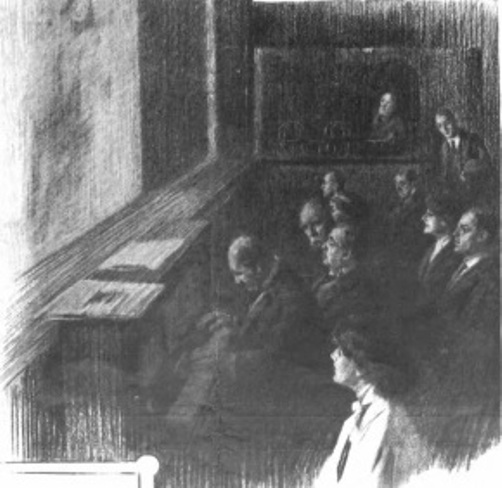
lureofthefilms2

‘There is not so much as a change of expression, much less a sign of applause.’ Illustration by Wilson C. Dexter that accompanies the original article, with caption

Yet these apathetic groups who now appear, except for their occasional bursts of unjoyous mirth, emotionless, are the same men and women who only a few years ago thronged constantly to the melodramas at the urge of what seemed to be an elemental need, the need of wholesome emotional exercise. No audience was ever disappointed in one of these eminently reliable performances; none was ever bored or critical or sleepy. One knew what one had come for and settled down comfortably to enjoy it. It was of relatively little importance whether the central figure in the tangle of love, danger, sacrifice, villainy, heroism, disaster, and triumph was Nellie, the Beautiful Cloak Model, or Bertha, the Sewing-Machine Girl — the succession of thrills was of practically the same character and intensity. What these audiences unconsciously demanded was an excuse to laugh, weep, pity, resent, condemn, and admire, all in strict conformity with the orthodox moral code; and it was this that was abundantly furnished them. It would surely be a psychological marvel if so deep a need could have vanished as the coincidence of a mere change of fashion in entertainments.

But the best and most satisfying feature of the melodramas was their imaginative scope, their denial of logical limitations. The simple, normal mind while it has felt a childlike delight in the occasional realistic detail, has probably always been charmed by the theater in proportion as its spectacle, as a whole, transcended reality. A world as unfettered as the world of faery, whose characters should have the shape and speech of the ordinary wage-earner, would have at any time a compelling appeal. “What attracted me so strongly to the theater,” Wagner says, speaking of his childhood, “was … the fascinating pleasure of finding mvself in an entirely different atmosphere, in a world that was purely fantastic and often gruesomely attractive. Thus to me … some costume or a characteristic part of it seemed to come from another world, to be in some way as attractive as an apparition.” There is no doubt that this is the expression of a universal experience; and that if a sensitive, impressionable child of six or seven could define and express the emotions (too vaguely recalled by the adult) aroused by its first theater, this would form a human document of thrilling interest. And it may be that melodrama at its best supplied multitudes of adult children with an approximation of this delicious and memorable experience of infancy.

In comparison with the popular drama that it has succeeded and supplanted, the motion picture of course provides little or no emotional outlet. It is far from attempting to “purge with pity and terror” the casual multitudes that it attracts. In most cases the interest that it excites, when it excites any, is shallow, fleeting, two-dimensional, like the pictures themselves. It offers no illusion and no mystery. What is left to those who have had to accustom themselves to this thin and unsatisfying form of emotion, but to acquire, as they have, a self-protective surface of apparent torpor?

It is easy, of course, to recall conspicuously exceptional cases. There is now and then a feverish desire to see the pictured record of some current event of especial interest, particularly when it has to do with sports. But the kind of excitement that would be aroused by the records of a baseball or football game is a very special thing, and is infinity [sic] removed from the mere normal desire for amusement. Yet it is fully shared, as everybody knows, by sophisticated childhood. Indeed, the overpowering desire felt by youthful East Side citizens to see certain celebrated “movies” has more than once led them into tragic difficulty. Not many months ago, just after a much-advertised prize-fight, two little boys, whose uncontrollable longing for the admission fee to a picture-hall had led them to upset a grocer’s display and barter his goods independently, were brought to the Children’s Court. “The price of admittance was five cents?” inquired the judge, examining them. The smaller boy, who was very small indeed, quickly raised his thin, tense face. “Oh, but it was ten cents to see the big fight, judge!” he cried, hoarsely, the tremendous intensity of his manner and expression at once defining the almost irresistible character of his temptation and what he felt to be the manly magnitude of his crime.

But even though its imagination starve, a disaster of which it can scarcely be conscious, it is not difficult to understand why the vast, simple, unexigent public so faithfully follows up the moving picture. Almost any institution that cost so little would probably be patronized, even though the most it did was to provide a convenient and often comfortable lounging place, and, in the poorer quarters of the city, to provide an excuse for social contact. After all, there is no question but that the equivalent of a nickel is usually supplied. Beyond this, there is the fascination of never knowing what one is going to see, which is a far greater lure than an exact knowledge of what is forthcoming. But its strongest hold must be the fact that it makes no demand whatever upon its audiences, requiring neither punctuality — for it has no beginning — nor patience — for it has no end — nor attention — for it has no sequence. No degree of intelligence is necessary, no knowledge of our language, nor convictions nor attitude of any kind, reasonably good eyesight being indeed the only requisite. In the world of amusement, no line of less resistance than this has surely yet been offered.

Comment: Olivia Howard Dunbar (1873-1953) was an American biographer and writer of ghost stories.
Seeing American Films

Source: ‘Seeing American Films’, Yo-shi Bao [The Amusement Paper], September 1897, quoted in Jay Leyda, Dianying / Electric Shadows: An Account of Films and the Film Audience in China (London/Cambridge, Mass.: The MIT Press, 1972), p. 2

Text: Last night, in the cool of the evening following a shower of rain, my friends took me to the Chi Gardens to see a show. After the audience gathered, the lights were put out and the performance began. On the screen before us we saw a picture – two occidental girls dancing, with puffed-up yellow hair, looking rather silly. Then another scene, two occidentals boxing. Then a woman bathing in a tub … In another scene a man puts out the light and goes to bed, but he is disturbed by a bedbug. To catch it he throws off all the bedding, and when he finally puts it in the chamber pot he looks very funny …

Comment: The first projected film show in China was on 11 August 1896. The American photographer James Ricalton brought Edison films to Shanghai from June 1897 and according to Jay Leyda this is a review of a Ricalton show, but the films described appear to be Georges Méliès productions (and hence French films): Après le bal le tub (1897), Une nuit terrible (1896), and possibly Match de boxe (1897). The dancers with yellow hair suggests that the films had hand-painted colour.

Years of Change

Source: Arthur Newton, Years of Change: Autobiography of a Hackney Shoemaker (London: Hackney Workers’ Educational Association/Centerprise Publications, 1974), pp. 37-38

Text: Entertainment was altering too. The new-fangled ‘Moving Picture Theatre’ was creeping up on us. People up to now had relied on the Music Hall and their own family gatherings to pass an evening away, but now were able to see real moving pictures. No sound – not yet – that was to come around 1928. The first moving pictures I can remember seeing was in Bethnal Green Road, opposite the Red Church. One penny to go in and hard, backless forms to sit on. They gradually increased in number. The Museum Cinema in Cambridge Heath Road. Morley Hall – one penny to see, and if you sat behind the screen and saw the picture backwards, one halfpenny. Empress by St Thomas’s Square, Mare Steet, where its patrons were given tea and biscuits in the afternoon, and the Pavilion (just recently demolished) was built around 1914-1915. These were the first cinemas in the locality.

Comment: Arthur Newton was born 1902 in South Hackney, London.

Mrs Bathurst

Source: Rudyard Kipling, ‘Mrs Bathurst’, The Windsor Magazine, September 1904, pp. 376-386, collected in Traffics and Discoveries (London: Macmillan, 1904), pp. 337-365

Text: “Yes,” said Pyecroft. “I used to think seein’ and hearin’ was the only regulation aids to ascertainin’ facts, but as we get older we get more accommodatin’. The cylinders work easier, I suppose … Were you in Cape Town last December when Phyllis’s Circus came?”

“No – up country,” said Hooper, a little nettled at the change of venue.

“I ask because they had a new turn of a scientific nature called ‘Home and Friends for a Tickey.'”

“Oh, you mean the cinematograph – the pictures of prize-fights and steamers. I’ve seen ’em up country.”

“Biograph or cinematograph was what I was alludin’ to. London Bridge with the omnibuses – a troopship goin’ to the war – marines on parade at Portsmouth an’ the Plymouth Express arrivin’ at Paddin’ton.”

“Seen ’em all. Seen ’em all,” said Hooper impatiently.

“We Hierophants came in just before Christmas week an’ leaf was easy.”

“I think a man gets fed up with Cape Town quicker than anywhere else on the station. Why, even Durban’s more like Nature. We was there for Christmas,” Pritchard put in.

“Not bein’ a devotee of Indian peeris, as our Doctor said to the Pusser, I can’t exactly say. Phyllis’s was good enough after musketry practice at Mozambique. I couldn’t get off the first two or three nights on account of what you might call an imbroglio with our Torpedo Lieutenant in the submerged flat, where some pride of the West country had sugared up a gyroscope; but I remember Vickery went ashore with our Carpenter Rigdon – old Crocus we called him. As a general rule Crocus never left ‘is ship unless an’ until he was ‘oisted out with a winch, but when ‘e went ‘e would return noddin’ like a lily gemmed with dew. We smothered him down below that night, but the things ‘e said about Vickery as a fittin’ playmate for a Warrant Officer of ‘is cubic capacity, before we got him quiet, was what I should call pointed.”

“I’ve been with Crocus – in the Redoubtable,” said the Sergeant. “He’s a character if there is one.”

“Next night I went into Cape Town with Dawson and Pratt; but just at the door of the Circus I came across Vickery. ‘Oh!’ he says, ‘you’re the man I’m looking for. Come and sit next me. This way to the shillin’ places!’ I went astern at once, protestin’ because tickey seats better suited my so-called finances. ‘Come on,’ says Vickery, ‘I’m payin’.’ Naturally I abandoned Pratt and Dawson in anticipation o’ drinks to match the seats. ‘No,’ he says, when this was ‘inted -‘not now. Not now. As many as you please afterwards, but I want you sober for the occasion.’ I caught ‘is face under a lamp just then, an’ the appearance of it quite cured me of my thirsts. Don’t mistake. It didn’t frighten me. It made me anxious. I can’t tell you what it was like, but that was the effect which it ‘ad on me. If you want to know, it reminded me of those things in bottles in those herbalistic shops at Plymouth – preserved in spirits of wine. White an’ crumply things – previous to birth as you might say.”

“You ‘ave a beastial mind, Pye,” said the Sergeant, relighting his pipe.

“Perhaps. We were in the front row, an’ ‘Home an’ Friends’ came on early. Vickery touched me on the knee when the number went up. ‘If you see anything that strikes you,’ he says, ‘drop me a hint’; then he went on clicking. We saw London Bridge an’ so forth an’ so on, an’ it was most interestin’. I’d never seen it before. You ‘eard a little dynamo like buzzin’, but the pictures were the real thing – alive an’ movin’.”

“I’ve seen ’em,” said Hooper. “Of course they are taken from the very thing itself – you see.”

“Then the Western Mail came in to Paddin’ton on the big magic lantern sheet. First we saw the platform empty an’ the porters standin’ by. Then the engine come in, head on, an’ the women in the front row jumped: she headed so straight. Then the doors opened and the passengers came out and the porters got the luggage – just like life. Only – only when any one came down too far towards us that was watchin’, they walked right out o’ the picture, so to speak. I was ‘ighly interested, I can tell you. So were all of us. I watched an old man with a rug ‘oo’d dropped a book an’ was tryin’ to pick it up, when quite slowly, from be’ind two porters – carryin’ a little reticule an’ lookin’ from side to side – comes out Mrs. Bathurst. There was no mistakin’ the walk in a hundred thousand. She come forward – right forward – she looked out straight at us with that blindish look which Pritch alluded to. She walked on and on till she melted out of – he picture – like – like a shadow jumpin’ over a candle, an’ as she went I ‘eard Dawson in the ticky seats be’ind sing out: ‘Christ! There’s Mrs. B.!'”

Hooper swallowed his spittle and leaned forward intently.

“Vickery touched me on the knee again. He was clickin’ his four false teeth with his jaw down like an enteric at the last kick. ‘Are you sure?’ says he. ‘Sure,’ I says, ‘didn’t you ‘ear Dawson give tongue? Why, it’s the woman herself.’ ‘I was sure before,’ he says, ‘but I brought you to make sure. Will you come again with me to-morrow?’

“‘Willingly,’ I says, ‘it’s like meetin’ old friends.’

“‘Yes,’ he says, openin’ his watch, ‘very like. It will be four-and-twenty hours less four minutes before I see her again. Come and have a drink,’ he says. ‘It may amuse you, but it’s no sort of earthly use to me.’ He went out shaking his head an’ stumblin’ over people’s feet as if he was drunk already. I anticipated a swift drink an’ a speedy return, because I wanted to see the performin’ elephants. Instead o’ which Vickery began to navigate the town at the rate o’ knots, lookin’ in at a bar every three minutes approximate Greenwich time. I’m not a drinkin’ man, though there are those present” – he cocked his unforgettable eye at me–“who may have seen me more or less imbued with the fragrant spirit. None the less, when I drink I like to do it at anchor an’ not at an average speed of eighteen knots on the measured mile. There’s a tank as you might say at the back o’ that big hotel up the hill – what do they call it?”

“The Molteno Reservoir,” I suggested, and Hooper nodded.

“That was his limit o’ drift. We walked there an’ we come down through the Gardens – there was a South-Easter blowin’ – an’ we finished up by the Docks. Then we bore up the road to Salt River, and wherever there was a pub Vickery put in sweatin’. He didn’t look at what he drunk – he didn’t look at the change. He walked an’ he drunk an’ he perspired in rivers. I understood why old Crocus ‘ad come back in the condition ‘e did, because Vickery an’ I ‘ad two an’ a half hours o’ this gipsy manoeuvre an’ when we got back to the station there wasn’t a dry atom on or in me.”

“Did he say anything?” Pritchard asked.

“The sum total of ‘is conversation from 7.45 P.M. till 11.15 P.M. was ‘Let’s have another.’ Thus the mornin’ an’ the evenin’ were the first day, as Scripture says … To abbreviate a lengthy narrative, I went into Cape Town for five consecutive nights with Master Vickery, and in that time I must ‘ave logged about fifty knots over the ground an’ taken in two gallon o’ all the worst spirits south the Equator. The evolution never varied. Two shilling seats for us two; five minutes o’ the pictures, an’ perhaps forty-five seconds o’ Mrs. B. walking down towards us with that blindish look in her eyes an’ the reticule in her hand. Then out walk – and drink till train time.”

Text: Rudyard Kipling’s mysterious short story ‘Mrs Bathurst’, from which the above is an extract, features a conversation between four men – Pycroft, Pritchard, Hooper and the narrator – the first two of whom are in the navy. Collectively they relate the story of Vickery, a warrant officer, and Mrs Bathurst, with whom it is implied he has had an affair. While stationed in South Africa Vickery sees Mrs Bathurst on an actuality film screened as part of a circus entertainment, something which affects deeply as he returns to see the film several times. Vickery apparently deserts and later a charred corpse matching his description is found, and with it a second, unidentified charred corpse. The significance of the story in an early cinema context is discussed by Tom Gunning in Andrew Shail, Reading the Cinematograph: The Cinema in British Short Fiction 1896-1912 (Exeter: University of Exeter Press, 2010) which also reproduces Kipling’s text in full. A tickey was a South African threepence coin. ‘Phyllis’s circus’ is a reference to Frank Fillis, a South African showman whose ‘Savage South Africa’ troupe was filmed when it visited Britain in 1899-1900. The story suggests that the film element of Fillis’ show lasted for five minutes, just before the elephants. As Gunning points out, the reference to the “dynamo like buzzin'” not only suggests the sound of the projector but implies that there was no musical accompaniment. The film itself bears a strong affinity with the many train arrival films common in the 1890s.

Brixton Scala

brixtonscala

Source: Advertisment, Brixton Free Press, 1914 [no day or month given], reproduced at http://www.urban75.org/brixton/history/posters4.html

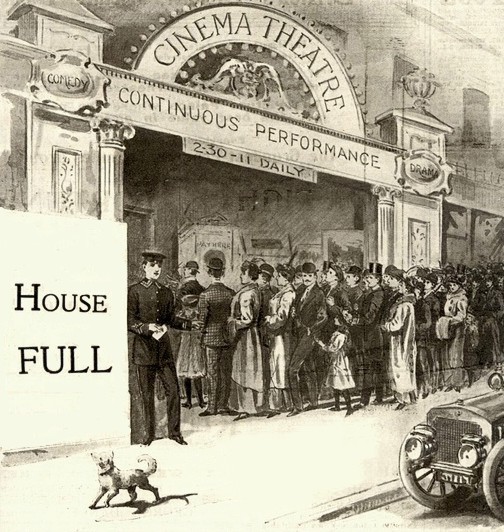
Comment: This image comes from advertisement for the Brixton Scala cinema, London, in the Brixton Free Press, 1914. The cinema opened in 1911. The widespread ‘continuous show’ policy, whereby audiences could drop in on a cinema show, played a huge role in early cinema’s popularity and adoption by those who felt excluded from many other forms of public entertainment.